





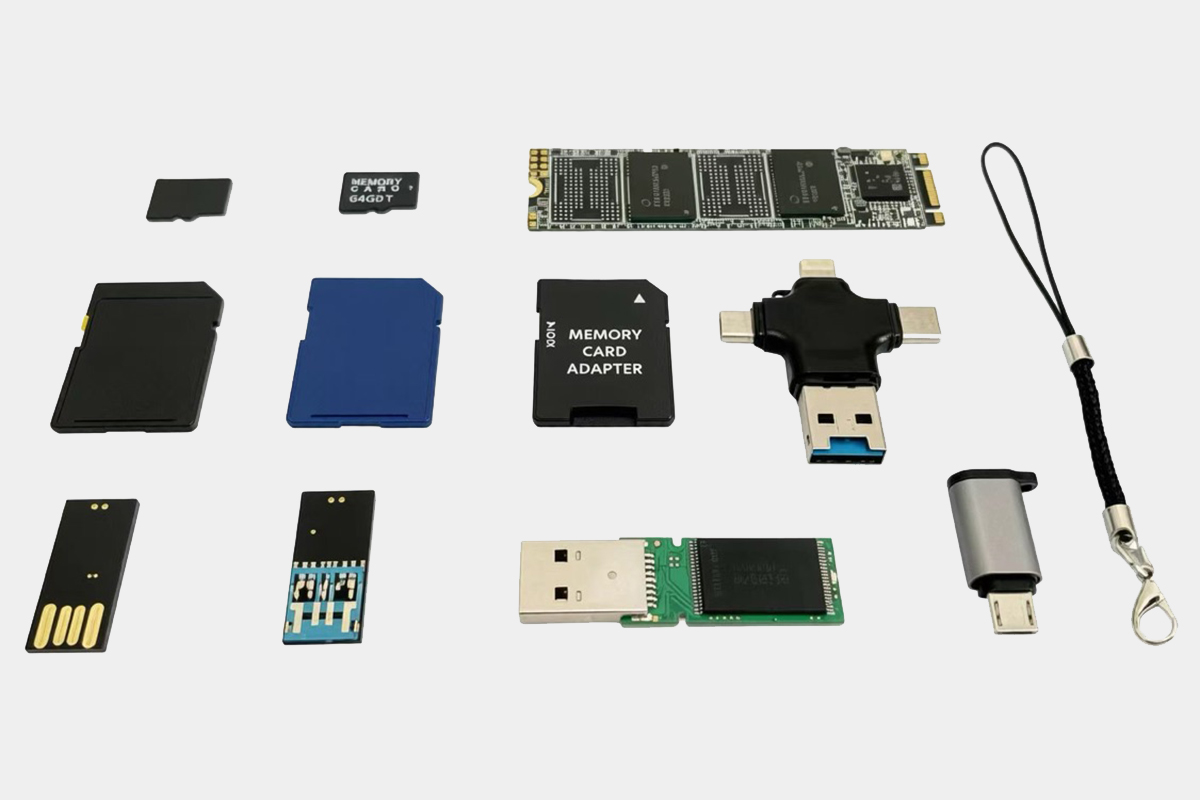
NAND flash (including compact flash cards and trans flash cards) embedded on circuit boards or in machines poses a significant data leakage risk, but it’s also a new source of profit growth.
Where NAND is found
For home use, flash memory is primarily found in handheld devices, mobile devices, Chromebooks, home security cameras, routers, set-top boxes and doorbells. For business use, it is found in servers and switches.
Recyclers know to perform data erasure and destruction on mechanical hard drives and solid-state drives, but data isn’t limited to these devices.
An 8GB or 16GB flash memory module inside a home security camera stores your home Wi-Fi password, as well as video or photo records from the past week or month. Some even record conversations.
Your home router stores your Wi-Fi password, and it also keeps a persistent log of your web history and downloads over the past six months.
Your home set-top box records the movies you watched last month or over the past six months, which movies you downloaded and which websites you visited.
In commercial settings, such as servers, the file names of uploaded and downloaded documents, as well as the IP addresses of company devices, can be easily extracted from the server’s flash memory, all of which is recorded.
From the flash memory of a switch, it’s very easy to extract information about uploaded and downloaded websites and files, as well as the device’s firmware.
If a hacker got your retired network switch, they would obtain a key to your company data center.
Data dangers
Although these devices contain highly sensitive personal data, more than 90% of them are shipped to Malaysia or the Philippines without adequate data destruction.
Recyclers are aware of this data vulnerability, but most of them still shred the devices. In reality, shredding is a highly ineffective method for data erasure.
We partnered with a large recycling company to conduct an experiment on solid-state drive (SSD) data destruction. The drives contained 8 NAND flash memory chips. After passing through a shredder, we found the data was retrievable from most of them, proving shredding as an ineffective data-security method.
Most recycling companies use machine shredders to shred hard drives, but the shredding results are not very effective. Even if an SSD is shredded, as long as its read and write ports remain undamaged, the data can still be retrieved.
The data erasure process is destroying the storage architecture of mechanical hard drives. Imagine an apartment building with 100 rooms. Conventional data destruction methods are essentially like removing the door numbers from each room, you don’t know which room the data is in, but the data is still there.
Presenting opportunity
Using physical methods to destroy storage devices or performing so-called data erasure on hard drives carries inherent risks and is not very efficient.
Fortunately, this presents a new business opportunity.
Data on SSDs can be completely erased. Software like TRIM, provided by major manufacturers, can thoroughly eliminate data. SSD operates on a binary system of 0s and 1s, where each bit carries a charge. Erasing involves forcibly converting all 0s to 1s, so the original data is completely erased and cannot be recovered. You can use OEM software like Samsung Magician, Kingston SSD Manager and NVMe Format to ensure complete erasure.
Once you erase the NAND flash, what’s left is the chance to cash in..
Current NAND flash prices are 5 to 10 times higher than they were in 2023. We can harvest the NAND, erase the data, perform quality inspections on the laser-reballed units and then resell them. In this way, what was once a threat becomes a product capable of generating significant profits.
With the explosive growth of large AI models, smart devices, industrial control equipment and the server industry, the supply-demand dynamics of NAND flash memory have been completely reshaped.
According to TRENFORCE’s latest report, the global NAND market will experience explosive growth in 2026, with total NAND demand reaching $550 billion. The value of NAND flash supplied through recycling channels alone is expected to reach $270.6 billion, a staggering 281% year-over-year surge.
This surge is driven not by short-term speculation but by a structural supply-demand imbalance. On the supply side, companies such as Samsung, SK Hynix and Micron control more than 90% of NAND supply.
Because the AI industry offers more favorable prices, these major manufacturers have redirected 70% of their production capacity toward the manufacturing of HBM and DDR5. This has led to an 18% contraction in traditional NAND production capacity.
Based on current market conditions, the supply-demand gap for NAND is projected to reach 6% by 2026, and this gap is widening.
NAND flash primarily consists of three types: eMMC, UFS and SSD chips, which are mainly used in consumer electronics, industrial control systems, storage devices and communication equipment such as tablets and smartphones.
More demand, less supply
The market is experiencing extreme shortages, so various recycling channels have essentially sprung up like mushrooms after rain. Even Grade B products and defective units from OEM factories are being retested, repackaged and sold to lower-end markets.
The most popular NAND brands in the recycling channels are Samsung, SK Hynix, Micron, Kioxia, MXIC, SanDisk, Winbond, and Nanya. Several of the world’s largest OEM manufacturers have already begun recycling tested NAND for repairs or to incorporate into new device production.
NAND inventory in the recycling channel is at its lowest level in 15 years, essentially making it a scarce resource.
Over the next three to five years, the overall NAND market will experience rapid growth. In 2027 alone, global demand for NAND flash is projected to reach nearly $770 billion, with an annual growth rate exceeding 40%.
Major manufacturers have focused their production capacity primarily on 3D stacked and HBM-related applications. However, there is a severe shortage of consumer-grade NAND, NAND for mobile devices and automotive NAND.
The shortage of NAND in the recycling channel has become so severe that it is now being utilized in stages. The first stage involves OEMs using it to manufacture new smartphones, tablets and laptops.
Second-life use involves recycling the NAND extracted from the circuit boards of discarded smartphones, tablets or laptops to manufacture products such as POS terminals, unbranded laptops and tablets, and mobile phones for the African market.
The third-tier use involves repurposing these white-label laptops, tablets and mobile phones, after they’ve been taken out of service, to produce toys or smart control circuits.