






This article appeared in the June 2023 issue of Resource Recycling. Subscribe today for access to all print content.Hard conversations, checking unconscious bias and letting employees drive change with leadership’s support are all vital to building more diverse workforces, experts recently explained.
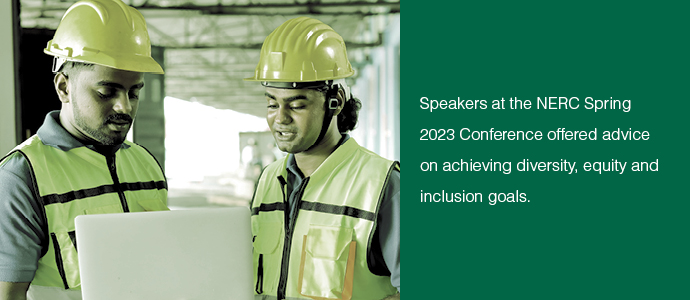
Taking place in early April, The Northeast Recycling Council (NERC) Spring 2023 Conference: Building a Diverse Workforce for Sustainable Materials Management featured a variety of speakers giving advice on how to build – and keep – a diverse workforce.
Attracting a diverse array of applicants
Keynote speaker Cheryl Coleman, senior vice president at the Institute of Scrap Recycling Industries (ISRI), kicked off the conference by emphasizing that the crucial point is “not taking a month or week or day to highlight diversity, but doing it all year long and investing in a long-term inclusion journey that has tangible results.”
She noted it’s important to be open to learning and to take a building-block approach.
“Don’t try to do everything at once,” she said. “Take your time and build on each success as well as any attempts that may not be as successful. Actually, we often learn more from what we perceive as failures.”
At ISRI, Coleman’s work has included crafting a workforce management toolkit that includes ads, best practices and other ways of helping companies take a more diverse approach to recruitment and retention.
Another focus for Coleman is building pathways for non-traditional applicants. She worked with Historically Black Colleges and Universities (HBCUs), refugee groups and organizations that support formerly incarcerated individuals to craft internships, fellowships, scholarships and other opportunities aimed at getting people into the recycling industry.
Reaching out to colleges
In an April 3 session called “Clearing Career Pathways for Underrepresented Individuals,” speakers also focused on HBCUs.
Fields Jackson, CEO of Racing Toward Diversity Magazine and president of the College Diversity Network, said he works to get students connected with jobs through a network of over 100 HBCUs and over 250 other schools around the country.
Jackson runs job boards for students and alumni, and said if companies are willing to cast a wider net, “you will find some great talent that was just not aware of your opportunity.”
“You may have to explain the opportunity because people may not know it’s an opportunity,” he added.
In that same session, Michelle Wiseman, director of waste diversion and outreach for the Atlanta Mayor’s Office of Resilience, recommended approaching diversity from an asset-based community development model mindset, which looks at how to use the various skills of each individual to help solve problems in the community.
That’s different from America’s current mindset, which is a social service model that focuses on needs rather than skills, she said.
“It’s focused on problems and seen as charity or donations, more of a systems approach, but the asset-based community development approach is looking at individuals as relationships and [asking], ‘what are the current issues within the community that we can help solve with our people?’” she said.
Coleman noted in her keynote that companies should look at diversity as a gift.
“There is diversity in recycled materials and we want diversity in those who work in recycled materials,” she said.
Retaining new hires
An April 4 session, “Creating Retention Strategies for an Inclusive Workplace,” focused on how to keep recent hires by building a welcoming environment.
Whitney Cox, the diversity, equity and inclusion program manager at Schnitzer Steel, said the first 90 days of employment are crucial, because 33% of employees leave in that time frame. Creating a good first impression can decrease turnover, she said, and that requires a strong onboarding process that promotes inclusion and belonging.
At Schnitzer Steel, that’s achieved via an interview at 30 days and a review at 90, to try to catch any problems early and show employees that the company is responsive to their needs.
“We feel it’s really valuable to check on our onboarding process and to help make it better,” Cox said.
In addition, Schnitzer provides an open suggestion box, set CEO office hours and annual company-wide culture training on topics such as unconscious bias and the difference between equity and equality. Cox said those trainings are summarized and added to the new hire process each year, to ensure that all employees have the same knowledge base.
Another tactic Schnitzer Steel uses is employee resource groups (ERGs). These groups allow employees to team up and work on any diversity issues they see. The company provides a basic template for each group to maintain consistency, and they have been very successful, Cox said.
For example, the Hispanic ERG recommended that the company switch from using a variety of translation service companies to just one, which saved money and time, and made it easier for employees to get the translations they needed.
Cox said it’s also vital to allow ERG meetings to happen on company time, so it’s not an extra request of employees who want to make a difference.
Expanding the retention toolbox
In that same session, Mara Iverson, founder of Mara Iverson Equity Education & Consulting, gave two day-to-day retention tools.
She recommended identifying points in the workflow that require choices, and then making sure those choices are not happening on autopilot, but rather with an eye to conscious, equitable practices.
Common choice points come up around relationship-building, goal-setting, delegation, hiring, check-ins, developing people and performance problems, Iverson said.
“There are common places where we know choices are being made, so we can think about how we are structuring those choices and what we could do differently,” she said.
Iverson recommends a five-step approach to choice points. First, set the desired outcome and check whether the current approach will get you there.
“Are there unintended results? What do we want to see instead?” she asked.
Then, identify the decision-making opportunities where “you can bake in equity and inclusion.” Examine the choices and the defaults, and look at who benefits, who might be harmed or who might be carrying the burden in each.
Finally, brainstorm alternatives to the default approach, then follow them and evaluate the result.
“Often, you have to make shifts over time and that’s okay,” Iverson said. “It doesn’t mean we didn’t do it well the first time.”
The second tool is using a preference tradition and requirement (PTR) framing to decide which methods in the workflow are used because they are the preference of those in charge, which are happening because they’ve always been done that way, and what the actual requirement is.
“Are you inadvertently adding pieces that benefit one specific way of doing things or one specific culture’s way of doing things?” Iverson asked.
If so, that can be a barrier to retention. She recommends identifying the preferences and the traditional way of doing things, then checking that against the actual requirement to see if they line up.
Leading by example
Building on those tools, Cox said it’s important to make sure company leadership is on board and actively engaged, or nobody else will value the diversity, equity and inclusion (DEI) programs.
“Leadership engagement is the key to any culture change in the company, and DEI is a culture shift,” she said.
Coleman noted that an important part of retention is making sure that a new hire who may be different from the majority of the other employees does not feel othered or that they are a token.
She urged companies to work with existing staff to explain diversity projects and to “start small and let that build.”
“We want an environment where people feel safe expressing who they are,” she said.
Iverson echoed that sentiment, noting that “trust is the cornerstone” and that the people who get to decide whether there is a culture of trust and safety are those in the minority.
The people who are more typically accommodated do not get to decide whether the space is safe, Iverson said, “because those with more power and control will read ‘uncomfortable’ as ‘unsafe,’ and that is not true.”
For example, people in power will often judge a conversation about implicit bias or structural racism as unsafe and push to stop it, when in reality such a conversation is not putting them in any danger – it is simply making them uncomfortable. Meanwhile, disadvantaged or minority groups will often find themselves in unsafe situations, and can therefore recognize the difference between unsafe and uncomfortable, Iverson said.
Marissa Heffernan is the staff reporter of Resource Recycling. She can be contacted at marissa@resource-recycling.com.