





This story was first published in the 2026 issue of E-Scrap News Magazine. Subscribe today for access to all print content.
After more than two decades covering IT asset disposition, I see the industry’s boundaries expanding again.
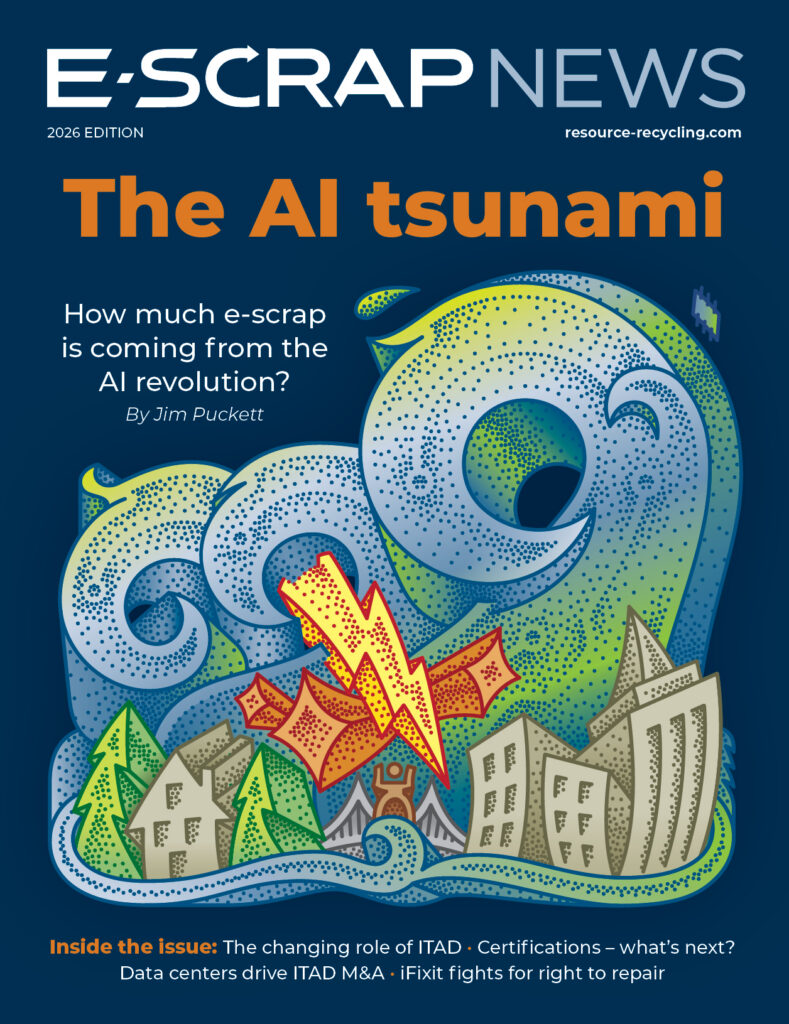
I began covering ITAD in 2003, after several years analyzing the mainstream IT hardware market. ITAD was a considerably smaller field then, and much of the discussion centered on what happened after an organization decided it no longer needed its equipment.
Today, the physical responsibilities remain recognizable, and most of the original tasks of ITAD are deeply relevant to today’s enterprise IT asset disposition programs. Equipment must be collected and accounted for, and data has to be managed appropriately. Reusable assets need a route back to market, and equipment without sufficient reuse value eventually moves into recycling.
But the business surrounding those activities has changed. Enterprise governance is reaching further into disposition, while data-center infrastructure is creating different operating requirements. Materials recovery has attracted greater strategic attention, and increasingly, AI is influencing several of these changes at once.
Governance is moving closer to ITAD
Health care provides a useful example. In 2023, much of the attention around health care ITAD centered on HIPAA exposure and control over retired equipment. By 2025, the questions were becoming broader. A mid-2025 Compliance Standards sector study found refresh intent increasing, particularly in health care and finance. ITAD was also being pulled further into cyber-risk frameworks, ESG disclosures and compliance audits.
Executing physical work remains essential and is still at the core of ITAD activity. But over time, customers have been requiring evidence that the process was controlled and the disposition record can withstand scrutiny beyond the operational group arranging the pickup.
That puts ITAD providers more directly into the third-party oversight applied to companies handling sensitive equipment or information. Governance requirements are likely to reach further into disposition as a result.
AI changes the infrastructure equation
Data centers represent a more visible change. PCs and endpoint devices have been central to ITAD for decades. Data-center decommissioning introduces assets with different economics and operating requirements.
AI has accelerated that transition. Since 2022, hyperscalers have poured capital into servers and accelerators, along with the networking, power and data-center capacity required to support AI workloads. Enterprises, meanwhile, are making another round of infrastructure and device decisions around how they will adopt and deploy AI. For ITAD, the first effect comes as this equipment is installed. The second will come when it is retired.
Today’s data-center construction should eventually create substantial disposition opportunities. How much of that material reaches traditional ITAD channels will depend on ownership and retirement schedules, as well as who controls the decommissioning process.
AI infrastructure also changes the equipment itself. High-density computing can involve liquid cooling and specialized power systems. Valuable accelerators may change the economics of recovering individual components instead of treating a server as one resale unit.
Data-center ITAD is therefore likely to become more specialized. Some providers may pursue hyperscale environments. Others may be better positioned in co-location facilities or particular equipment categories. The volume of infrastructure being installed is certainly worth watching. The competitive question comes later: Who will be capable of handling those assets when they eventually come out?
The Rectangle Era may be ending
There is another AI-driven change that ITAD companies should watch, although its effect will take considerably longer to become visible. I think we are approaching the end of what I call the Rectangle Era: roughly 1990 through 2025, when personal computing became concentrated in a handful of standardized forms. The desktop and laptop dominated for years, followed by the tablet and smartphone.
That standardization was necessary. Common form factors allowed the technology industry to build and refine the underlying stacks, including semiconductors and operating systems. Software, networks, cloud infrastructure and global supply chains matured around them. Computing became affordable, reliable and nearly universal.
AI may now allow the industry to build something much more varied on that foundation. As intelligence moves into the interface and increasingly onto devices themselves, hardware does not necessarily have to conform to one general-purpose design. Computing can become more closely tailored to particular environments and occupations, or to individual ways of interacting.
That could mean foldable or flexible devices and intelligent glasses. Wearables, ambient computing and specialized workplace systems may also develop into products that do not fit comfortably within today’s definitions of a PC, phone or peripheral.
For ITAD, this possibility matters because much of the industry’s infrastructure has developed around relatively predictable asset categories. Collection and testing benefit from that standardization. So do repair, data destruction, parts harvesting, resale and recycling. If device types multiply, those assumptions begin to change.
Material combinations could become less standardized and testing and repair may become more specialized. Some devices could have longer lives because users become attached to highly personalized products. Others could become effectively disposable because they are difficult to repair, refurbish or transfer to another user.
The latter outcome would be particularly significant. More disposable electronics could increase material-recovery volumes while damaging the reuse economics that remain central to ITAD. Smaller components and embedded batteries could also complicate processing. Adhesives and changing material combinations could increase costs further.
AI could therefore affect ITAD through more than another equipment refresh. It could eventually change the types of equipment entering recovery channels.
M&A is providing another signal
Capital provides another useful indication of where ITAD is headed. A Compliance Standards analysis of 22 ITAD transactions completed between October 2024 and July 2026 found deal frequency essentially flat year over year, but the composition of activity changed. (Read more about M&A in ITAD on page 34.)
Private equity platforms were moving from opportunistic acquisitions toward stated multi-deal programs. Buyers were acquiring governance and program-management capability alongside processing capacity. Materials and metals companies also appeared as strategic investors.
Twenty-two transactions do not establish the direction of an entire market. However, they do show that buyers are finding value in a broader range of capabilities than processing alone. Customer access and governance can carry value. Investment by materials companies raises a separate question about access to downstream material streams.
Critical materials are moving closer
Reuse remains central to ITAD economics. When reuse is no longer viable, equipment moves into recycling and materials recovery. Critical-mineral investment is bringing greater attention to what happens next.
One documented example is Paladin EnviroTech’s joint venture with Critical Materials Recycling, which is scaling rare-earth recovery from 40 to 300 metric tons annually. The venture is targeting metals in e-scrap streams that conventional refiners may not currently report or pay on.
If new recovery technologies can create value from materials that previously generated little return, relationships between asset originators and ITAD companies could become more important. The same applies to their relationships with downstream processors.
Recent investments from materials companies suggest some downstream interests already see strategic value in getting closer to ITAD asset streams. There is not yet enough evidence to call this a broad industry pattern.
Movement across borders
International movement of e-waste is becoming more controlled as well. The Basel Convention’s e-waste amendments entered into force on Jan. 1, 2025, expanding controls over transboundary movements of electrical and electronic waste.
For ITAD companies operating internationally, classification and documentation therefore have direct operational consequences. National approaches can also differ when determining whether used equipment destined for reuse, repair or refurbishment constitutes waste.
International expansion requires more than finding a downstream vendor in another country. Providers need to determine whether the controls they promise customers can actually be reproduced locally.
Automation will reach ITAD itself
AI is also beginning to change how ITAD companies operate. Computer vision and AI-assisted sorting are expected to improve identification and routing, as automated testing can increase throughput. Intelligent chain-of-custody platforms will reduce manual record handling and strengthen traceability. All these technology advancements will inevitably boost productivity and efficiency.
But the economics will vary. Data erasure and intake offer relatively immediate opportunities, followed by testing, grading and resale preparation. Robotic disassembly presents a different economic case because its usefulness depends heavily on equipment consistency and volume.
Greater hardware diversity could make some forms of physical automation harder. Robots benefit from predictability, just as conventional processing lines do.
What I see happening next
After covering ITAD since 2003, I am reluctant to describe every technology cycle as an industry reset. ITAD has already lived through enormous changes in hardware, secondary markets and enterprise computing.
Several changes are now reaching the sector at roughly the same time. Data-center specialization is increasing, while governance is moving closer to operations. Materials companies are showing greater interest in ITAD asset streams. Regulation is adding complexity to international movements, and automation is moving further into processing. This is all while AI is influencing each of these developments to varying degrees.
Consolidation will probably continue, but there is still room for independent ITAD providers. Scale helps when customers require broad geographic coverage. Independents can compete through local relationships, specialized capabilities or particular market expertise. Trying to offer everything everywhere can quickly become expensive.
Each company will have to decide where it should participate as the technology lifecycle itself changes. Some providers will remain focused primarily on disposition. Others will specialize in particular data-center environments or build stronger governance capabilities. Some may move closer to materials processors.
AI could make those choices considerably more consequential. It is already affecting infrastructure investment and enterprise refresh decisions. Over time, it could influence the types and values of assets entering secondary markets. It could also change how those assets are processed and, eventually, the physical forms of the devices ITAD companies receive.
The Rectangle Era created an ITAD industry built largely around predictable categories of equipment. AI may help bring that period to an end. ITAD companies will have to decide how far they need to adapt as the equipment entering their facilities begins to change.