





Resource Recycling
  • The Latest
  • Analysis
    • All
    • Certification Scorecard
    • Industry Announcements
    • Opinion
    Recycling council emphasizes importance of supply

    Sorted: Why recycling isn’t a ‘scam’

    AI and the changing economics of retired hardware

    Certification Scorecard — Week of June 8, 2026

    ITAD is moving past its adolescent phase: beyond end-of-life

    Rainforest

    Inside the Circle: What the rainforest can teach us about EPR

    Closeup of a printed circuitboard

    Hardware demand puts new focus on parts harvesting

  • Conferences
    • Resource Recycling Conference
    • Plastics Recycling Conference
    • E-Scrap: The Longevity Conference
    • Textiles Recovery Summit
  • Publications
    • E-Scrap News
    • Plastics Recycling Update
    • Policy Now
    • Resource Recycling
    • Other Topics
      • All Topics
      • Brand Owners
      • Critical Minerals
      • Glass
      • Grant Watch / RFPs
      • Markets
      • Organics
      • Packaging
      • Research
      • Technology
      • Textiles
Subscribe
No Result
View All Result
Resource Recycling
  • The Latest
  • Analysis
    • All
    • Certification Scorecard
    • Industry Announcements
    • Opinion
    Recycling council emphasizes importance of supply

    Sorted: Why recycling isn’t a ‘scam’

    AI and the changing economics of retired hardware

    Certification Scorecard — Week of June 8, 2026

    ITAD is moving past its adolescent phase: beyond end-of-life

    Rainforest

    Inside the Circle: What the rainforest can teach us about EPR

    Closeup of a printed circuitboard

    Hardware demand puts new focus on parts harvesting

  • Conferences
    • Resource Recycling Conference
    • Plastics Recycling Conference
    • E-Scrap: The Longevity Conference
    • Textiles Recovery Summit
  • Publications
    • E-Scrap News
    • Plastics Recycling Update
    • Policy Now
    • Resource Recycling
    • Other Topics
      • All Topics
      • Brand Owners
      • Critical Minerals
      • Glass
      • Grant Watch / RFPs
      • Markets
      • Organics
      • Packaging
      • Research
      • Technology
      • Textiles
Subscribe
No Result
View All Result
Resource Recycling
No Result
View All Result
Home Resource Recycling Magazine

First Person Perspective: Markets have shifted, but paper recycling is strong (just look at the numbers)

byBrian Hawkinson
July 15, 2019
in Resource Recycling Magazine
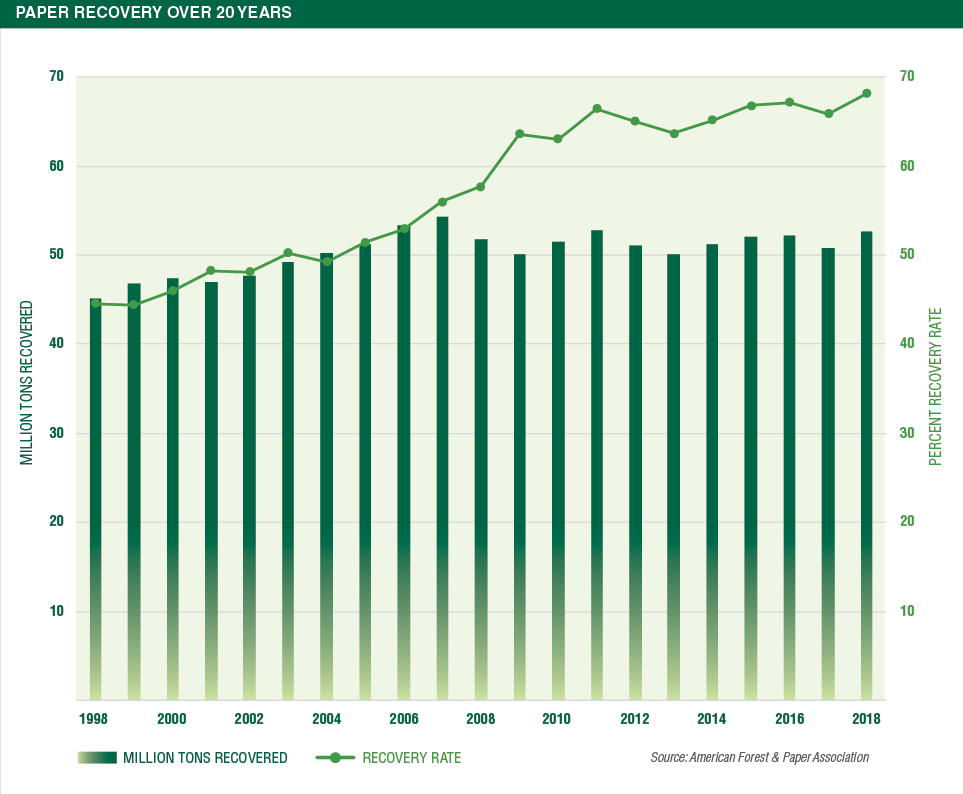
The U.S. paper recovery rate has been at or above 63% each year for the past decade.

Every year, the American Forest & Paper Association (AF&PA) releases the U.S. paper recovery for recycling rate. The annual figure informs us how much recovered paper is being used to create new products in a given year and is also an important indicator of how much paper and paper-based packaging is kept out of landfills after use.

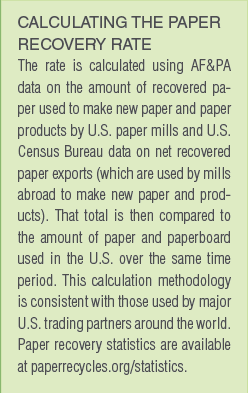
In 2018, the U.S. paper recovery for recycling rate increased to 68.1%, more than double what the rate was in 1990 and the highest U.S. paper recovery rate ever recorded. In addition, the rate has been at or above 63% each year for the past decade.

Our industry has a goal to exceed 70% paper recovery for recycling by 2020, and we are constantly doing our part to improve the quantity and quality of paper recovered for recycling.

The China challenge

In July 2017, China announced that it would halt the import of many recovered materials, including “scrap and unsorted waste paper” (defined as “mixed paper” by China) by the end of the year. It also implemented very strict quality standards on other grades of imported recovered paper.

Being the largest export market for U.S. recovered paper, the impact of China’s import restrictions on the U.S. recovered paper market came soon after: The U.S. paper recovery rate fell from its previous record of 67.2% in 2016 to 65.9% in 2017. Many doom and gloom news stories about the future of recycling followed.

However, markets for recovered paper are very resilient. Since 2016, the U.S. paper industry has increased its use of recovered paper to make new products by 3.8% and announced manufacturing capacity expansions that will use additional recovered paper. Interestingly, U.S. exports to China of new paper products increased since 2016, indicating that China’s demand for paper products remains high.

Meanwhile, recovered paper export markets have fully recovered from China’s abrupt import restrictions. In 2018, there was an overall 4.2% increase in U.S. recovered paper exports compared with 2017. While exports to China were off 30.5% in 2018, that decline was more than offset by exports to other trading partners – other Asian countries in particular. And despite its import restrictions, China remains the single largest export market for U.S. recovered paper.

This all shows that U.S. paper recovery for recycling is successful because it is market driven.

Supply, demand and global economics all play a role in how much paper is ultimately recovered for recycling, because recovered paper markets are driven by the same dynamics that characterize the broader economy.

The use of recovered paper to manufacture new products is something that takes place around the world and the market determines whether recovered paper will be used by U.S. mills or exported and used in other countries.
Strengthening paper recycling

AF&PA is in favor of letting the market decide outcomes, including the area around paper recovery for recycling. The voluntary recycling system in the U.S. has proven to be capable of achieving and maintaining very high rates, even with natural ebbs and flows in the market.

AF&PA, our members and our partners do work to ensure these high paper recovery for recycling rates are maintained through efforts to increase the quantity and quality of paper recovered for recycling.

Our work with The Recycling Partnership creates public-private partnerships that bring sound recycling infrastructure to communities where it does not yet exist and invests in improvements to the recycling system in communities where it is established. Since its founding in 2014, The Recycling Partnership has worked in more than 1,000 communities across the nation.

States, communities and the industry all play roles in making residential recycling successful. Communities can improve the performance of residential recycling systems by adapting effective practices. Research conducted for AF&PA in 2015 by Skumatz Economic Research Associates identified key drivers underlying strong-performing community recycling programs:

  • Accepting 12 or more kinds of paper and paper-based packaging in residential collection.
  • Implementing weekly recycling collection.
  • Investing $1 to $2 per household in consumer education.
  • Including recycling education in schools’ K-12 curriculum.

In addition, states can create a fair policy environment and provide support to communities to help improve residential recycling. AF&PA’s Building Effective Recycling Programs guide helps states assess progress toward recycling-friendly policies, including:

  • Setting voluntary recycling goals.
  • Avoiding restrictive regulations on managing recyclable materials.
  • Promoting universal access to curbside and/or drop-off residential recycling collection.
  • Providing technical assistance with the right tools and resources to municipalities.
AF&PA also develops educational materials to inform audiences about best recycling practices. This includes identifying what is recyclable; informing consumers why they should make the effort to recycle; reminding them to make sure items are clean and dry before they are put in the recycling bin to minimize contamination; and helping residents refrain from “wish-cycling.”

An ongoing effort

Paper recovery for recycling is an integral part of the paper industry’s legacy of sustainability. AF&PA and our members are proud of achieving a record 68.1% paper recovery for recycling rate in 2018. And we are working toward achieving our goal to exceed 70% recovery by 2020.

We know achieving that rate will require the same team effort – working with states, communities and Americans who recycle paper at work, home and school – that has enabled the industry to maintain a recovery rate at or above 63% for each of the last 10 years.

Brian Hawkinson is executive director of recovered fiber at the American Forest & Paper Association. He can be contacted at
[email protected].

This article originally appeared in the June 2019 issue of Resource Recycling. Subscribe today for access to all print content.

Tags: DataTextiles
TweetShare
Brian Hawkinson

Brian Hawkinson

Related Posts

Goodwill, WM partner for textile recycling pilot

CiCLO co-creator helps forge path to sustainability

byPaul Lane
June 11, 2026

Andrea Ferris says her additives, which can make synthetic fabrics biodegradable, can help companies improve their environmental footprints while meeting...

Various PET thermoform containers.

Thermoform recovery soars, PCR content falls

byAntoinette Smith
June 10, 2026

In its first standalone PET thermoform market analysis, NAPCOR examined production, recycling, PCR use and policy in North America.

CommanderAI launches searchable hauler database

Underwater data centers drive shift in ITAD models

byDavid Daoud
May 26, 2026

The new technology is grabbing headlines for saving energy, but are people looking at the complete lifecycle?

A map of Europe with various pinned locations.

EU growth slows for circular plastics

byAntoinette Smith
May 19, 2026

Just when Europe should be accelerating its transition to a circular economy, the sector is slowing dramatically, said the president...

Sorted: America’s textile waste problem starts in your closet

byStefanie Valentic
May 19, 2026

This month's column explains why the gap between donating clothes and recycling them is bigger than you may realize.

Reports highlight existing textile reuse infrastructure

byKeith Loria
May 12, 2026

Two recent reports suggest the textile recovery industry is far more mature and operational than many consumers, policymakers and brands...

Load More
Next Post

Community Spotlight: L.A. planners juggle goals, markets and huge volumes of material

More Posts

House resolution aims to make recyclability central to product design

NY EPR bill fails to advance after third try

June 8, 2026
Various PET thermoform containers.

Thermoform recovery soars, PCR content falls

June 10, 2026
CalRecycle withdraws proposed regs for SB 54

Oceana, NRDC, CAW sue CalRecycle over SB 54 regs

June 5, 2026

Three-bill package aims to revamp Michigan’s bottle return system

June 9, 2026

Battery fires still a major risk to recyclers: report

June 9, 2026
Revised CA budget includes $200m for recycling

CAA files California program plan for SB 54

June 15, 2026
Rare look inside the world’s largest plastics recycler

Mass balance matters: Why different rules can lead to different outcomes 

June 5, 2026
Circular Materials to supply PlasCred chem recycling plant

Circular Materials to supply PlasCred chem recycling plant

June 4, 2026
Recycling industry addresses Beyond Plastics report

Recycling industry addresses Beyond Plastics report

May 26, 2026

ITAD is moving past its adolescent phase: beyond end-of-life

June 10, 2026
Load More

About & Publications

About Us

Staff

Archive

Magazine

Work With Us

Advertise
Jobs
Contact
Terms and Privacy

Newsletter

Get the latest recycling news and analysis delivered to your inbox every week. Stay ahead on industry trends, policy updates, and insights from programs, processors, and innovators.

Subscribe

Welcome Back!

Login to your account below

Forgotten Password?

Retrieve your password

Please enter your username or email address to reset your password.

Log In

Add New Playlist

No Result
View All Result
  • The Latest
  • Analysis
  • Recycling
  • E-Scrap
  • Plastics
  • Policy Now
  • Conferences
    • E-Scrap Conference
    • Plastics Recycling Conference
    • Resource Recycling Conference
    • Textiles Recovery Summit
  • Magazine
  • About Us
  • Advertise
  • Archive
  • Jobs
  • Staff
Subscribe
This website uses cookies. By continuing to use this website you are giving consent to cookies being used. Visit our Privacy and Cookie Policy.