





For a dated recycling program, success or failure is often assessed from an autopsy.
Contamination turns up as a downgraded load at the sorting facility. Diversion surfaces in a year-end report built by hand from scale tickets. Participation becomes a question only when a grant form asks for a number nobody tracks. This information is vital, and yet it arrives after the fact, averaged across tens of thousands of households and stripped of any location data or material insights.
Meanwhile, the one part of the operation that touches every household on a fixed schedule generates a live, address-level record of exactly those things. The opportunity is on the collection truck.
Recycling tells you what already went wrong
Recycling performance is measured at two points, and both are lagging indicators. The first is the sorting facility, where inbound contamination is weighed and a load is rejected or sold at a discount.
The Recycling Partnership puts national inbound contamination near 17% by weight, and curbside programs recover only about a third of the recyclables within reach. Assessment at the sorting facility cannot tell a coordinator which neighborhoods are contaminating or whether last month’s mailer changed anything.
The second measure, the annual diversion report, is accurate to the ton but rarely includes any analysis of the materials themselves.
Here is the mismatch at the center of recycling measurement. Contamination and low participation are local and continuous. They happen one household at a time, every collection day.
The default approach is to measure them system-wide and periodically, once the material is mixed and the quarter is closed. A program cannot educate a 17% average or aim an intervention at a diversion rate, so most campaigns go out broad, land soft and get judged by a number that moved for a dozen reasons.
Every route already visits the problem
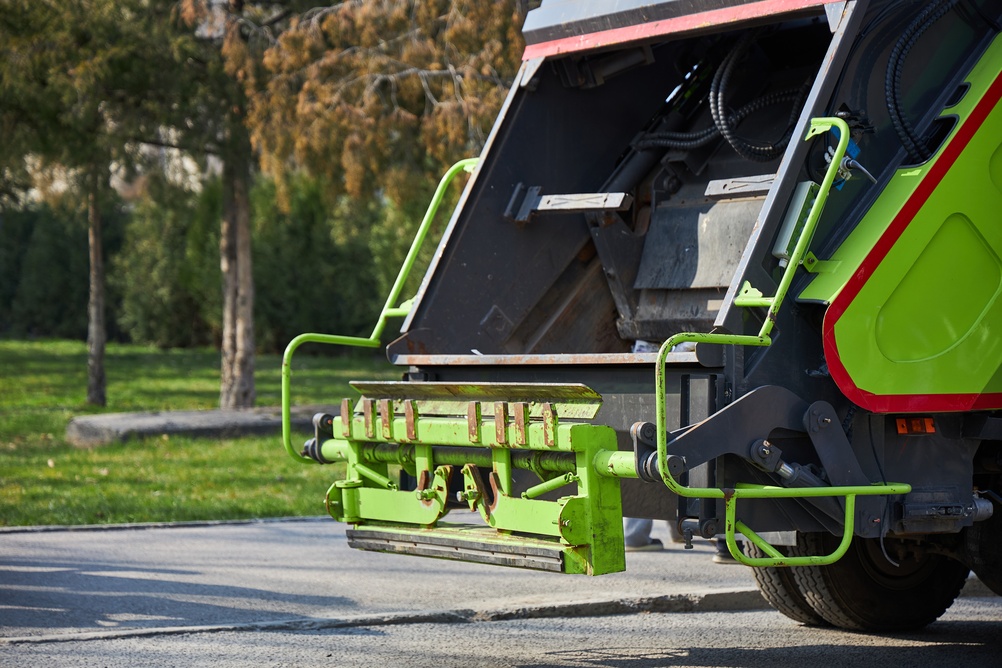
The collection truck is the only part of the system that meets the household where the behavior happens, and it does so again and again. A route passes every address several times a month, across seasons, year after year. No audit, survey or smart-bin pilot covers a service area that completely or that cheaply, because the coverage is a byproduct of a route the program already runs.
What the truck can record on each pass is recycling performance in its rawest, most local form. With AI image analysis, the cameras already mounted on many collection trucks can flag contamination as each cart is emptied and tie it to the service address, with no extra step for the driver.
Three signals carry most of the value. Set-out rates measure participation block by block, so a program sees which neighborhoods have improved or fallen off. Contamination tied to the service address turns averages into a street-by-street heat map, so outreach reaches the homes creating the problem, not every home on the route, saving time and money on resident engagement.
Tonnage by route and material shows where capture is won and lost long before it reaches an annual total. Read together, they convert recycling measurement from a number that arrives late into one that arrives in time to improve.
Put the number where someone can act on it
The bottleneck has never been capturing the data. It is connecting it to the people who act on it. After the Municipality of East Hants gave residents a self-service tool for what goes where and when, its recycling hotline calls fell 84%, the information reaching the household at the moment of the decision instead of after it. A signal that lands while it still means something is the one that changes an outcome.
The value of street-level data is not the dashboard. It is the shortened distance between noticing a problem and doing something about it. A coordinator who can see contamination cluster on a few routes can send targeted outreach to those blocks and watch the rate respond, instead of mailing the whole city and hoping.
A program that measures set-out can aim a participation push at the streets that have fallen off, instead of spreading the budget evenly. And a department that can break a diversion number down by route can show a council where the tons come from, and where the program can improve. Measurement and intervention finally sit close enough together to form an effective feedback loop.
None of this requires new trucks, new routes or a pilot. It requires treating the data the collection operation already produces as a performance instrument, and putting it in front of the people who run the recycling program.
The curb is the real scorecard
Recycling is a numbers business now, judged on diversion targets, contamination thresholds, capture rates, grant metrics and operational efficiency. The programs that do well are the ones that see those numbers early enough to bend them.
The richest and most current source of that data is not the sorting facility and not the year-end report. It is the collection truck, passing every cart, every week, and recording what it finds. The programs that learn from this data will be measuring recycling where it is decided, at the curb.