

This story originally appeared in the October 2016 issue of Resource Recycling.
Subscribe today for access to all print content.
People make everyday decisions out of habit. They may rarely give much thought to what they do with an empty soda can, how often they buy new clothes, or where they put that half-eaten apple left on a plate. Helping community members change their habits from wasteful to resourceful requires a plan. And hope.
Leaders of the Greater Greenville Sanitation District (GGSD) in South Carolina envisioned that kind of a plan when they created a Sustainable Schools Program in 2015. The aim was to create positive attitudes and action toward waste reduction and recycling.
“We realized that our plan needed to be long term and reflect the realities of how people live, worked and play today,” said Chuck LaGrange, GGSD’s public affairs and sustainability officer. “People want things that are convenient, portable and readily available. … We realized that we had to equally emphasize all areas of the waste hierarchy and not just recycling.”
GGSD created a program focusing on public school students in an effort to spawn an epidemic of positive attitudes and behaviors about recycling and waste minimization – a universal goal in the waste industry.
Combatting falling diversion rates
The Sustainable Schools Program partners the GGSD with Greenville County Schools, which has around 77,000 students, making it the largest school district in South Carolina and the 44th largest in the nation. The GGSD is a special purpose district created by the South Carolina legislature in 1968 to provide solid waste collection services in Greenville County.
The partners’ schools program promotes a cultural change about waste minimization and resource sustainability by focusing on K-12 students. It uses new approaches to reach a younger audience with information about sustainability, allowing students to, for example, discover that the aluminum in a soda can has more economic value than the soda itself. The goal is to influence students’ future habits and encourage change in the habits of their family members.
Such outreach action has been spurred by declining recycling rates in Greenville County and concerns about local landfill space – it is estimated landfill space will run out within 30 years if disposal habits do not shift. The recycling rate in the county dropped from 42.4 percent in 2011 to 22.4 percent in 2015, according to the South Carolina Department of Health and Environmental Control. Participation rates in the state reached a high in 2013 at 31.5 percent but fell to 26.5 percent in 2015.
In its 2015 annual solid waste management report, the Department of Health and Environmental Control recommended enhancing and strengthening education and outreach “to help South Carolinians understand and promote the economic and environmental benefits as well as the challenges of recycling and encourage them to do their part and participate.”
A paradigm shift
Because the traditional lecture-based classroom visit was no longer working to encourage recycling and waste minimization at home, efforts to find something that would effect a change began. Enter GGSD’s School Sustainability Program.
The program is guided by an Educational Advisory Council, a group of community education and sustainability experts, including educators from the Greenville County School District. The council reviews components of the program for educational value and offers suggestions of new initiatives.
One of the main obstacles the program had to overcome in the K-12 environment is an already-packed and changing school curriculum, where teachers cannot justify a classroom visit by a sanitation official if it does not fit into the curriculum standards. In developing the program, the components needed to align with the state’s standards in science, technology, engineering and math (STEM), or all of those subjects plus the arts (STEAM).
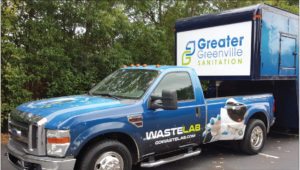
The flagship of the program is the GGSD’s WasteLAB, a 49-foot, 10.5-ton semi-trailer that has been converted into a mobile solid waste teaching center. It was funded through revenues set aside from the sale of recyclable materials. WasteLAB offers digital and tactile interactive games and STEM/STEAM-certified learning tools about real-world waste management problems and solutions.
From apps to action
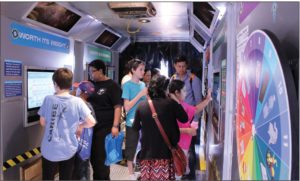
Ensuring that educational content met curriculum standards was a key to getting WasteLAB into schools, but that was only half the battle. The GGSD also knew it needed to do something extraordinary to reach students in a meaningful way – today’s students are far more interested in using Snapchat and catching Pokémon than in reading posters about recycling or composting.
The GGSD actively sought out teachers and students for their opinions and feedback on what would excite students to learn but also work within the curriculum. Additionally, an educational digital media coordinator was brought on board to develop original content. The objective was to develop a fun and valuable experience that students would share with family and on social media.
The short-term goal is to have WasteLAB reach every 5th grade student in the school district during the 2016-2017 school year. Starting with 5th graders is ideal, as educational research shows students at this age begin to think more logically and discern for themselves whether something might be important. As the program progresses, it will aim to continue to engage students as they move beyond 5th grade and also capture the new crop of 5th graders each year.
“It’s been truly a partnership of industry and the schools,” said Christine Burras, academic specialist for Greenville County Schools. “As our students get engaged at the middle- and high-school levels, they will have a role in developing greater sustainability practices by serving as leaders and mentoring at the elementary schools. It will lead to a rise of student leaders taking initiative, helping them to take personal ownership and be able to use their skills – such as creativity and problem solving – to really tackle issues that are going to impact all of us.”
Touching students of all ages
Ultimately, the SSP is designed to retain and encourage student participation and leadership into adulthood. Various components of the program target specific grade levels. These components are detailed below.
WasteLAB Mobile Unit. The main unit is educationally-suited for students at kindergarten through 5th grade. Teachers in the school district have the option to schedule the unit for their class to visit and tour. A commercially licensed driver brings the unit directly to the students’ schools rather than students coming to the unit, saving teachers valuable class time. After students explore the various tactile and digital exhibits that focus on recycling and resource sustainability, teachers follow up with classroom lessons. GGSD has provided links to educational materials on its website for teachers to access.
WasteLAB Organic Recovery Module (WORM). This K-12 mobile exhibit focuses on educating students about food waste minimization, an issue that has garnered national attention. In September 2015, the U.S. Department of Agriculture and U.S. Environmental Protection Agency called for a 50 percent reduction in food waste by 2030. This unit appeals to students at every grade level to help reach that goal.
Competitions. At the middle-school level – 6th through 8th grades – students will be challenged to come up with waste minimization and sustainability solutions in a variety of scenarios. Students can learn about these challenges, and possible awards, from classroom teachers and the WasteLAB social media pages.
Career-oriented grants and internships. At the high school level, students will have opportunities to work with the GGSD and local businesses on real-world projects related to waste minimization and resource sustainability. For example, students can work as WasteLAB guides at the elementary school demonstrations or work with a local business to find ways to increase recycling. Students with digital media skills will be encouraged to create videos, games and apps that address solid waste problems and solutions.
Community service learning. Beginning this fall, college students have the option to fulfill community service learning requirements at GGSD. Greenville Technical College instructors whose courses require community service learning projects can encourage their students to complete their service hours at GGSD. This exposes college students to sustainability issues while also involving them in the process of creating solutions on a community level. For GGSD, this provides a connection to the elusive millennial generation they have been trying to reach.
Initially, the program will focus on visiting schools with the main WasteLAB unit and the WORM, and creating composting-related career and challenge opportunities at the middle and high school levels. The community service learning component will begin with a small number of college students in 2016. The GGSD expects to expand and add elements to the program each year.
Inspiring change-makers of next generation
Initially, the success of the program will be gauged by metrics of student learning. On the day of their on-site field trip, students will be given pre- and post-visit tests to discover how much they learn from the WasteLAB experience. The hope is that students will be excited to experience the interactive games and tools for an hour or two, absorbing information about waste reduction in ways that simply don’t happen during a lecture visit.
Over time, as students take home information to family members, program leaders hope these educational efforts increase the county’s recycling and composting rates and decrease amounts entering landfills.
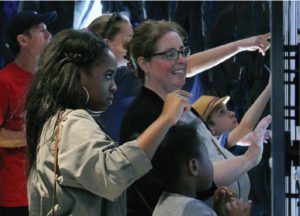
An additional positive byproduct that both the GGSD and school district hope to see is an increase in students interested in STEM-related careers and courses. Students who otherwise might not see the value in science or math courses may feel more inclined to explore opportunities and career paths after being engaged in problem solving related to sustainability. Students may be inspired to make a difference in resource issues that are, after all, going to be increasingly important for their generation to solve.
As the WasteLAB program rolls its way into schools this year, those involved hope to see students engaging with the social media tools, sending out Tweets or Snapchat messages that show they are aware of waste realities. In this way, the program will build a new awareness among peers and family members about minimizing consumption and increasing conservation. To follow this journey, just keep tabs on @goWasteLAB.
Margaret Dieringer is an instructor at Greenville Technical College in Greenville, S.C. and the owner of Meg’s D-Clutter LLC, a South Carolina service that focuses on sustainability by providing professional organization, conservation and resource reallocation services to individuals. She can be reached at megsdclutter@gmail.com. For information regarding the GGSD Sustainable Schools Program, contact info@gowastelab.com.