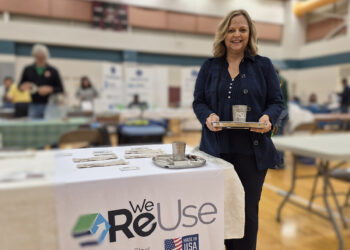




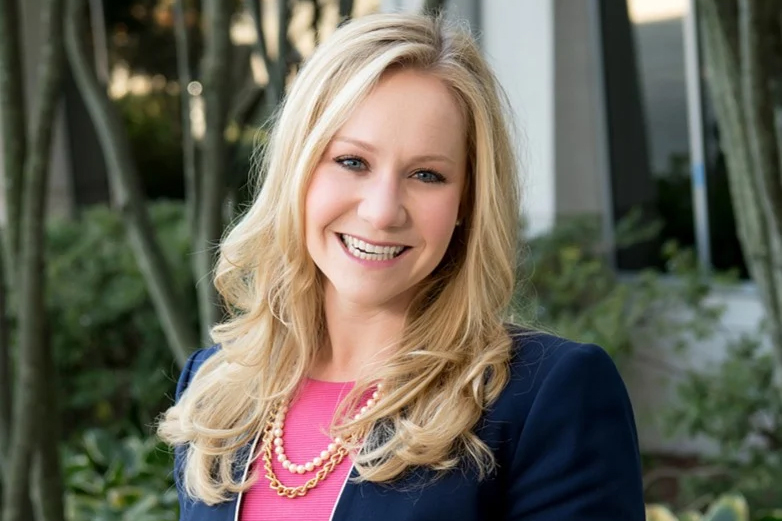
A warm welcome back to “Women in Circularity,” where we shine a light on women moving us toward a circular economy. This month, I was pleased to connect with a zero-waste leader: Susie Vincent, Director of Client Solutions, TRUE at the US Green Building Council (USGBC) — a global nonprofit that advances healthy, efficient and sustainable buildings and communities.
Susie helps clients achieve their sustainability and zero waste goals, drawing on more than two decades of experience in environmental planning and stakeholder engagement and training.
She blends systems thinking with practical implementation and is driven by a passion for relationship‑building, education and community advocacy to advance more circular, resilient communities.
How has a deeper understanding of/passion for circularity shaped your career?
My perspective on circularity is deeply rooted in how I was raised. I grew up with the influence of parents, grandparents and a great-grandmother who taught me how to be responsible with both material and natural resources. They didn’t see things as disposable; they valued what they had and used resources efficiently.
Today, our global economy is built on incredible speed and convenience, which offers benefits but also highlights some stark inequities. While it’s easier than ever for many to access goods on demand, we still have neighbors and communities struggling to meet basic needs.
For me, bridging that gap is where the real power and excitement of circularity lies. It’s not about restricting ourselves; it’s about unlocking creativity.
When we look at materials management through a local lens, we see immense potential for innovation. Designing systems that keep materials in use locally creates new economic opportunities, builds regional resilience and creates better avenues for resources to be shared and distributed equitably.
Ultimately, a deeper passion for circularity has taught me that environmental stewardship and economic opportunity go hand in hand just as it has in generations past. It’s a creative tool we can use to strengthen our local economies and support our neighbors at the same time.
How does your work with TRUE help organizations accelerate their sustainability goals?
The TRUE rating system provides a brilliant framework, but every organization starts from a different place. My role is to meet clients where they are and help them find the specific path that aligns with their unique goals.
I love encouraging teams with strategies that go beyond what’s simply published in our resources, drawing on industry learnings and sharing real-world stories from successful projects I’ve navigated over the years so they don’t have to reinvent the wheel.
One of the most rewarding aspects of my work comes after a facility achieves TRUE certification – helping them tell their story. When a company is ready to share their journey publicly, celebrating their achievements does more than just honor their hard work. It sends a powerful signal to the entire market.
Highlighting these successes across different industries and geographies proves that responsible materials management is achievable anywhere, whether it’s a manufacturing plant, a corporate office or a large professional sports stadium.
By elevating these stories, we showcase global market readiness for better materials management and inspire other organizations to accelerate their own timelines.
Is there a recent project you supported that felt especially impactful, and why?
Recently, I’ve been incredibly rewarded by our collaboration with a prestigious, research-intensive university in the Southeast United States. We’ve been in conversation with their dedicated staff for a few years, and they recently made the monumental decision to pursue TRUE certification at the portfolio level, starting by registering their first five projects.
What makes this project so impactful is the unique environment of higher education. Public universities operate under tight budget constraints and financial resources are never unlimited.
With our team’s support, their staff successfully built a compelling business case to prove that zero-waste certification isn’t just a cost, it’s a value driver that showcases their institutional leadership and directly accelerates their climate goals.
I especially love working with universities because of their built-in stakeholder base – their students. Today’s students are incredibly eager and expectant when it comes to environmental stewardship, they demand better materials management from the places where they live and learn.
Furthermore, for a university known globally for its top-tier science and engineering curriculum, adopting circular practices aligns perfectly with who they are at their core. It proves that zero waste is a logical, necessary innovation for the next generation of leaders and problem solvers.
What major shift do you see in the efforts to scale the circular economy?
The biggest shift I see is that circularity is moving from a voluntary “feel-good” initiative to an auditable corporate necessity. For years, organizations focused heavily on tracking their direct energy use. Now, driven by global frameworks like the UN Sustainable Development Goals (SDG), specifically SDG 12 (Responsible Consumption and Production) where we see a massive push toward rigorous value-chain reporting. Companies are realizing they can’t achieve true net-zero goals without tackling their indirect emissions.
Under the Greenhouse Gas Protocol, this means accounting for Scope 3, Category 5 (Waste Generated in Operations) and Category 12 (End-of-Life Treatment of Sold Products). This compliance piece is scaling circularity at an unprecedented corporate level.
But what excites me most is how this macro-level reporting is driving micro-level innovation on the retail shelf. When a corporation is forced to take financial and environmental responsibility for a product’s end-of-life, it fundamentally changes how they design it. We are starting to see reduced packaging, bio-based materials and clearer labeling that makes circularity simple for the everyday user.
As these innovations reach consumers, they act as an educational tool. Consumers learn what to look for, their expectations rise and they begin sending that demand right back up the supply chain to the producers.
There is still immense room to grow, but this feedback loop, where global compliance meets conscious consumer demand, is how we scale the circular economy from the boardroom to the living room
What is a meaningful piece of guidance that has changed how you approach your work?
One that has deeply formed my path is the principle of stewardship found in Genesis — the calling to care for and tend to the Earth. To me, stewardship isn’t a passive role; it’s an active, daily responsibility to protect both the creation we’ve been given and the people who rely on it. It reminds me that resources are a trust, not a commodity.
In my work with TRUE and circularity, I don’t just see material management metrics or corporate goals – I see an opportunity to fulfill that foundational calling to care for our shared home and look out for one another.
However, more recently, I have had times when my optimism for change has been challenged, so if I may share a second, but more recent inspirational quote from Mother Teresa: “If you cannot feed a hundred people, then feed just one.”
In the sustainability field, it is very easy to get overwhelmed by the sheer scale of global waste and climate challenges. This piece of advice has completely changed how I approach my day-to-day work. It reminds me that global systems change starts at the micro-level, with one facility, one client or one local community finding a better way to manage their resources.
We don’t have to solve the entire world’s waste crisis by tomorrow morning, but we can make a tangible difference exactly where we are standing right now.