Resource Recycling
  • The Latest
  • Analysis
    • All
    • Certification Scorecard
    • Industry Announcements
    • Opinion
    E-scrap magnet recycling company scales up

    Why only some rare-earth sources are economically viable

    e-Stewards to develop an ITAD-specific standard

    Certification scorecard — week of Sept. 21

    Who should pay for lithium-ion battery fire damage?

    America’s critical-materials buildout has a feedstock problem

    Certification scorecard – week of Sept. 14

    Canada Plastics Pact reports 2024 progress

    Trade tensions shift global mineral partnerships 

  • Conferences
    • Resource Recycling Conference
    • Plastics Recycling Conference
    • E-Scrap: The Longevity Conference
    • Textiles Recovery Summit
  • Publications
    • E-Scrap News
    • Plastics Recycling Update
    • Policy Now
    • Resource Recycling
    • Other Topics
      • All Topics
      • Brand Owners
      • Critical Minerals
      • Glass
      • Grant Watch / RFPs
      • Markets
      • Organics
      • Packaging
      • Research
      • Technology
      • Textiles
Subscribe
No Result
View All Result
Resource Recycling
  • The Latest
  • Analysis
    • All
    • Certification Scorecard
    • Industry Announcements
    • Opinion
    E-scrap magnet recycling company scales up

    Why only some rare-earth sources are economically viable

    e-Stewards to develop an ITAD-specific standard

    Certification scorecard — week of Sept. 21

    Who should pay for lithium-ion battery fire damage?

    America’s critical-materials buildout has a feedstock problem

    Certification scorecard – week of Sept. 14

    Canada Plastics Pact reports 2024 progress

    Trade tensions shift global mineral partnerships 

  • Conferences
    • Resource Recycling Conference
    • Plastics Recycling Conference
    • E-Scrap: The Longevity Conference
    • Textiles Recovery Summit
  • Publications
    • E-Scrap News
    • Plastics Recycling Update
    • Policy Now
    • Resource Recycling
    • Other Topics
      • All Topics
      • Brand Owners
      • Critical Minerals
      • Glass
      • Grant Watch / RFPs
      • Markets
      • Organics
      • Packaging
      • Research
      • Technology
      • Textiles
Subscribe
No Result
View All Result
Resource Recycling
No Result
View All Result
Home E-Scrap

Report provides path to reduce medical e-scrap

byPaul Lane
September 25, 2026
in E-Scrap
Cutting healthcare plastics could save $18B

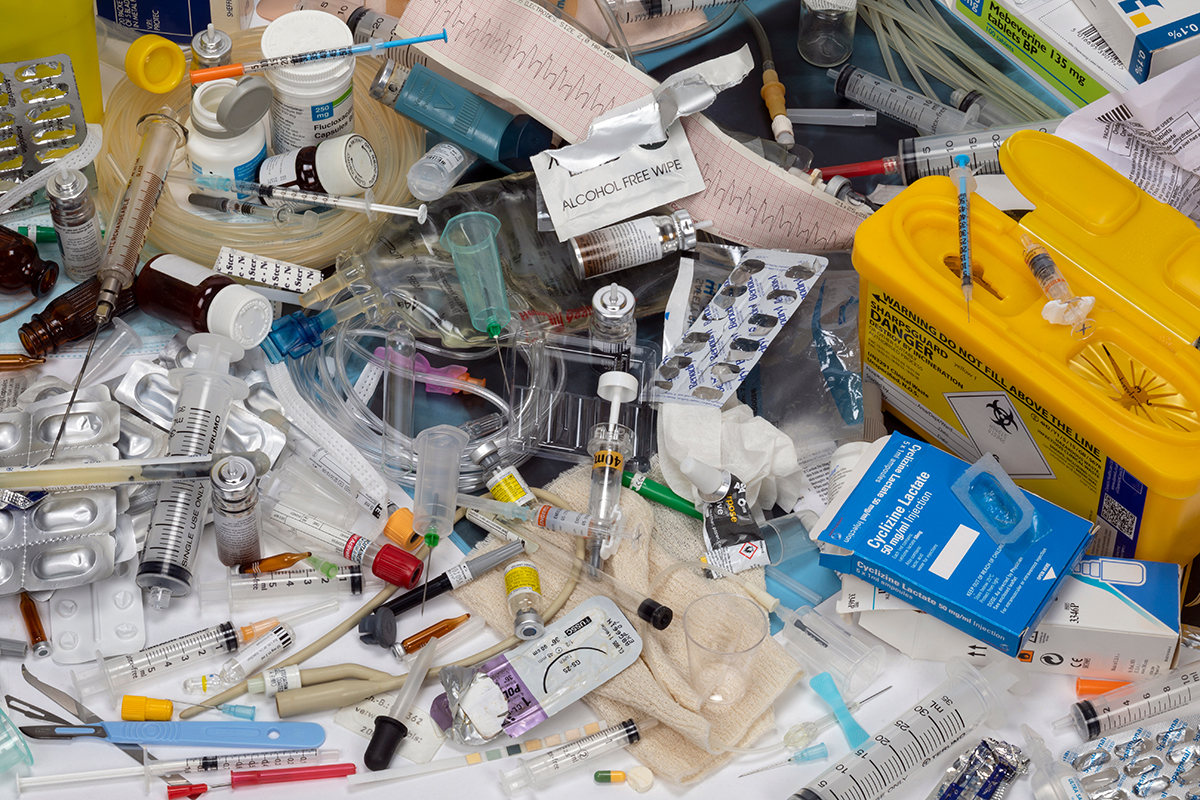
A European report studied how to address the growing volume of e-scrap generated from medical devices. | Steve Allen / Shutterstock

A new report out of Europe calls for people across the health care value chain to help reduce the ever-growing volume of medical e-scrap.

The report from the Digital Health in the Circular Economy (DiCE) found that manufacturers, providers, policymakers and patients can all do their part to reduce e-scrap without impacting safety. The four-year project considered design, collection, logistics, refurbishment and recycling in laying out what DiCE leaders consider a “practical blueprint” for bringing circularity to health care.

The onset in recent years of digital devices — tens of millions of diabetes sensors, blood pressure monitors, surgical instruments and similar products just in Europe — has created a need to curb the landfilling of these items, according to Pascal Leroy, director general of the Belgium-based Waste Electrical and Electronic Equipment (WEEE) Forum.

“The rapid growth of this market is creating a largely overlooked problem: a fast-growing stream of electronic waste,” he said. “DiCE has shown how to mitigate that problem and recover increasingly precious and strategically critical raw materials.”

Contamination and privacy concerns result in a lot of medical devices ending up as health care waste, leaving them to be incinerated without extracting the reusable components or minerals they contain. Extending product lifetimes, the authors found, would deliver greater environmental benefits.

To recover more minerals, the report makes five recommendations:

  • Design medical devices so they can be repaired, refurbished or remade
  • Introduce digital product passports and bills of materials to improve recovery
  • Expand collection and return systems through pharmacies and other facilities
  • Better align device regulations with sustainable product design so environmental goals complement patient needs
  • Develop circularity indicators that reward lifetime extension, reuse and repair rather than recycling alone

To help achieve these goals, DiCE developed a five-step Circular Design Guide with clinicians, engineers and users. The document is meant to help teams integrate circular thinking into existing systems — making devices cleanable, for example, or allowing for them to be disassembled to retrieve at least some components.

The project also compiles lifecycle assessments examining the impacts of certain products. While circuit boards, batteries and displays make up the bulk of materials from these devices, the report found redesigning health care systems can have a bigger impact than redesigning the devices to make these parts more retrievable.

Among the examples the researchers found:

  • Reusable electrocardiogram leads reduced environmental impacts by at least 81% compared to disposable ones, with efforts focused on sterilization after introduction
  • Electronic pharmaceutical labels reduced the climate impact of drugs by about 27% by keeping medicine in use when label information changed
  • Powered surgical staplers allowed for shorter procedures and hospital stays, reducing the climate impact of surgery by 12%
  • More than 60% of the study participants were willing to return devices when convenient collection was accessible

The bottom line, the authors concluded, is circularity can be improved without impacting patients.

“The healthcare sector increasingly depends on digital technologies, yet many devices are designed to be used and discarded,” said Tamara Hoveling of TU Delft, lead author of the Circularity Design Guide. “The challenge this project faced was to preserve clinical performance and patient safety while extending product life, recovering valuable materials and reducing environmental impacts. Delivered by the DiCE project is the first integrated blueprint for circular designing of medical devices.”

The report involved 414 people from 20 organizations across nine European countries. It gathered data from October 2022-September 2026.

Globally, more than 600 million wearables shipped in 2025, including medical devices; that number could grow to more than 2 billion by 2050, based on current trends. Their expected refresh cycle is 1-3 years.

There exists no formal health care e-scrap tracking in the US; Health Care Without Harm estimates the total volume of waste just from US hospitals to exceed 5 million tons a year. On the plastic side, estimates have the US health care system going through 2.1 million metric tons of single-use plastics a year.


Tags: ElectronicsEuropeRepair & ReuseTechnology
TweetShare
Paul Lane

Paul Lane

Paul Lane is an award-winning journalist who joined Resource Recycling in June 2026 after working for several years in corporate communications and at various local news outlets. He can be reached at paul.lane@resource-recycling.com.

Related Posts

E-scrap magnet recycling company scales up

Why only some rare-earth sources are economically viable

byDavid Daoud
September 24, 2026

Rare-earth recycling economics depend on several factors, and there is no single price or date that makes the process pencil...

Bin to Better gets students involved in reuse, recycling

Bin to Better gets students involved in reuse, recycling

byPaul Lane
September 24, 2026

E-scrap among three focus areas for student-run, California-based environmental advocacy group.

Who should pay for lithium-ion battery fire damage?

byDavid Daoud
September 21, 2026

Fires continue to be a major threat to the recycling industry, even as states explore new policy solutions.

America’s critical-materials buildout has a feedstock problem

byDavid Daoud
September 18, 2026

As the US invests in critical-minerals capacity will facilities have enough material to process?

Study assesses environmental cost of excess data storage

BAN paper says AI e-scrap estimates are low

byPaul Lane
September 17, 2026

The advocacy group said current estimates on the scrap resulting from data centers don’t account for the full picture of...

Van filled with rolled carpeting for recycling or disposal.

California carpet recycling rate reaches 37%

byBrian Clark Howard
September 17, 2026

The state’s recycling rate rose for the sixth year in a row, despite challenging market conditions.

Load More

2026 Buyers’ Guide

Equipment, services and technology suppliers serving the recycling industry.

Browse the Guide

More Posts

Recyclers reeling from NJ PCR extension

Recyclers reeling from NJ PCR extension

September 23, 2026
Colorado’s EPR programs move from planning to practice

Colorado’s EPR programs move from planning to practice

September 17, 2026

Who should pay for lithium-ion battery fire damage?

September 21, 2026

SB 54 plan for cartons, film draws warning

September 15, 2026
US packaging is evolving. The recycling system isn’t ready

US packaging is evolving. The recycling system isn’t ready

September 16, 2026
Alpek closing Pennsylvania RPET plant

Alpek seizing on war-related opportunity 

July 27, 2026
Industry announcements for January 2026

Industry announcements for September 2026

August 31, 2026
ALPLA’s holistic approach to packaging design

ALPLA’s holistic approach to packaging design

September 18, 2026
Bridge Green, Hartree partner on mineral processing deal

Bridge Green, Hartree partner on mineral processing deal

September 21, 2026
Maximizing the value of post-consumer PP 

Maximizing the value of post-consumer PP 

August 5, 2026
Load More

About & Publications

About Us

Staff

Archive

Magazines

Work With Us

Advertise
Jobs
Contact
Terms and Privacy

Newsletters

Get the latest recycling news and analysis delivered to your inbox every week. Stay ahead on industry trends, policy updates, and insights from programs, processors, and innovators.

Subscribe

Welcome Back!

Login to your account below

Forgotten Password?

Retrieve your password

Please enter your username or email address to reset your password.

Log In

Add New Playlist

No Result
View All Result
  • The Latest
  • Analysis
  • Recycling
  • E-Scrap
  • Plastics
  • Policy Now
  • Conferences
    • E-Scrap Conference
    • Plastics Recycling Conference
    • Resource Recycling Conference
    • Textiles Recovery Summit
  • Magazines
  • About Us
  • Advertise
  • Archive
  • Jobs
  • Staff
Subscribe
This website uses cookies. By continuing to use this website you are giving consent to cookies being used. Visit our Privacy and Cookie Policy.