




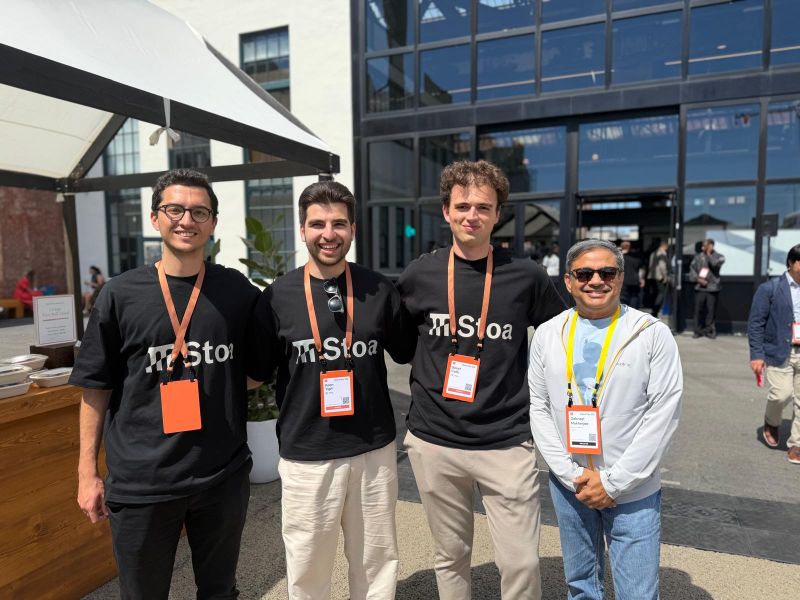
As the world builds up its AI infrastructure, the co-founders of Stoa found a glaring gap: no central marketplace for new and used equipment.
Berat Celik, Eren Berke Saglam and Kaan Yigit saw that AI hardware was becoming a financial asset, but those dealing in it had to navigate a 21st-century Wild West to get what they needed.
Demand has surged — more than 75 million PC graphics processing units (GPUs) shipped in the second quarter of 2026. Wall Street has noticed, as lenders have extended more than $48 billion in GPU-backed financing so far this year, and Nvidia recently signed agreements with six major asset managers aiming to make more than $500 billion available for AI companies to borrow against.
But where commodities such as oil, metals and power are traded via regulated exchanges, the AI hardware market had no central place to get deals done and acquire needed resources.
“I spent months talking with suppliers and end users, and with the bankers and lenders behind them, about the problems they face when buying, selling or financing AI hardware,” said Celik, also Stoa’s CEO. “Companies were making large investments in equipment, but prices were scattered across private deals. Buyers had no clean way to compare offers, and lenders had no dependable reference price for the hardware they financed.”
That’s how the idea for Stoa was born. The company offers a three-pronged approach to creating financial infrastructure for AI hardware:
- Stoa Markets is a request-for-quotation-based marketplace in which buyers can submit their project’s specifications and get binding quotes from verified suppliers. Sellers then verify the product’s condition, and the sale is completed. There is also a process for handling deals involving faulty or misrepresented equipment.
- Stoa Intelligence is a GPU price benchmark and fleet valuation tool for lenders and data center operators.
- Stoa Exchange is a financial marketplace bringing futures, swaps and options for GPU price risk to market. A license is pending, and the exchange would be regulated by the Commodity Futures Trading Commission.
“We’re building the exchange for physical AI hardware, starting with GPUs,” said Saglam, also Stoa’s CFO. “We’re creating the infrastructure for these assets to be traded, priced and ultimately hedged. Until now, there has been no independent reference price for physical GPUs, even though lenders have financed tens of billions of dollars of them.”
There’s value across the board, Saglam said. Buyers should know if they’re paying a fair price and what the equipment might be worth when it’s time to unload it. Lenders need a reference point for valuing collateral. Public prices make such decisions much easier, he said.
Stoa supports new, certified refurbished and tested used hardware, said Yigit, also Stoa’s CTO. The company makes declaring product details part of the transaction for all used devices, bringing more control to the ITAD side of its business.
“For sellers, a functioning resale market provides a way to recover capital when they upgrade or retire a fleet,” he said. “Configuration, condition and warranty are structured fields in every request and quote, so a used system is compared on the same terms as a new one.”
“A strong secondary market gives useful equipment a path to another owner and helps companies recover capital,” Celik said. “That requires comparable prices, clear information about condition and dependable execution. Stoa is building the infrastructure around those needs so companies can manage their hardware throughout its life. For ITAD and refurbishment companies, Stoa is a channel to sell tested equipment to verified institutional buyers and a reference price for the inventory they hold.”
The company has seen strong interest since launching in July, Celik said. San Francisco-based Stoa participated in the summer 2026 batch of Y Combinator, a startup accelerator that has backed Airbnb and Reddit. It’s had inbound interest from Europe and the Middle East and has secured funding from investors including Decacorn Venture Capital.
“Stoa has hit the ground running with blistering velocity,” Debneel Mukherjee, Decacorn’s founder and managing partner, wrote in a LinkedIn post touting the company. “Stoa is aggressively scaling toward building the definitive financial exchange for the world’s most valuable asset class.”
The leadership team is keeping investment and other financial details private for now, but Saglam said it will generate revenue through transaction fees and pricing and data subscriptions. The company plans to focus on the US market initially and consider international expansion in the coming year, Saglam said. The company is also bolstering services around physical trading, he said, including inspection, logistics and access to third-party financing.
“We want a company buying a GPU fleet, or a lender financing one, to be able to manage that price exposure through an established market,” Celik said. “Our exchange vision grows from the physical trade: Reliable hardware prices support financing and provide the foundation for financial contracts tied to the assets themselves.
“We are building the infrastructure for the entire hardware trade.”