
Resource Recycling
  • The Latest
  • Analysis
    • All
    • Certification Scorecard
    • Industry Announcements
    • Opinion

    From CES to the shredder: What 2026 PCs mean for ITAD

    Certification scorecard for week of Jan. 12, 2026

    Industry announcements for January 2026

    Certification scorecard for Dec. 18-30, 2025

    Certification scorecard for Dec. 18, 2025

    Industry announcements for the week of Dec. 15

    Certification scorecard for December 10, 2025

    Industry Announcements for Week of December 8

    Certification Scorecard for December 3, 2025

  • Conferences
  • Publications

    Other Topics

    Textiles
    Organics
    Packaging
    Glass
    Brand Owners

    Metals
    Technology
    Research
    Markets
    Grant Watch

    All Topics

Subscribe
No Result
View All Result
Resource Recycling
  • The Latest
  • Analysis
    • All
    • Certification Scorecard
    • Industry Announcements
    • Opinion

    From CES to the shredder: What 2026 PCs mean for ITAD

    Certification scorecard for week of Jan. 12, 2026

    Industry announcements for January 2026

    Certification scorecard for Dec. 18-30, 2025

    Certification scorecard for Dec. 18, 2025

    Industry announcements for the week of Dec. 15

    Certification scorecard for December 10, 2025

    Industry Announcements for Week of December 8

    Certification Scorecard for December 3, 2025

  • Conferences
  • Publications

    Other Topics

    Textiles
    Organics
    Packaging
    Glass
    Brand Owners

    Metals
    Technology
    Research
    Markets
    Grant Watch

    All Topics

Subscribe
No Result
View All Result
Resource Recycling
No Result
View All Result
Home Plastics

Cutting healthcare plastics could save $18B

Antoinette SmithbyAntoinette Smith
September 24, 2025
in Plastics
Cutting healthcare plastics could save $18B
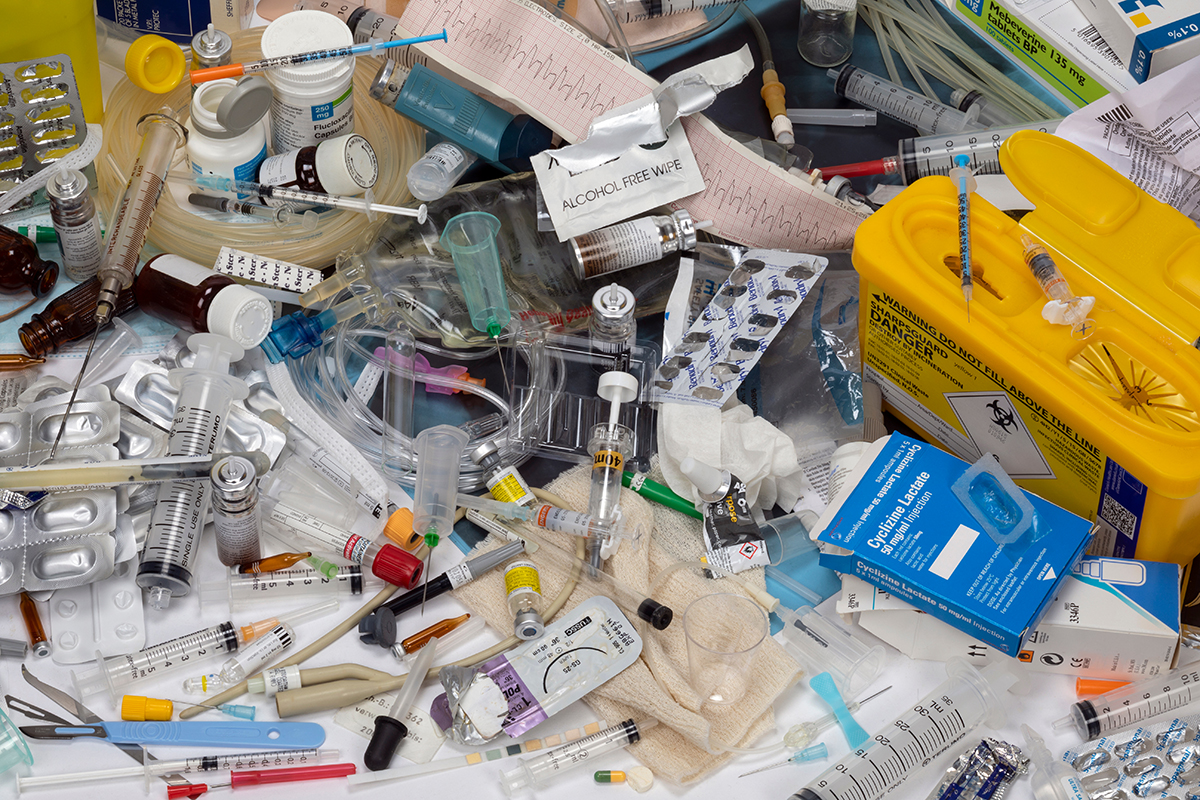
A new report says healthcare plastics could rise 40% by 2040, but scaling recycling strategies could cut waste in half and save $18B annually across global systems. | Steve Allen / Shutterstock

Healthcare organizations generate large quantities of recyclable single-use plastics, but face unique challenges, said panelists during a recent webinar from Eunomia Research and Consulting. 

Building off a report from Eunomia and systems change firm Systemiq, the webinar A Prescription for Change explored the environmental and financial impacts of single-use plastics in medical facilities and provided strategies to help accelerate progress in the circularity space.

As of 2023, the healthcare system used 2.1 million metric tons of single-use plastics, said Yoni Shiran, partner at Systemiq, during the webinar. If the healthcare industry continues to operate under “business as usual” practices, annual healthcare plastic waste volumes could rise 35-40% by 2040, he added.  

Unlike for some packaging applications, plastic is uniquely suited for medical uses because of sterility requirements, but is often exempt from state-level regulations addressing plastic waste. This is exacerbated by a fragmented US system of responsibility as well as rising procedural and demographic demand, Shiran said.  

Seven product categories make up most of the single-use plastic consumption in healthcare: fluid bags and tubing (23%), gloves (22%), rigid devices (14%), device packaging (14%), PPE (12%), wipes (8%) and pharmaceutical packaging (8%). And most of the associated emissions and costs come from upstream processes, the report said. 

“Healthcare has been largely outside most conversations around circularity and decarbonization to date,” Shiran said, adding that legislation such as California’s SB 54 and Europe’s packaging and packaging waste regulation has exempted healthcare waste from programs meant to curb plastic waste. And activists from non-governmental organizations have largely avoided the medical sphere due to sensitivity concerning patient health and safety, he said. 

Without effecting systemic change, the negative impacts of single-use plastics in healthcare will grow more severe, he said, putting more pressure on public budgets, waste streams and climate outcomes. However, he added that if the strategies put forward by the report were scaled, health systems could cut single-use plastics waste by 53% by 2040, and save $18 billion a year, or 24%.

One example of a local solution is the “Glove Smart” campaign at St. Paul’s Hospital in Vancouver, British Columbia. Following a post-Covid surge in glove usage – up to 33,000 gloves each month in the intensive care unit – the facility launched an education-based pilot that ultimately reduced noncompliant glove usage by 53%. 

Moreover, in 2023, Chicago’s Northwestern Memorial Hospital and intravenous fluid (IV) bag maker Baxter completed a three-year pilot to collect and recycle IV bags made of polyvinyl chloride, with plans to expand it to other hospitals and maintain it at Northwestern Memorial. Baxter also has worked with Orbia’s Vestolit business to expand collection and recycling of non-hazardous IV bags in Colombia. 

Navigating roadblocks to circularity

The competing priorities common to medical facilities have stood in the way of efforts to reduce plastic waste in hospital settings, said Hardeep Singh, chief of health policy, quality and informatics at Baylor College of Medicine in Houston. “There’s always some other fire burning to put out,” such as financial pressures, or a pandemic. 

But attaining buy-in from clinicians is a good start, he said. “A lot of them don’t understand the implications and ramifications of all this plastic waste. Even though they see it they don’t know what to do about it, and we need to empower them.” 

Rachel Meidl, deputy director and fellow in energy and sustainability at the Baker Institute for Public Policy at Rice University in Houston, said adoption of sustainable plastic practices is being held back by a mix of regulatory, market and cultural barriers. 

Fragmented legislative policy also causes inconsistencies and makes confident investment far more difficult, she said. In addition, the healthcare sector is traditionally risk-averse, potentially made worse by inconsistent market signals. 

Jason Fischer, director of the office of sustainability at Houston Methodist, said his organization looks at how to make processing and sorting recyclable items without sacrificing efficiency. In addition, the vast but far-flung Houston Methodist network must make sure it can aggregate enough post-use materials to make them valuable as a commodity. Smaller organizations could develop regional networks and partnerships to help realize the end-market opportunities for recyclable plastics, he said.  

To build worker buy-in, Fischer recommended recruiting “champions” to lead and advocate for plastic waste reduction across the hospital system, choosing those most passionate about the effort. He also cautioned against trying to do too much at once, suggesting instead that hospitals target the low-hanging fruit by focusing on areas with the biggest impact.

Perhaps even more so than in other industries, healthcare settings are extremely cost-conscious, exacerbating the existing objections of using post-consumer resin instead of cheaper virgin resin. 

Making the business case for recycling plastics and for using recycled resin requires consistent, high-quality data on the types, volumes and fates of plastics, Meidl said. “There’s limited visibility” as to what plastics are used and what is recovered, but gaining a better understanding could inform better decisions, she said, suggesting supply chain mapping to show where various impacts occur.


Tags: Hard-to-Recycle MaterialsPolicy Now
TweetShare
Antoinette Smith

Antoinette Smith

Antoinette Smith has been at Resource Recycling Inc., since June 2024, after several years of covering commodity plastics and supply chains, with a special focus on economic impacts. She can be contacted at [email protected].

Related Posts

CARE launches carpet fiber ID device to aid recyclers

byAntoinette Smith
January 14, 2026

The customized unit can identify all yarn fibers and blends in about half a second, helping to make sorting more...

New Comstock site to feed Nevada solar panel recycling

New Comstock site to feed Nevada solar panel recycling

byScott Snowden
January 13, 2026

Comstock Metals has opened a new California facility aimed at improving the collection and transport of retired solar panels to...

Policy Now | January 2026 – Resolutions target packaging

Policy Now | January 2026 – Resolutions target packaging

byEditorial Staff
January 5, 2026

Legislators introduced new measures as 2025 wrapped up and the recycling industry geared up for 2026.

#PRC2026 Speaker Spotlight: Christine Yeager

#PRC2026 Speaker Spotlight: Christine Yeager

byScott Snowden
December 29, 2025

Christine Yeager blends CPG leadership with advocacy, bringing energy to EPR and recycling debates. A former Coca-Cola sustainability director, she...

State policy drives tire recycling investment in Southeast

State policy drives tire recycling investment in Southeast

byAntoinette Smith
December 23, 2025

Liberty Tire Recycling is investing in $1.4 million of equipment upgrades at a facility in North Carolina, and credits the...

Solar recycling ramps up in NY with new pickup service

Solar recycling ramps up in NY with new pickup service

byScott Snowden
December 23, 2025

New York’s clean energy and digital infrastructure sectors have grown in recent years and the flow of decommissioned, warranty-return, storm-damaged...

Load More
Next Post
Clean Harbors hits 2030 recycling goal early

Clean Harbors hits 2030 recycling goal early

More Posts

paint cans recycling

PaintCare brings stewardship to Illinois, Maryland on deck

December 19, 2025
Mitsubishi Materials buys into Elemental e-scrap pact in US

Mitsubishi Materials buys into Elemental e-scrap pact in US

December 19, 2025
#PRC2026 Speaker Spotlight: Joel Morales

#PRC2026 Speaker Spotlight: Joel Morales

December 22, 2025
Panel tracks shifts in e-scrap as policy, AI reshape

Panel tracks shifts in e-scrap as policy, AI reshape

December 22, 2025
Robot pilot targets legacy parts to help supply defense

Robot pilot targets legacy parts to help supply defense

December 29, 2025
Solar recycling ramps up in NY with new pickup service

Solar recycling ramps up in NY with new pickup service

December 23, 2025
State policy drives tire recycling investment in Southeast

State policy drives tire recycling investment in Southeast

December 23, 2025
New Hampshire makes progress on waste goals

New Hampshire makes progress on waste goals

December 22, 2025
Federal PACK Act aims to preempt ‘patchwork’ of state laws

Federal PACK Act aims to preempt ‘patchwork’ of state laws

December 23, 2025
APR year in review

APR year in review

December 30, 2025
Load More

About & Publications

About Us

Staff

Archive

Magazine

Work With Us

Advertise
Jobs
Contact
Terms and Privacy

Newsletter

Get the latest recycling news and analysis delivered to your inbox every week. Stay ahead on industry trends, policy updates, and insights from programs, processors, and innovators.

Subscribe

Welcome Back!

Login to your account below

Forgotten Password?

Retrieve your password

Please enter your username or email address to reset your password.

Log In

Add New Playlist

No Result
View All Result
  • The Latest
  • Analysis
  • Recycling
  • E-Scrap
  • Plastics
  • Policy Now
  • Conferences
    • E-Scrap Conference
    • Plastics Recycling Conference
    • Resource Recycling Conference
    • Textiles Recovery Summit
  • Magazine
  • About Us
  • Advertise
  • Archive
  • Jobs
  • Staff
Subscribe
This website uses cookies. By continuing to use this website you are giving consent to cookies being used. Visit our Privacy and Cookie Policy.