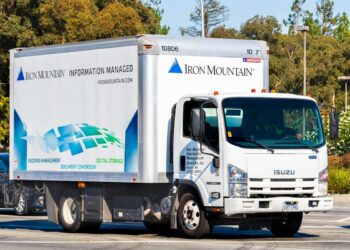

Iron Mountain Data Centers’ 2025 Sustainability Overview gives colocation operators a benchmark for clean power procurement and facility efficiency. For a company working in data center decommissioning, the report’s real interest sits in what it leaves out.
The scale is significant. Iron Mountain operates 30+ data centers across seven countries and 21 markets, covering roughly 6 million gross square feet and a 1.4 gigawatt platform of existing and pipeline capacity — 963 MW in North America, 220 MW in Europe, 163 MW in APAC. Every refresh cycle across that footprint produces volumes of CPUs, GPUs, memory, storage, cabling, and power gear that eventually need somewhere to go. Given its “sustainability” focus, the report offers little visibility into where.
On energy, the numbers are strong. Iron Mountain has certified 100% of its annual electricity purchases against renewable sources every year since 2017. It has also built hourly (“24/7”) clean power matching at 16 sites, covering 75% of total customer power, with full coverage targeted for 2040. WUE improved from 0.996 to 0.82 in 2025 and CUE from 0.0039 to 0.0031. PUE held flat at 1.41 for a second straight year. A 12 MW/23 MWh battery storage system at the NJE-1 site in Edison, New Jersey, paired with a 7.2 MW rooftop solar array — built with partner Calibrant Energy and due for completion in late 2026 — lets the facility discharge into the grid during peak demand rather than simply drawing from it.
One number cuts against the overall narrative of progress: total Scope 1 and 2 emissions (market-based) rose from 2,496 in 2022 to 3,529 in 2025, even as carbon intensity (CUE) improved. Growth in footprint is outpacing efficiency gains on a per-unit basis.
In the ITAD and decommissioning context, and for companies involved in the sector, the report provides pointers as to where improvements in reporting must take place. For example, facility-level data on volumes of retired servers, storage systems, and network gear leaving these sites each year would give a clearer picture, as would a quantified breakdown of reuse, refurbishment, remarketing, and recycling shares. Visibility into these areas would help validate the company’s circular strategy, which may explain why the reporting remains incomplete here while it is so thorough elsewhere. Iron Mountain markets asset lifecycle and ITAD services elsewhere in its business, though those services are not yet tied into this sustainability narrative. Bringing the two together would show customers and investors what landfill diversion or material recovery those offerings actually produce.
That absence is where a decom provider has room to make its case: bring facility-level reuse and recycling data, chain-of-custody detail, and material recovery metrics to a report that currently stops at the power meter.