Resource Recycling
  • The Latest
  • Analysis
    • All
    • Certification Scorecard
    • Industry Announcements
    • Opinion
    Rainforest

    Inside the Circle: What the rainforest can teach us about EPR

    Closeup of a printed circuitboard

    Hardware demand puts new focus on parts harvesting

    Rare look inside the world’s largest plastics recycler

    Mass balance matters: Why different rules can lead to different outcomes 

    Certification Scorecard — Week of June 1, 2026

    IT asset disposition and electronics recycling: Now and then

    $60 billion in AI servers will create an ITAD challenge

    The independent ITAD at a crossroads

    DMD acquires ITAD firm Lifespan, outlines acquisition strategy

  • Conferences
    • Resource Recycling Conference
    • Plastics Recycling Conference
    • E-Scrap: The Longevity Conference
    • Textiles Recovery Summit
  • Publications
    • E-Scrap News
    • Plastics Recycling Update
    • Policy Now
    • Resource Recycling
    • Other Topics
      • All Topics
      • Brand Owners
      • Critical Minerals
      • Glass
      • Grant Watch / RFPs
      • Markets
      • Organics
      • Packaging
      • Research
      • Technology
      • Textiles
Subscribe
No Result
View All Result
Resource Recycling
  • The Latest
  • Analysis
    • All
    • Certification Scorecard
    • Industry Announcements
    • Opinion
    Rainforest

    Inside the Circle: What the rainforest can teach us about EPR

    Closeup of a printed circuitboard

    Hardware demand puts new focus on parts harvesting

    Rare look inside the world’s largest plastics recycler

    Mass balance matters: Why different rules can lead to different outcomes 

    Certification Scorecard — Week of June 1, 2026

    IT asset disposition and electronics recycling: Now and then

    $60 billion in AI servers will create an ITAD challenge

    The independent ITAD at a crossroads

    DMD acquires ITAD firm Lifespan, outlines acquisition strategy

  • Conferences
    • Resource Recycling Conference
    • Plastics Recycling Conference
    • E-Scrap: The Longevity Conference
    • Textiles Recovery Summit
  • Publications
    • E-Scrap News
    • Plastics Recycling Update
    • Policy Now
    • Resource Recycling
    • Other Topics
      • All Topics
      • Brand Owners
      • Critical Minerals
      • Glass
      • Grant Watch / RFPs
      • Markets
      • Organics
      • Packaging
      • Research
      • Technology
      • Textiles
Subscribe
No Result
View All Result
Resource Recycling
No Result
View All Result
Home E-Scrap

Company debuts battery-containing device shredder

Antoinette SmithbyAntoinette Smith
June 26, 2025
in E-Scrap
Company debuts battery-containing device shredder

Seeing the lack of smaller-scale systems suited for processing small personal devices containing lithium-ion batteries, Houston-based Gloyd Recycling Solutions developed what it says is the first marketed device to shred battery-containing devices of laptop size and smaller.

“The big battery recyclers only want 30,000 or 40,000 pounds. So what are the small recyclers to do?” company founder Jeff Gloyd told E-Scrap News. “They put them in five-gallon pails, hoping that they don’t have reactions, and they store it next to 35,000 pounds of other reactive batteries. And that’s why we have facilities burning down.” 

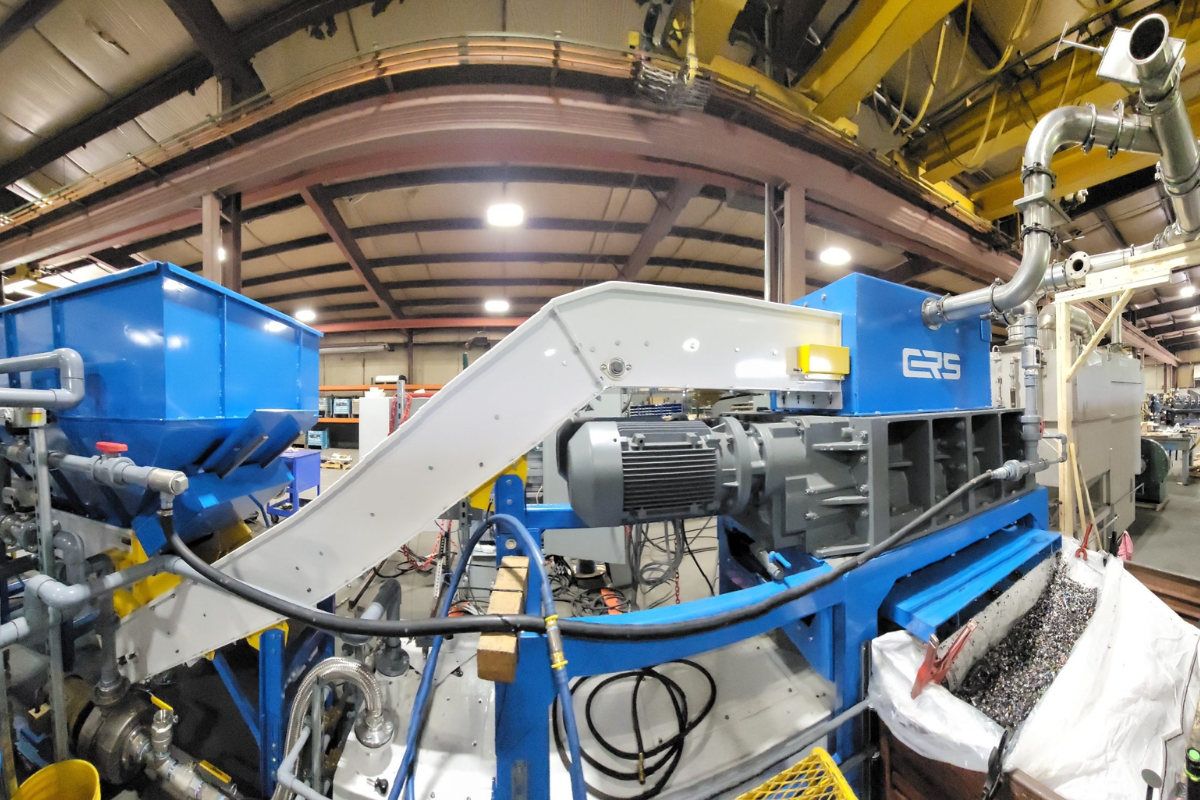
The Battery-In-Device Shredding machine, or BIDS, handles smaller devices — such as electric toothbrushes, remote controls and children’s toys — and is well-suited for smaller recyclers, Gloyd said. The system uses a feed hopper to load a screened wet shredder. Devices then are mechanically separated into plastics, metals and black mass, the battery material obtained during recycling that contains valuable metals. A wet scrubber eliminates emissions.

The machine has a small footprint, sized to fit inside a 40-foot shipping container. Its modular design enables simple setup, requiring only electricity and customer-added water for the two systems to deactivate the batteries and to separate plastics from metals. As for water loss, the machine doesn’t require discharge permits, since the system retains most of the fluid.  

Gloyd said the capacity is about a ton per hour of battery containing devices, though the density of the material affects the throughput rate. He pointed out that while the capacity may be dwarfed by shredders for printers, copiers and other bulky items, “if you think about 2,000 pounds of earbuds, that’s a lot of earbuds.”

Focused on reducing risk, maximizing throughput

Processors globally have been employing wet shredding for some time, Gloyd said, but mostly on larger batteries, such as EV packs, due to the processing volumes required to recoup a company’s capital investment in the equipment. “We’re taking that same concept and just doing it on a much smaller scale.” 

By flooding the shredding chamber with water, and starving it of oxygen, the battery is unable to expand and cause a thermal event. “We don’t want them reacting in supersacks or in gaylords after they leave the system” and causing a fire or injury, he said. 

Larger-scale processors are typically focused on a clean recovery stream from black mass, requiring removal of alkaline batteries from devices to avoid contamination, Gloyd said.

BIDS processes most battery types, which still results in a potential revenue stream – albeit slightly lower in value – but the BIDS focus is on reducing risk from batteries and lowering the upfront costs associated with manually removing unsuitable battery types, Gloyd said. “We can do it much more efficiently, which then we think can lower the prices (of the process), which gets more material into the recycling stream.”

Using earbuds as an example, manual separation would result in perhaps 10 pounds of material processed each day by each employee, Gloyd said. “There’s not enough you could charge to a supplier to ever make money.” 

First unit sold, future plans in the works

Over the course of about two years, Gloyd’s company designed the unit and sold the concept, and now the first unit is operational, he said. It’s currently being decommissioned for shipping to the customer who bought it.

In a situation familiar to any manufacturer today, Gloyd is monitoring global trade developments, though almost all BIDS components are made in the U.S. For the one piece that is imported, if tariffs present an untenable scenario, “we might have to look at sourcing that piece more domestically, which we could — that’s not an issue. So I think we’ve got a good plan so that our clients and ourselves aren’t affected by any of the geopolitics. As far as logistics and shipping, no issue.”

Looking ahead, Gloyd said the company may develop an add-on to accommodate larger items, as a response to customer feedback. And while the current BIDS design produces a mixed fraction of ferrous and nonferrous metals, some potential clients are unable to further process the mixture to optimize the value of the recovered materials. 

Gloyd is exploring if the valuable metals in the black mass could be concentrated using some kind of technology, he said, such as an optical sorter or an eddy current, to get cleaner and thus more marketable aluminum and other commodities. 

For ITAD firms that receive battery-containing devices, that could allow them to recover additional commodities rather than handing them off to another service provider, Gloyd said. “ITAD operators typically don’t have any (eddy) currents, or any kind of centrifuge to concentrate black mass, so we’re looking at engineering what we’re going to call a metal concentration unit, which would be similarly sized” and could sit adjacent to the BIDS.

As for the very first unit, “we stopped using the word ‘prototype,’ even though it is the first, and it’s easier for people to say it’s a prototype,” Gloyd said. “But essentially it’s the first operating unit of its kind, and it is operating, which I think is very exciting.”


Tags: BatteriesCritical MineralsProcessors
TweetShare
Antoinette Smith

Antoinette Smith

Antoinette Smith has been at Resource Recycling Inc., since June 2024, after several years of covering commodity plastics and supply chains, with a special focus on economic impacts. She can be contacted at [email protected].

Related Posts

Battery fires still a major risk to recyclers: report

byPaul Lane
June 9, 2026

The June fire report from Ryan Fogelman shows there were 40 incidents in May at facilities in the United States...

DOE commits federal funds toward critical minerals

ABTC wins DOE appeal for Tonopah Flats lithium refinery project

byStefanie Valentic
June 8, 2026

ABTC has won back a DOE grant that was among hundreds terminated last fall.

Rare earth processor lands $5.1M in Defense funds

IonicRE partnership supports recycled rare earth supply chain for defense magnets

byIsabella Burke
June 8, 2026

The Australian company is joining with Florida-based Advanced Magnet Lab in a new MOU.

Our top stories from June 2021

Colorado advances EV battery EPR law

byStefanie Valentic
June 3, 2026

Colorado, which passed its Battery Stewardship Act in 2025, is now looking to close the gap on large-format, EV batteries.

Fire at an EMR recycling facility in Camden, New Jersey May 29, 2026.

EMR faces shutdown calls after numerous fires

byBrian Clark Howard
June 2, 2026

A fire at a facility in Camden, New Jersey, has raised fresh questions on recycler safety and lithium ion batteries.

Emerging technology holds the key to rare earth recovery

Emerging technology holds the key to rare earth recovery

byDan Wang, Toyoshima Green Tech
June 1, 2026

Toyoshima has developed a process that recovers critical materials at high purity in an efficient way.

Load More
Next Post
E-scrap buyer launches AI to recognize circuit board grades

E-scrap buyer launches AI to recognize circuit board grades

More Posts

Recycling industry addresses Beyond Plastics report

Recycling industry addresses Beyond Plastics report

May 26, 2026
Fire at an EMR recycling facility in Camden, New Jersey May 29, 2026.

EMR faces shutdown calls after numerous fires

June 2, 2026
IT asset disposition and electronics recycling: Now and then

$60 billion in AI servers will create an ITAD challenge

June 3, 2026
House resolution aims to make recyclability central to product design

NY EPR bill fails to advance after third try

June 8, 2026
The independent ITAD at a crossroads

DMD acquires ITAD firm Lifespan, outlines acquisition strategy

June 2, 2026
CalRecycle withdraws proposed regs for SB 54

Oceana, NRDC, CAW sue CalRecycle over SB 54 regs

June 5, 2026
BASF, Encina expand circular feedstock partnership

BASF, Encina expand circular feedstock partnership

June 3, 2026
Our top stories from June 2021

Colorado advances EV battery EPR law

June 3, 2026
War, not demand driving polymer pricing

War, not demand driving polymer pricing

June 2, 2026
In My Opinion: Comparing the nation’s first packaging EPR laws

What Maine’s vape EPR law means for recyclers

June 4, 2026
Load More

About & Publications

About Us

Staff

Archive

Magazine

Work With Us

Advertise
Jobs
Contact
Terms and Privacy

Newsletter

Get the latest recycling news and analysis delivered to your inbox every week. Stay ahead on industry trends, policy updates, and insights from programs, processors, and innovators.

Subscribe

Welcome Back!

Login to your account below

Forgotten Password?

Retrieve your password

Please enter your username or email address to reset your password.

Log In

Add New Playlist

No Result
View All Result
  • The Latest
  • Analysis
  • Recycling
  • E-Scrap
  • Plastics
  • Policy Now
  • Conferences
    • E-Scrap Conference
    • Plastics Recycling Conference
    • Resource Recycling Conference
    • Textiles Recovery Summit
  • Magazine
  • About Us
  • Advertise
  • Archive
  • Jobs
  • Staff
Subscribe
This website uses cookies. By continuing to use this website you are giving consent to cookies being used. Visit our Privacy and Cookie Policy.