













Recently, avid readers of recycling trade journals likely noticed that the Institute of Scrap Recycling Industries (ISRI) made a position statement embracing environmental justice (EJ). Some of us had to read the headline twice. An electronics recycler texted me and asked, “So are they the good guys now?”
It was a good question. If I was asked if there was one industry association that in the course of my life’s work on global pollution took positions that were most antithetical to environmental justice, ISRI – an organization whose mission is being “the voice of the recycling industry” – would unfortunately rise to the top of the list.
But now, with this new announcement, my hopes are being raised.
A fair distribution of environmental impacts and benefits
Environmental justice is defined as a condition where one’s economic, national, racial or social status will not mean that their environment and health are disproportionately harmed by the actions, laws or policies of others. It’s about a fair distribution of environmental benefits and impacts of all stakeholders no matter where they live or work. It’s about choosing not to externalize costs and harm to others even when it’s quite possible and even legal to do so.

The most effective means by which environmental justice has historically been achieved is via legislation or tort law that internalizes costs, ensures that those causing damage are held liable and accountable for it, or ensures the transparency of impacts and the consent of those impacted.
In the U.S. and Canada, there are many of these laws, albeit applied unevenly (a fact from which the environmental justice movement was spawned). The situation which finds poorer or disenfranchised communities disproportionately harmed in North America is egregious and all too common. But on the global stage, the situation is worse – laws protecting poorer communities in developing countries are almost non-existent.
The notable exception is the Basel Convention, an international treaty that was specifically called for by developing countries to avoid routinely falling victim to the environmental injustice of a free (yet blatantly unfair) trade in hazardous and other wastes too often moved under the name of “reuse” or “recycling,” or more recently, the “circular economy.” Today, the Basel Convention has become one of the most respected environmental treaties, with 187 country parties having ratified it out of 195 United Nations countries (96%).
Sadly, the U.S. remains the only developed country that has never ratified Basel, and ISRI, being a powerful inside-the-beltway lobby, has been a major reason for that fact.
ISRI has never supported the Basel Convention and never supported the Basel Ban Amendment, which was passed by the Convention in 1995 and is now in force. The amendment prohibits the export of hazardous wastes, including much electronic waste, from being exported by the rich and powerful countries of the world to developing countries.
Nor did ISRI support the most recent Basel Convention effort to control by notification and consent requirements the export of contaminated and difficult-to-recycle mixed plastic wastes. To this day, a large proportion of plastic wastes are routinely dumped and burned in developing countries, particularly in Asia, due to the near impossibility of economically sorting, cleaning, recycling and finding markets for them. Every Basel party agreed to the passage of these amendments. But ISRI did not.
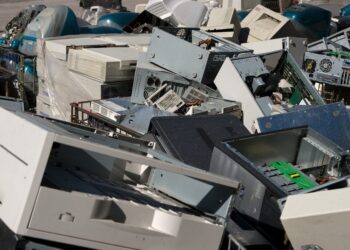
BAN brought the electronic waste trade issues to global attention in 2002 with our documentary “Exporting Harm,” as did later media reports such as the 2008 “60 Minutes” feature. ISRI’s response was to diminish our findings and maintain a stance of free trade as usual.
This has caused many of their own members to break ranks and form the Coalition for American Electronics Recycling (CAER), which fully supports the Basel Convention and moreover has helped draft the bipartisan Secure e-Waste Export and Recycling Act (SEERA). That legislation would ban most of the highly polluting electronic waste exports to developing countries. ISRI is the only organization known to oppose SEERA.
Environmental justice knows no borders
ISRI’s recent EJ statement calls for “the equal treatment and opportunity for all people regardless of race, ethnic origin, heritage, language or economic status; and, to contribute positively to the communities in which our members operate, including the opportunity to be heard.”
This sounds very good to our ears. But is ISRI including the treatment of those communities and people living and working overseas? Is the organization concerned about the impacts of thousands of tons of often hazardous scrap shipments from hundreds of ISRI members every year contributing negatively to the many hundreds of communities in countries such as Malaysia, India, Indonesia, Mexico or Turkey?
EJ knows no borders. It is a global issue and it is desperately needed that groups like ISRI recognize it as such.
ISRI has not been alone in failing to recognize EJ as a serious global issue. To date, agencies of our own government have worn similar blinders. But it’s high time this changed. On May 13, over 150 organizations, including environmental groups and recyclers, signed a letter to President Biden, pointing out the incongruity of the administration’s embrace of EJ and its lack of support for the Basel Convention and its new amendments.
So, it is a good question. Will ISRI’s newly iterated solidarity with EJ mean that the group accepts that a circular economy cannot be built on a circle of poison? That it cannot mean that disempowered communities in developing countries are forced to accept the externalities of pollution and health hazards from richer nations? Can ISRI be considered “the good guys” now?
There is cause for hope. Recycling, of course, is a vital part of any sustainability strategy, allowing us to conserve resources, reduce energy consumption and minimize harmful extraction. But like any industry, recycling can cause serious harm if not conducted with awareness and guardrails that prevent great harm and costs for those downstream.
Recently, I contacted ISRI’s Adina Adler, the organization’s vice president of advocacy, and asked her if ISRI will now support the U.S. ratification of the Basel Convention. Her answer was quick, yet hopeful: “ISRI’s position is under review.”
This review will surely show us to what degree ISRI stands behind environmental justice, both here and around the world.
Jim Puckett is founder and director of the Basel Action Network (BAN), a global environmental justice watchdog working to promote ethical and responsible waste management and trade. In 2009, BAN created the e-Stewards Standard for Ethical and Responsible Reuse, Recycling, and Disposition of Electronic Equipment and Information Technology and e-Stewards Certification to help prevent the global dumping of e-waste. He can be contacted at [email protected].
The views and opinions expressed are those of the author and do not imply endorsement by Resource Recycling, Inc. If you have a subject you wish to cover in an op-ed, please send a short proposal to [email protected] for consideration.
A version of this story appeared in E-Scrap News on June 24.