






No new state has adopted an electronics recycling law in more than a decade. The most recent new law came from Washington, DC in 2014. The action has moved to the 25 states and DC that already have one, as regulators add battery-powered devices, change how manufacturers are billed and hand more control to producer responsibility organizations (PROs).
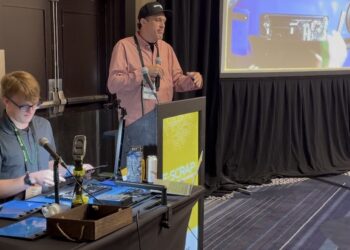
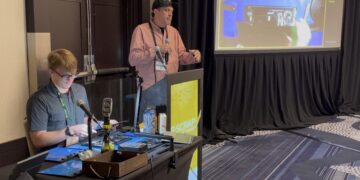
State officials and Jason Linnell, executive director of the National Center for Electronics Recycling (NCER), walked through the changes at an Electronics Recycling Coordination Clearinghouse (ERCC) workshop on Oct. 26 at the E-Scrap Conference in New Orleans.
The common thread between all of these is product scope, Linnell said. States are also still wrestling with targets, convenience standards, markets for problematic materials and how to handle battery-embedded devices.
Wisconsin
Wisconsin’s Natural Resources Board adopted a rule updating the E-Cycle Wisconsin program on Sept. 23, said Eric Flesch, E-Cycle Wisconsin coordinator at the state Department of Natural Resources (DNR). The rule, WA-15-24, amends ch. NR 530 of the state administrative code. DNR’s rulemaking timeline calls for legislative review this winter and an effective date around summer 2027.
It puts into rule the changes from 2023 Wisconsin Act 108, which was signed in March 2024. That law expanded the definition of peripherals, raised manufacturer registration fees and tied manufacturer targets to the weight recyclers actually receive, rather than to sales.
The rule adds digital music players and battery-operated wearables, such as smart watches and fitness trackers, to the list of devices eligible for collection. The DNR also considered digital cameras, radios and walkie-talkies but cut them from the final list.
Battery fires drove the expansion, Flesch said. Improperly discarded rechargeable batteries have caused many fires in Wisconsin, damaging trucks and facilities.
The rule also fixes a timing problem. Manufacturers that register partway through a program year can now be folded in when DNR recalculates targets by March 1, instead of through repeated midyear changes.
Manufacturers that miss their targets pay shortfall fees of 30, 40 or 50 cents per pound, depending on how close they came. The rule sets minimum requirements for waiving those fees. A manufacturer must hit at least 50% of its target to request one.
Waiver requests were essentially nonexistent before 2021, Flesch said. DNR received multiple requests in 2024 and 2025. The criteria largely track guidance the department has used since 2023.
The rule also requires collectors to register only the sites they operate themselves and to certify compliance with broader solid waste rules.
Oregon
Oregon’s modernized E-Cycles program took effect Jan. 1 under HB 3220, passed in 2023. The law eliminated the state contractor program, which NCER had operated, and moved all manufacturers into a PRO system with plans approved by the Oregon Department of Environmental Quality (DEQ).
Two PROs applied for 2026. DEQ approved one, Electronic Manufacturers Recycling Management Co. (MRM), and rejected the other, from Dynamic Lifecycle Innovations. With a single PRO, no coordinating body was needed.
DEQ rejected MRM’s 2027 plan in August. MRM, the only bidder for 2027, had until Oct. 9 to submit a revised plan. As of Oct. 27, DEQ had not posted a decision. The agency’s timeline runs plan review through November.
The law also expanded the device list to include items such as fax machines, VCRs and cable and satellite receivers. It set a new convenience standard: 95% of residents must live within 15 miles of a collection site, with additional site requirements for counties and cities based on population.
The standard is drawing attention from other states, Linnell said. Rural areas still require variances and collection events.
Illinois
Illinois amended its Consumer Electronics Recycling Act through HB 3098, now Public Act 104-0274. The changes take effect in the 2027 program year.
Home audio components and peripherals join the list of covered devices that manufacturers must register and pay for. The law also adds public education requirements for the manufacturer clearinghouse NCER runs and gives counties more flexibility on collection events, particularly rural events that struggled to meet minimum truckload weights.
Hawaii
Hawaii’s SB 1298, enacted in 2025 as Act 162, added peripherals and legacy devices to the state’s program. It also phased in the manufacturer target, which will reach 70% of the weight of devices sold two years earlier in 2027.
Collection volumes have risen with the targets, Linnell said, but the increase has caused consternation among manufacturers trying to meet them. The Hawaii Department of Health must report to the Legislature on possible changes before the 2028 session.
California
California, the only state with a consumer-paid electronics fee, began charging it on battery-embedded products Jan. 1 under SB 1215.
Unlike EPR programs, manufacturers do not run take-back for these products. Recyclers submit claims to the state for reimbursement. Linnell said manufacturers have filed notices for more than 60,000 devices across many product categories.
Maine
Maine became the first state to pass an EPR law for vapes and e-cigarettes with LD 1519, signed in April. Producers must submit a stewardship plan by November 2027, and the program includes a $2 bounty per returned device.
Between 70% and 80% of the devices sold in Maine are illicit, said Andrew Pomiak, environmental specialist at the Maine Department of Environmental Protection. Many are imported directly from overseas and have substandard lithium-ion batteries, he said.
The tobacco industry raised concerns about funding a program with that many illicit devices on the market, Pomiak said. Schools have been among the law’s biggest backers.
Lack of resources
Running these complex programs falls hard on lean state staff. During the audience Q&A, a Connecticut regulator said the state’s electronics program once had three full-time employees. After pandemic-era departures and a retirement, it is down to one person.
That person handles registrations for more than 100 manufacturers, reviews recycler applications and permits, manages the budget and runs outreach, from newspaper and TV spots to ads in movie theaters. Connecticut has tried to add new device types but lacks the staff, the regulator said.
“It’s not because we don’t want to,” the regulator said. “Just lack of resources.”
Linnell said workload depends on how a law is built. In Connecticut, the agency approves recyclers and sets the rates billed to manufacturers each year. Oregon moved to a PRO model partly because the state did not want to keep running its contractor program.
A Vermont regulator said the state runs its own program, probably the only truly state-led one in the country. Manufacturers did not want a PRO when the law passed, so the state became the implementer.
Vermont’s statute spells out covered products, and reopening it is difficult. Smart watches show the problem.
“Apple watches are also phones, so we can’t even say they’re computers because phones are excluded,” the Vermont regulator said. States like Wisconsin can add devices by rule instead.
Size is another constraint. Vermont gets complaints about high prices and having only one recycler, but bidders have told the state its market is too small. Manufacturers have urged it to coordinate with neighboring states.
“We live in the United States,” the regulator said. “The states all do their own thing, and that’s kind of how it is.”
What counts
Electronics collection still happens in states without laws, but much of it goes uncounted.
“There’s national programs, there’s state programs, there’s local programs that happen and are collecting,” Linnell said.
Ohio has an extensive community collection, funded through local fees or taxes. However, no one knows how much those programs handle, he said.
“No one’s reporting in some of those states about what is actually happening,” Linnell said.
The gaps show up when collection goes wrong. Iowa, which has no electronics law, ended up with warehouses full of CRTs, said Steve Noble, electronics recycling specialist at the Michigan Department of Environment, Great Lakes, and Energy.
“That means somebody was collecting,” he said. “They’re just skimming off the good stuff.”
Michigan is only now finishing a five-year cleanup of a similar problem in its Upper Peninsula, Noble said.
Riding the wave
The existing laws passed in waves between roughly 2006 and 2010, and manufacturers’ clout varied from state to state, Linnell said.
“There were certain states where certain manufacturers actually had better lobbyists than others, and they’re able to exempt themselves from certain laws and not in other states,” he said.
The states left are the hardest. A law often puts new duties on a state agency, Linnell said, and “if there’s any whiff of opposition, it really is easy to stop it.”
Katie Reilly, vice president of environmental affairs and industry sustainability at the Consumer Technology Association, added that legislatures bring their own politics.
“Even if you have all the stakeholders aligned pointing in the same direction, there are other variables about why things may or may not move forward,” she said.
Massachusetts has tried for more than 20 years to pass a law, and could still pass one in any session, Linnell said. In January, a state EPR commission created under a 2024 climate law recommended electronics EPR. It noted two pending bills, H.1015 and S.653, but endorsed neither.
Batteries may be the push that moves more states, Linnell said.
“The focus on batteries may be something that brings more states to look at some of these laws,” whether those laws target batteries alone or battery-containing products, including electronics, he added.