About 600 electronics recycling, repair and manufacturing stakeholders convened in Austin, Texas, for the first annual Electronics Sustainability Summit hosted by electronics certification organization SERI.
The Oct. 22-24 event featured three days of programming that broadly sought to cover electronics “circularity,” and did so with three connected tracks exploring the first use, repair and ultimate recycling of electronics. It drew small repair firms – particularly for the first day of the show, which focused on mobile device repair – e-scrap processors, industry advocates and major OEMs alike.
It’s the latest iteration of the event that was formerly branded as the E-Reuse Conference, which launched in 2010 and evolved from a previous event called the International Computer Refurbisher Summit. SERI purchased and rebranded the conference early this year.
Apple makes major shift toward repairability
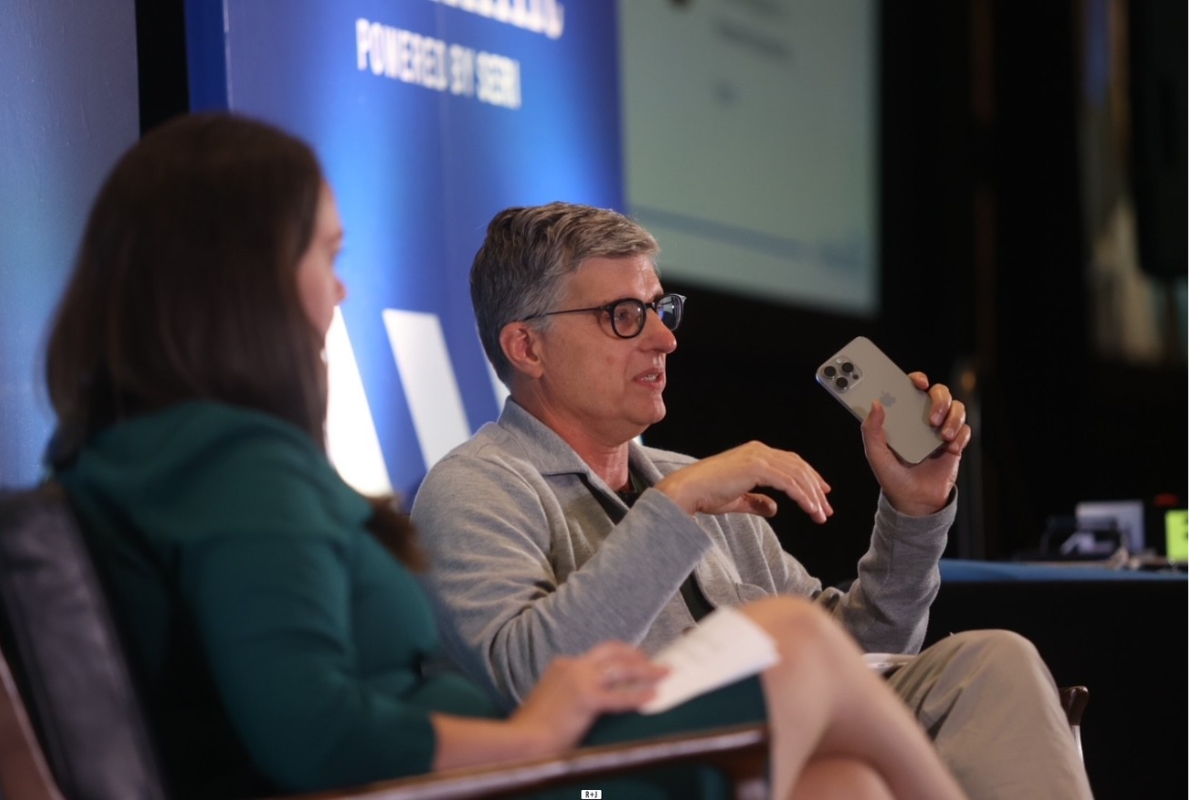
During an opening plenary discussion, Tom Marieb, Apple’s vice president of product integrity for hardware engineering, said the company is evolving its stance on repair.
“We’re here, and we’re listening,” Marieb told the audience of refurbishers and repair advocates. He explained the company is “trying to go less secretive in this space, we’re trying to talk a little more openly, discuss our goals, discuss where we’re headed, as well as take ideas in.”
That was particularly visible with the company’s recent launch of its iPhone 16 lineup. Sarah Kim, director of the Electronics Sustainability Summit and host of the conversation with Marieb, noted that “our friends at iFixit have actually called it the most repairable iPhone yet.”
Marieb agreed that the iPhone 16 has more individual modules that are repairable than in any previous iPhone model.
“The thing that we are very excited about is our battery adhesive,” he added, describing it as a “liquid ionic battery adhesive.”
Apple – and many OEMs – have long designed smartphones that have difficult-to-remove batteries, a design choice that has drawn criticism from repair advocates. Groups including iFixit have tried to develop ways of easily removing the adhesives, including using chemicals. Now, Apple has begun using a different type of adhesive that is removable with a small power source, such as a 9-volt battery, and a low current. Marieb noted adhesive removal in previous designs was a “difficult process to do, unfortunately. This makes it so much easier.”
An Apple technician demonstrated the process onstage with two different methods. First, the technician used what a homemade system might consist of, a 9-volt battery and a couple alligator clips coming off the 9-volt terminals. One clip attached to a part of the in-phone battery, and the other went to a grounding point. Using that method, the battery was rendered removable in about 90 seconds.
Second, the technician demonstrated a more “industrial device,” Marieb explained, which will be placed in Apple stores and will also be available for purchase. It requires a higher voltage source but removes the adhesive faster.
It took years of developing the adhesive with suppliers, he added, to ensure that the devices retain the same level of durability and reliability when they’re dropped, while still allowing for easy battery removal.
The new adhesive removal method is only available on iPhone 16, not iPhone 16 Pro, Marieb noted, because the company wants to observe how it works before deploying it on a wider scale.
Additionally, in Apple’s iOS 18, the company included “repair assistant,” a software tool designed to “calibrate” replacement parts with the device. According to Apple, the tool helps facilitate back glass, battery, display and camera repairs on iPhone 12 models and later; display and camera repairs on iPad Pro models; and display repairs on iPad Air models.
EPA considering major overhaul of diversion reporting
The U.S. EPA hopes to publish an update to its once-annual Facts and Figures report, covering national recycling rates, next year. But it will use an entirely different methodology and won’t be comparable to the previous reports.
In a keynote address at the summit, EPA Office of Resource Conservation and Recovery Director Carolyn Hoskinson provided an update on the Facts and Figures report, which was last updated in 2020 with data covering 2018. After publishing the 2020 report, “we basically found that our data was horrible” because the agency hadn’t taken a hard look at its methodology for a while, she said. A lot of the information was “very limited,” and sometimes even included data from just one community being extrapolated nationally.
“We’ve designed a whole new methodology for Facts and Figures. We hope it will be coming out next year,” Hoskinson said. “It will not be able to be compared to the old report,” she added, because “the methodology will be completely different.”
The 2020 report found e-scrap had a 38.5% U.S. diversion rate in 2018, with 2.08 billion pounds of electronics recovered out of 5.40 billion pounds generated.
Repair advocates pursue copyright exemptions
During a meeting of the Repair Association held at the summit, members of the board of directors updated the group on their latest requests for digital software lock exemptions.
Every three years, the Library of Congress authorizes exemptions to the Digital Millennium Copyright Act, effectively allowing consumers and repair firms to circumvent software locks without violating copyright protection.Other exemptions have allowed refurbishers to legally unlock phones to be used with any mobile carrier, which is important for resale value.
This year, repair advocates at iFixit requested exemptions to digital locks that prevented legal repair of some commercial food preparation equipment. The main target? Ice cream machines at McDonald’s, which malfunction with alarming frequency. At any given time, nearly 15% of the McDonald’s ice cream machines in the U.S. are broken, according to McBroken.com, a website that tracks where such machines are currently out of service (and, after a recent partnership with Wendy’s, that also labels nearby Wendy’s restaurants).
A week after the Electronics Sustainability Summit concluded, the U.S. Copyright Office granted the exemption for the ice cream machines and an additional limited array of commercial food preparation equipment. But as iFixit noted, the ruling does not allow iFixit or other organizations to share or sell repair tools for that equipment, leaving the possibility of wide-scale ice cream machine repair “largely theoretical.”
Awards given to electronics stakeholders
During an Oct. 23 evening reception, summit organizers presented awards recognizing various achievements in electronics sustainability.
The Jim Lynch Award, named for a cofounder of the first iteration of what is now the Electronics Sustainability Summit, recognizes individuals who “exhibit selfless service to sustainability in the electronics industry and those who are part of it.” There were two winners of the award this year: Billy Johnson, chief lobbyist at the Recycled Materials Association, who passed away suddenly at his home in September; and Gay Gordon-Byrne, executive director of The Repair Association.
Petri Hayrynen, global head of product marketing at Human Mobile Devices, or HMD, received the Innovation Award, which “recognizes individuals whose commitment to shattering norms and thinking outside the box has positively impacted the electronics industry and those who are part of it.”
Billy Marion, vice president of ITAD at the Association of Service, Communication, Data, and ITAD Providers, or ASCDI, earned the Rising Star Award recognizing “recent additions to the world of electronics sustainability who quickly come to represent the attitude and character we want to define our community.”
Google received an Advocacy Award presented by Kyle Wiens, CEO of iFixit. Wiens said the award recognizes an organization that has done the most to advance the right to repair and the broader industry, among other points. Google earned the award for its work supporting legislation banning parts pairing – the repair-hampering practice of linking components with devices – in Oregon and Colorado.
Other takeaways
- Choosing her words carefully, Hoskinson said during her keynote that the U.S. EPA is “committed” to “exploring” Basel Convention ratification. She said that’s as much as the agency is currently willing to state.
- While the company remains deeply engaged in sustainability work, Google prefers to avoid the term ESG, which refers to environment, social, governance. In the U.S., the term has come to evoke various wider ideological debates, said Ted Briggs, sustainability program manager at Google. Briggs added that ESG often brings up “these ideas of these trade offs between environmental and economic goals.” The OEM isn’t alone in noticing the term has gained negative associations that may have little to do with what it originally referred to – last year, CNN interviewed an ESG advocate who acknowledged the term had become “too politically charged” and should be replaced.
- Even if the term itself is controversial in the U.S., companies still understand the benefits when they’re framed in the correct way. The easiest way to win the ESG argument in America is to point to the commercial benefits it can bring a business, according to Sebastian Foote of consulting firm Bloom ESG. Those benefits can include attracting new and different types of investment, and even lower borrowing costs, he said.