






The following is written by experts at Eunomia Research & Consulting.
The US per capita generation and consumption for packaging increased 8% between 2021and 2023 to nearly 400 pounds annually, according to a forthcoming report, equivalent to a large refrigerator, outpacing personal consumption growth. Meanwhile, global plastic packaging use has increased by 13% since 2018.
Seven states have recently passed Extended Producer Responsibility (EPR) as a tool to better manage packaging with many other states looking to follow suit.
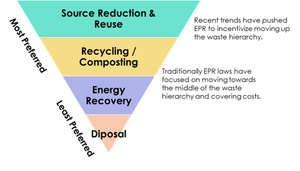
Traditionally, EPR has been a policy tool to transfer the financial responsibility of managing material at its end of life from communities to producers.
But EPR is evolving beyond this to include mechanisms to encourage reuse and promote design changes to enable recycling and reduce the amount of packaging placed on the market. These mechanisms are known as “source reduction.”
The missing link in effective EPR plans – source reduction
The first states to pass EPR for packaging were Maine and Oregon in 2021, a full 30 years after Germany and nearly 20 years after Ontario passed similar legislation. There are, however, benefits to being a late adopter: where European and Canadian EPR programs primarily focus on investment and service needs to recycle more, US laws have mandates to reduce the amount of packaging introduced, helping states to leapfrog international peers on the waste hierarchy.
California is the first state to include source reduction requirements in their legislation. The Plastic Pollution Prevention and Packaging Producer Responsibility Act (SB 54) requires a 10% reduction in single use plastic packaging and food service ware by 2027, 20% by 2030, and 25% by 2032 compared to a 2023 baseline. Within these targets, minimum reductions must be achieved through reuse and refill systems, set at 2% by 2027, 4% by 2030, and 10% by 2032. Other states’ approaches include the use of eco-modulated fees to incentivize reductions in material use and increase reuse (Colorado), or to require the Producer Responsibility Organization (PRO) to set a source reduction target in their program plans (Washington and Minnesota).
The strategy behind source reduction
Businesses can reduce packaging use through packaging redesign and reuse system deployment.
- Packaging Redesign (Material reduction at source): This approach reduces packaging through design changes that minimizes material use while maintaining product performance.
- Light weighting: reduce the weight or thickness of packaging components while maintaining the necessary good protection and performance.
- Right sizing: optimize the dimensions, proportions, and design of packaging so that it uses only the amount of material necessary to protect, contain, and present the product.
- Elimination: remove unnecessary components from packaging.
- Concentration: reformulate products so the same performance is delivered with less product per use, requiring less packaging per functional unit.
- Large format: increase package size or volume per unit, reducing the amount of packaging needed per unit.
- Material substitution: Replace materials with lower weight alternatives or, in the case of plastic reduction, shift to a non-plastic packaging format.
- Reuse Systems (structural source reduction): A transformative approach is the introduction of reusable packaging systems, which require coordinated changes across the value chain. Interoperable systems depend on standardized packaging designs and convenient return and refill infrastructure, enabled through multi-stakeholder collaboration. These include:
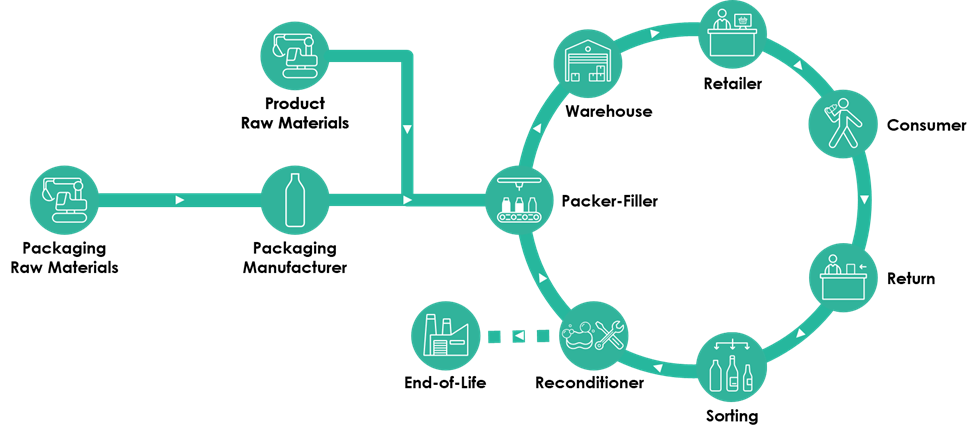
- Prefill: consumers buy packaged products in packaging that is designed to be recirculated multiple times. After the packaging is returned it is cleaned and ultimately reused (See Figure 1). The producer or a third party ultimately owns the packaging.
- Refill: consumers bring their own packaging to fill through in-store dispensing or filling of a product.
These strategies support source reduction compliance while lowering material costs and EPR fees, with reusable packaging exempt from fees in California and some other states.
Leading the conversation on source reduction
Eunomia, with our study partners Perpetual, InterEthnica, and Touch Design, recently completed the SB 54 Source Reduction Material Design needs assessment for the California Department of Resources Recycling and Recovery (CalRecycle).
This needs assessment is the country’s first to focus only on source reduction, rather than performance and cost of the recycling system. Our team evaluated the actions and investments required of the PRO, producers, and other businesses to achieve the reuse and other source reduction requirements set out in the law. As the requirements are rapidly approaching in 2027, 2030, and 2032 we needed to consider the strategies and infrastructure feasible in these timescales.
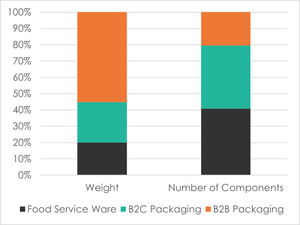
SB 54 is unique in covering business to consumer (B2C) packaging, business to business (B2B) packaging, and single-use food service ware, with source reduction targets for both plastic weight and number of components – a global first.
Our analysis of plastic use in California showed that, today, food service ware contributes the greatest share of plastic components. In contrast, B2B packaging dominates the weight of plastic used (55%) – with food service ware and B2C packaging being smaller in this metric (see Figure 3).
We assessed a range of source reduction strategies for different plastic use cases, considering technical feasibility, consumer preferences, business models and supply chain complexity, regulatory constraints, and health and safety requirements.
Drawing on expertise from packaging designers, insights from throughout supply chains (e.g., supermarkets, manufacturers) and consumers, we screened out several strategies. While some strategies are technically possible (e.g., selling products in significantly larger containers), we identified substantial barriers that would limit their real-world uptake and impact.
Some strategies can meaningfully reduce the weight of plastics used, but would do little to reduce the number of plastic components in circulation. Take pallet wrap, for example: while a large volume of plastic is used to wrap pallets, reducing its weight – through paper or reusable wrap – makes little impact on the number of components used in the system. Similarly, light weighting strategies don’t impact the number of plastic components in the system. At a systems level, our analysis showed, it is more efficient to focus on strategies such as reuse or materials substitution that generate meaningful reductions in both weight and number of components.
While many source reduction strategies exist and could be applied across numerous areas of plastic use, meeting reduction targets requires a coordinated approach – on just a few high impact areas. This includes having a strong focus on single use plastic food service ware by implementing reusable systems at closed loop settings such as stadiums, switching to non-plastic formats, and eliminating unnecessary items. B2B reusable packaging systems are a good approach because they minimize consumer burden and eliminate the need for incentive programs and costly return infrastructure typical of B2C contexts. They also establish core infrastructure such as sorting and washing facilities, that can later support broader B2C systems, making B2B a lower risk steppingstone.
Our analysis provided two pathways for CalRecycle to meet source reduction requirement in the 5-year period. These pathways illustrate that while the challenge is complex and ambitious it can be addressed through targeted, achievable changes in key industries.
The first of these pathways would lead to the following changes by 2032:
- Nearly half of all restaurants, stadiums, event spaces, school cafeterias etc. who currently supply single use plastic food service ware on site shift to reusable cups, plates and cutlery;
- More than 10% of B2B sales are delivered in reusable packaging (think containers for oil or bakery ingredients) that when finished can be picked up when a new order is delivered and then refilled;
- 20% of unnecessary plastic food service ware are eliminated, such as not providing plastic cutlery in some to go orders; and
- Nearly 20% of plastic food service ware and 10% of plastic packaging shift to a non-plastic material. This could include using bamboo utensils or packaging an item in glass rather than plastic.
Meeting these targets would lead to significant investment in greener infrastructure, create thousands of jobs, and reduce waste. Overall, the scenario described above would generate capital investment of $900 million, support 2,700 new jobs and avoid 700,000 tons of new single use plastic manufacturing every year, resulting in cleaner, and more environmentally friendly communities.
Is source reduction in EPR here to stay?
The US is still early in its source reduction journey. Circular Action Alliance, the designated PRO in nearly all EPR states, will begin setting additional source reduction targets in Washington and Minnesota, as required in their program plan. These targets will set the standard for source reduction targets that are not required within legislation. Moving forward, we may also see if states choose to include specific source reduction targets similar to California, such as New York, which was unable to pass its EPR legislation last year, or to task the PRO with setting the target as part of its program plan.
While the analysis we carried on behalf of CalRecycle demonstrates that the 2032 targets are feasible, the specific strategies to meet them will be determined by the PRO and its producers. Our analysis shows that under the short timeline to 2032 starting with reusable food service ware and then moving to B2B reusable systems will support meeting the reuse and refill target while a strong focus on material substitution and elimination will help contribute to the remaining 15% as these strategies contribute to both weight and component reduction.
There are upcoming reporting deadlines for all producers.
By May 31st annual supply reports need to be submitted for California, Colorado and Oregon, while simplified supply reports for Minnesota, Maryland and Washington are due. California has an additional annual source reduction report due this day and the 2023 baseline producer report needs to be confirmed or submitted within 30 days of California regulation being approved.
Producers will be required to submit additional supply data and their individual California source reduction plans to the PRO by August 1st at the latest. These plans must:
- Estimate the amount of plastic reduced between 2013-2023
- Outline the planned reductions by weight and number of components, for 2027, 2030 and 2032.
- Review plastic packaging formats to evaluate the suitability of different source reduction strategies and estimate potential reductions from each approach.
These plans will provide the PRO with critical insight as they develop their overall program strategy. As California is the fourth largest economy in the world, coordinated investment and strategy will likely be required to meet the targets, but will lead to substantial environmental impact.
Find out more about meeting California’s source reduction requirements by watching the recording of Eunomia’s webinar held in March.