
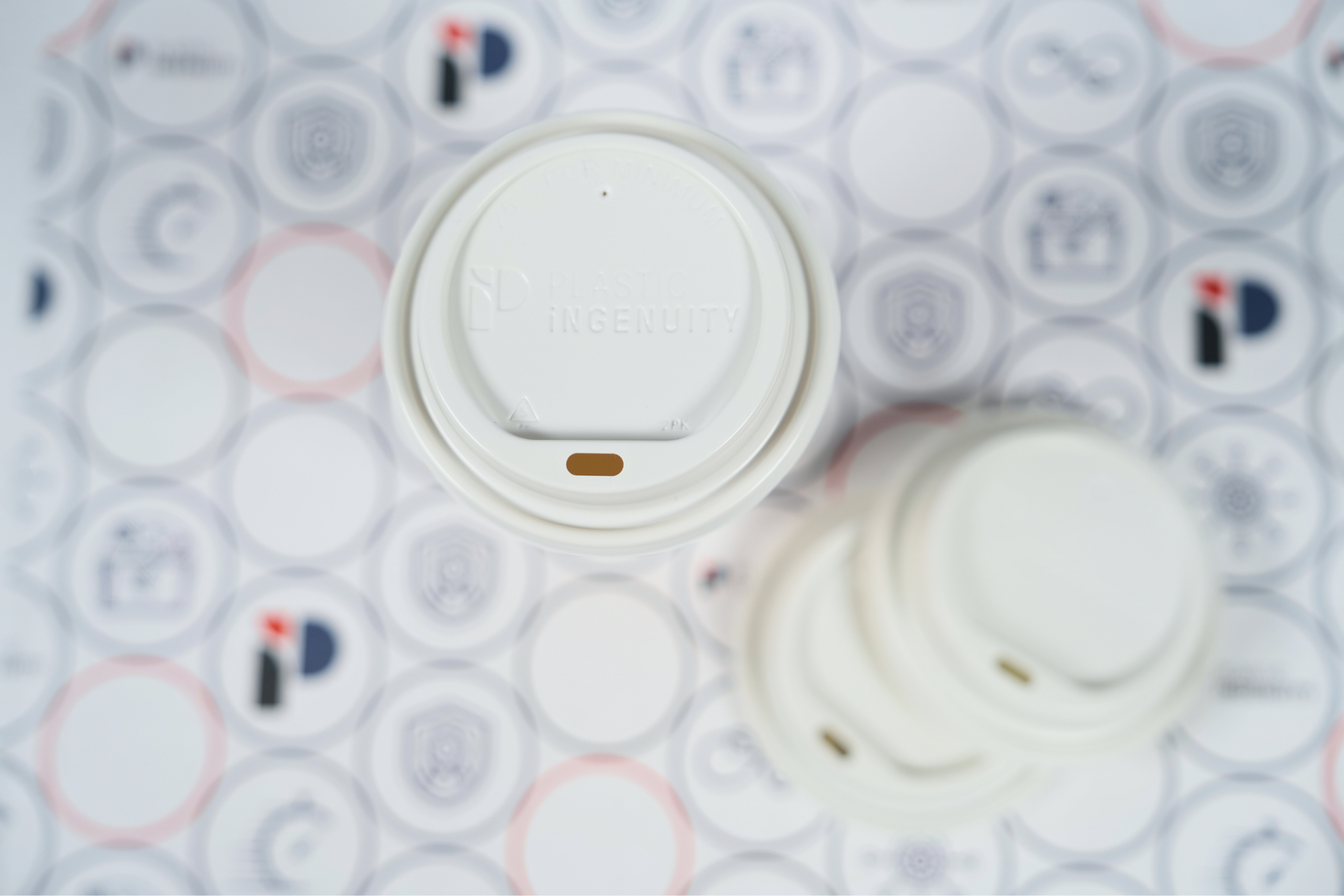
Wisconsin-based thermoformer Plastic Ingenuity (PI) is incorporating recycled PP resin from PureCycle Technologies into its coffee lid production.
The lids will be available with 25% to 100% recycled content, and although the primary color will be white, natural and other color options are available, Zach Muscato, director of sustainability and innovation at PI, told Plastics Recycling Update..
“One of the reasons we’re so excited about this partnership with Plastic Ingenuity is their relationship with brand owners that take sustainability seriously,” said Christian Bruey, director of sustainability and external affairs at PureCycle. “We believe these coffee lids that are made with PureFive resin are just the beginning of a partnership that will greatly improve the circularity of polypropylene.”
Developing end markets
End markets are crucial to making recycling systems viable. Plastic Ingenuity is among the Association of Plastic Recyclers (APR) Recycling Demand Champions, recognized for its commitment to expanding the use of post-consumer recycled (PCR) content in its packaging solutions.
“This commitment has strengthened our relationships with sustainability-focused customers and opened new opportunities for innovation in material science and design,” the company said on the APR site. “Over the past several years, our use of PCR has accelerated significantly as supply chains have matured and technology has advanced, enabling us to achieve higher PCR content levels without compromising performance.”
PI also has transitioned packaging for Wahl hair clippers from PVC – a challenging polymer to recycle – to more recyclable PET.
“Plastic Ingenuity is a strong example of how forward-thinking manufacturers are leading the transition to more sustainable packaging,” Bruey said.
APR also recently recognized PureCycle for its innovative work in recycling curbside-collected PP into clear, food-grade packaging – “a feat never before accomplished.”
APR owns Resource Recycling, Inc., publisher of Plastics Recycling Update.
PureCycle looks to coffee lids for high volumes, margins
In the two most recent PureCycle investor calls, CEO Dustin Olson pointed specifically to coffee lids among high-value applications for recycled PP.
“One of the biggest successes has been with white thermoform coffee lids,” he said in November 2025. “This led to progress with three of the top five quick-service restaurant companies, or QSRs, and we expect to be shipping into stores for a top-five QSR group in the fourth quarter and ramping in 2026.”
In a late February investor call he said, “We continue to make progress with our first QSR coffee lid project, good product fit, excellent trials and good relationship building between the end brand and converter.” Olson added that PureCycle was in discussions with four more brands, “but these same customers also manage a growing cold beverage category that is taking market share.”
In the same call, Olson said that although adoption of PureCycle’s recycled PP resin has been slower than expected, he was optimistic about demand coming from consumer pressure, state-level legislation and overseas demand.
He added, “Brands are launching more products in this high incremental margin category. Additionally, brands are also transitioning to PP in 12 states that have already passed single-use polystyrene bans. This will give us additional tailwind to our product in the beverage containers.”
Earlier in February, PureCycle and packaging company Toppan announced they had developed a snack bar wrapper containing more than 30% recycled content using PureFive resin.
PureCycle’s flagship recycling plant in Ironton, Ohio, removes impurities such as dyes and additives from post-consumer polypropylene, resulting in virgin-quality resin.
Procter & Gamble developed the proprietary recycling process and in 2015 licensed the technology to PureCycle. Unlike chemical recycling processes like pyrolysis, solvent-based or dissolution recycling does not change the molecular structure of the polymer.
Recently PureCycle received a €40 million grant toward its project in Antwerp, Belgium. The company also is working on a plant in Thailand, with groundbreaking scheduled in the second half of this year in Rayong.
Progress on the company’s other US plant, planned for Augusta, Georgia, still hinges on refinement of the so-called Gen 2 dissolution recycling technology, which offers scaled-up production capacity from the current iteration.