

Artificial intelligence is a key element of increasing plastic recycling, panelists at the 2024 Plastics Recycling Conference in Grapevine, Texas, said last month.
It will also be vital in meeting new legal requirements, the industry experts added, though there’s certainly still questions left to answer.
The discussion was part of the session “AI and Plastics Recycling: What’s Coming Next,” which featured Rey Banatao, director and project lead at Google X, Jiri Foukner, global business development manager of plastics recycling at Siemens, Matanya Horowitz, founder and CEO of AMP, and Rebecca Hu, founder and CEO of Glacier. It was moderated by Jon Powell, founder of Apex Catalytic and formerly of Closed Loop Partners.
Banatao explained that Google X is an early stage incubator arm of Alphabet, Google’s parent company, that’s “interested in figuring out how to leverage the best of AI technologies and platforms that we’ve developed.”
That includes using AI for object or image recognition to solve coming material challenges. Banatao said Google X is particularly interested in chemical recycling and how AI can interact with it. For example, it’s working on an AI model that could predict what effect the material it encountered would have on pyrolysis oil.
“We’re trying to look at how can we create tools and platforms that help derisk the techno economics of that and make that happen at a faster pace?” Banatao said. “Those two buckets, waste and feedstock, how that feeds into recycling and then the relationship between that and then the recycling process itself? How do we speed that up?”
Foukner said Siemens is in the middle of developing generative AI for industrial use, to allow it to self-program and speed up repairs.
At AMP, Horowitz said the goal is to use AI “to try to solve some of the main challenges of the recycling business.”
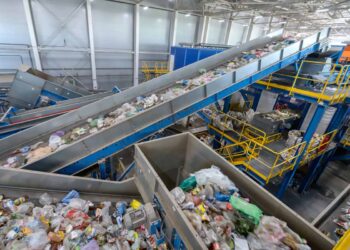
“What we’re best known for are robots that go into existing recycling facilities and help automate the sorting process,” he said. “We have hundreds of those robots deployed all around the world, but over the last several years, we’ve really had to focus on how can we use artificial intelligence to change greenfield recycling facility designs?”
AMP is working on several such projects now, he added, using AI to “tackle some of the central problems of the industry: Improve the fundamental economics of the sorting process, handle dirtier materials, sort materials out at higher purities.”
Hu said Glacier, similar to AMP, started out focused on purpose-built robotics enabled by AI to improve recovery rates in recycling facilities, but is now thinking about how AI, data and partnerships could improve the whole value chain.
“The ability to drive outcomes within the four walls of a recycling facility are certainly significant and there’s a lot of low hanging fruit there,” she said. “But to really think about pushing circularity in totality, you really have to involve all of these other stakeholders as well.”
Nuance is key in data reporting
There are plenty of challenges to face in reaching those goals. Hu noted that from a data enablement perspective, “we’re trying to do something pretty incredible, which is to basically taxonomize the entire landscape of stuff.”
“So the question becomes what is the right taxonomy to support?” she asked.
Extended producer responsibility legislation and other laws are helping to define that, she said, but it’s hard to know if AI capabilities should be built toward returning information on increasingly niche types of materials, or another way of identification, such as brand.
“I think there’s use cases for each layer of information, but the ultimate goal is really to be able to generate as much rich information about any given item coming through the recycling or the waste stream as possible,” she said.
That leads to another challenge, Hu added: There’s a growing ability to produce “massive mountains of data,” but she said a data overload isn’t helpful, and can also lack necessary context.
“That doesn’t create any action. In fact, it creates a lot of indecision and paralysis,” she said, making the challenge to understand “not only how do we extract all of that rich data, but how do we actually deliver it to the relevant stakeholders in a way that they can parse it and act quickly on that information?”
Data privacy is another concern, Matanya said. The way AMP has addressed the problem is holding the data under non-disclosure agreements that allows AMP to use the data to further train its AI models, but restricts the company from releasing the data in any way that’s individualized. The agreements also allow MRFs to use the information as they need.
“We’re pretty explicit about it because we think it’s an important question,” he said, especially as data on capture rates and contamination could also be useful to municipalities, brands and lawmakers.
Making sure there’s access to AI at different price points is also important, Hu added.
“We really want to make it possible for literally every MRF across the country, even the ones that are in more rural communities processing fewer tons, to be able to reap the economic benefits of technology like this by putting it at the right price point with interesting pricing models,” she said.
Moving into the future
Looking ahead, Hu said there’s a lot of customer demand for container line picking and film and flexible picking, as well as for bringing all parts of the packaging value chain together to design for recyclability.
“As we broaden our aperture to think not only about MRFs, we see a lot of value in certainly going downstream,” she said. “So we’re starting to work with these reclaimers that are accepting that material and thinking about how to clean it up better or improve their own yield.”
Matanya said AMP is also looking at positive sorting of containers, quality control of containers and quality control of fiber residue lines. Presort is also on the agenda, he said, though “that ends up being pretty hairy.”
Banatao said Google X is working on partnerships with machine companies, feedstock optimization for specific pyrolysis applications and how flexibles could be optimized for mechanical or chemical recycling.
“What I’m excited about for this year is expanding our platform into other categories, obviously beyond just chemical recycling,” he said. “We’re already starting some work on mechanical recycling. I’m really interested in textile waste and the opportunities there.”
A version of this story appeared in Resource Recycling on Apr. 9.