



This article appeared in the February 2020 issue of Resource Recycling. Subscribe today for access to all print content.
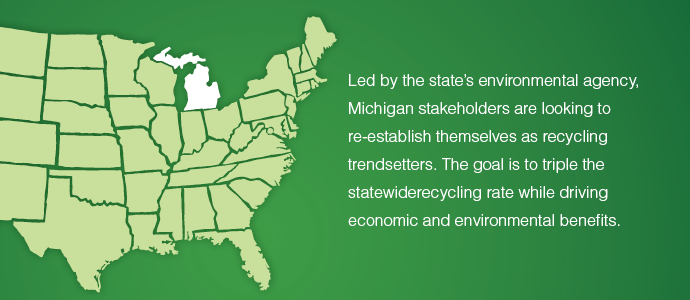
The state of Michigan is embarking on a new era of materials management, putting renewed emphasis on waste reduction, diversion, recycling and composting activities.
Like many other states, Michigan saw stagnant growth in recycling and composting in the past decade. While the recycling rate is up from 15% in 2015 to 18.1% in 2018, representing an additional 546,000 tons per year diverted to recycling, Michigan still lags near the bottom of Midwest states in recycling rates.
But with a variety of stakeholders working in a coordinated manner in the areas of data analysis, outreach, system funding, regional market development and more, Michigan is poised to once again become a national leader in materials recovery.
Big benefits from boosting recycling rate
Step one of the process was to dig into the numbers and outline why exactly the state should be focusing on diverting more.
Recent work by consultancy Resource Recycling Systems (RRS) on behalf of the state of Michigan updated recycling volumes and rates across the state, analyzed today’s challenging market forces and changing recyclables values, and identified supply chain gaps thwarting progress in the state.
Growing Michigan’s recycling rate to 45% would result in an additional 2.7 million tons of recovery from the estimated 8.8 million tons of Michigan-generated municipal solid waste that is currently landfilled or incinerated.
Some of the most compelling data supporting increased recycling is seen in the benefits to Michigan’s economy.
Using economic impact modeling, the recycling, reuse and recovery sector (RRR) would add over $33.8 billion to Michigan’s economy if the state’s recycling rate grew to 45%, with over $9 billion in added labor income. In fact, in achieving the 45% recycling rate goal, the Michigan RRR sector would edge out the transportation and tourism sectors, two of the 10 largest contributors to Michigan’s economy.
Further, while the RRS analysis acknowledged current commodities challenges (of which this readership is well aware), there are several bright spots in the Midwest that help to explain why recycling attention makes sense, even in the current industry climate.
First is Michigan’s distance from the coasts, a factor that helps insulate entities in the state from the export headaches caused by China’s National Sword. In recent years, substantially less volume was flowing from Michigan overseas than from its West Coast counterparts. While prices are historically low for primary recyclable commodities, materials from Michigan recycling processors are still moving.
Second, while mixed paper prices are depressed and corrugated cardboard sluggish, Pratt Industries’ recent opening of its Wapakoneta, Ohio plant, as well as investments and upgrades increasing capacity by mill operators in Michigan, demonstrates the long-view implications of the ongoing growth of e-commerce and the rise in containerboard use being spurred by the shopping shift. Increasing capacity is expected to improve both demand and pricing, at least for some fiber grades, into 2020 and beyond.
Providing support and funding
Under the leadership of Gov. Gretchen Whitmer, the Michigan Department of Environmental Quality has become the Department of Environment, Great Lakes and Energy (EGLE). But the move is more than a name change.
 Combining energy, water, and environment into one department allows the state to clearly align its mission with action. Recognizing the broad environmental benefits of materials recovery demonstrates a cohesive message across these sectors.
That strategy has been in development in recent years. In 2018, with support and justification from a variety of stakeholders (led by the Michigan Recycling Coalition), the Michigan legislature approved $15 million in annual funding for recycling. This included materials management planning, local recycling program improvements, and recycling market development.
The new funding has allowed Michigan to support recycling market development projects. A portion of the funding will be used to support projects that help recycling facilities meet end market specifications and to help businesses turn recycled materials into new products. Organics, mixed plastics and glass are the primary targets of grants focused on market development that were issued in 2019. In that first round, over $6 million was requested by 17 projects, with over $2 million being awarded to six projects.
EGLE has also helped communities transition from bins to carts for curbside recycling collection and has supported Detroit in efforts to establish curbside recycling. Additionally, funds are being used to expand processing infrastructure in the city of Marquette as well as in the state’s Upper Peninsula and in the state capital of Lansing.
In 2020, funding will be available to support recycling infrastructure projects.
Leveraging partnerships
Though the expansion of grant funding is a strong start, state officials are also working to develop deeper levels of coordination across the value chain.
EGLE is actively working to leverage private and public sector investment as everyone works together to improve end-market opportunities, strengthen the supply chain to feed those buyers, and create demand-pull for the recycled-content products and packaging that will drive a circular economy. While still in its early stages, EGLE is engaging with end markets, trade associations, universities and communities to invite partnerships that will leverage state dollars to maximum effect.
“Collaboration is a key component of the success of our work to increase recycling because together we can achieve the energy savings, water protection, greenhouse gas reductions and jobs that come from reducing and using waste sustainably,” said Liesl Clark, EGLE director.
The first partnership demonstrated in these early days of program development was a joint announcement of grant awards in Kent County, home to Michigan’s second largest city (Grand Rapids) and the largest hub-and-spoke materials recovery facility in the state.
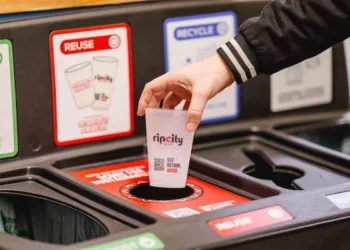
A $175,000 grant was awarded to Kent County by EGLE for equipment to divert additional construction and demolition (C&D) materials from landfill, which was paired with a $20,000 grant award from the Foodservice Packaging Institute (FPI) to assist the county in education and outreach around accepting, processing and recycling paper and plastic cups.
In addition, the Grand Rapids Public Schools district was awarded $258,000 from EGLE to improve the district’s collection capacity by 400% district-wide.
Finally, The Recycling Partnership and Michigan EGLE are currently working to decrease recycling contamination and improve quality with targeted education and data collection efforts. Funding could support up to $3 per household for recycling education efforts in selected communities.
Many more such match-grant opportunities are being teed up as the state actively invites partnerships. Brands, trade groups and manufacturers can benefit by leveraging their dollars in a state willing and ready to match their investment.
Engaging with communities, markets and more
Another important component is open dialogue to shape long-term planning.
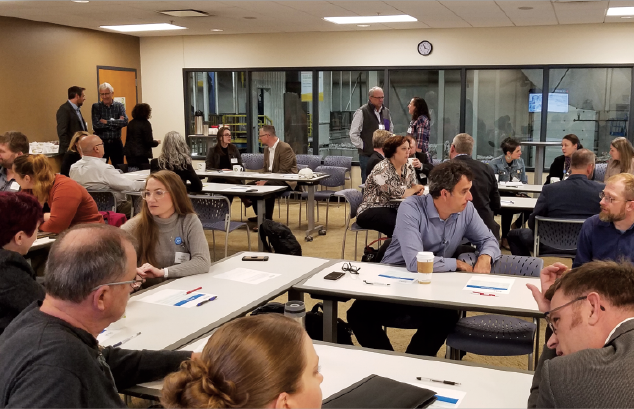
To that end, EGLE is hosting a series of engagement forums facilitated by RRS and held around the state in both rural and urban communities. These Regional Market Engagement Forums are bringing together community leaders, recyclers throughout the supply chain, end markets and manufacturers, and other key partners to acknowledge challenges, highlight opportunities, and encourage partnerships and collaborations to move recycling forward.
Discussion in these forums have recognized current challenges, detailed new data, and outlines opportunities coming by way of grants and collaboration.
“Bringing together businesses, decision-makers, and economic development professionals in our region is an important step to catalyze investment in recycling through partnerships,” said Lori Welch, recycling program manager for the city of Lansing.
In 2017, the Governor’s Recycling Council – backed by Rick Snyder, Michigan’s former governor – made 30 recommendations for action to improve recycling. The number one recommendation was to initiate a statewide education campaign to inform residents and businesses on how and why to recycle.
The education campaign development was guided by a survey to understand Michigan residents’ current actions, beliefs and knowledge related to recycling. The survey indicated the need to inform residents on the rules of recycling. Most people either thought they knew basic rules, but didn’t (for instance, some noted bagged recyclables or batteries in the curbside bin were OK) or were confused about where to find their local program rules.
On a more encouraging note, however, the survey found a high level of understanding of the benefits of recycling for the climate, air, water, and the economy. So what started as a campaign to increase participation quickly changed into a campaign to help people recycle better.
From this, the “Know It Before You Throw It” campaign was born. This initiative promotes best practices and emphasizes that recycling provides a wide range of environmental and economic benefits. Michigan’s statewide recycling education campaign is led by a team of recycling experts dubbed the Raccoon Recycling Squad – because who knows their way around garbage and recycling better than raccoons?
Michigan also recognizes the significant economic development opportunities that accrue from end market development. Mixed plastics, mixed paper, organics and glass have all been identified as opportunities for end-market growth requiring investment, partnerships and collaboration.
Michigan is inviting manufacturers, brands, and trade associations to the table to identify opportunities for end-market growth in the state. In addition to establishing the Michigan Materials Marketplace, which strives to connect material generators and end users, EGLE is developing an incubator-style framework to create a challenge competition to vet and support opportunities for end-market growth in the state.
Revising policies
Beyond recycling funding and education, strong supportive policies are needed if the state is to lead Michigan into a circular economy future. That is why Michigan is undertaking a comprehensive re-write of an old solid waste statute that focused on landfill space, updating language so it instead helps to keep materials circulating in Michigan’s economy.
Since Michigan has not called for an update of county solid waste management plans, many of the 83 counties have not updated their plans for recovery in decades. While waiting for legislation around the state statute rewrite to be introduced and acted upon, EGLE is working hard to build momentum, drive investment and prepare guidance for counties to reshape their planning in the years ahead.
For the past three years, Michigan brought a stakeholder group of more than 70 people together to draft key policy updates related to materials recovery. Goals include creating a planning process for sustainable materials management and recycling; establishing minimum recycling access standards; developing composting regulatory requirements; and formulating other key policy tools.
“Communities, businesses, and industry have worked together for well over three years to negotiate a solid framework for growing materials management opportunities in Michigan,” said Kerrin O’Brien, executive director of the Michigan Recycling Coalition. “This consensus-based, sensible approach to managing materials is ready for action by the legislature.”
A history of recycling progress
With the reduction in commodities pricing brought on by international market shifts coupled with steep increases in processing costs, some would say the timing of Michigan’s recycling initiative could not have been worse. Michigan’s funding and focus, however, has provided a unique opportunity to help communities and businesses weather the storm by focusing on two main areas: improving the quality of recyclables collected and growing local and regional end-use markets.
And moving the state forward in these areas will continue a legacy of focused materials recovery initiatives.
The city of Ann Arbor, for instance, in 1978 started one of the first curbside recycling programs in the U.S. And Michigan’s bottle bill is one of the most effective recycling programs, with well over 90% of containers returned for recycling.
Michigan is ideally positioned to continue to demonstrate the economic and environmental benefits of investing in and growing Michigan’s recycling circular economy. Focusing on all aspects of the recycling supply chain to close gaps and remove barriers will reap benefits in both attracting and expanding end-market opportunities in the state that are crucial to attaining recovery goals.
Michigan will grow into these new recovery opportunities, utilizing data to demonstrate clear winners – the economy, the environment, residences and businesses – and taking innovative approaches to invest state dollars in ways that are targeted to fill the gaps in the supply chain and grow end markets in collaborative ways. Such action will grow recycling opportunities for all residents and businesses.
Matt Naud is associate senior consultant at RRS and can be contacted at mnaud@recycle.com. Matt Flechter is recycling market development specialist at the Michigan Department of Environment, Great Lakes and Energy (EGLE) and can be contacted at flechterm@michigan.gov. Elisa Seltzer is senior consultant at RRS and can be contacted at eseltzer@recycle.com.