This article appeared in the August 2023 issue of Resource Recycling. Subscribe today for access to all print content.
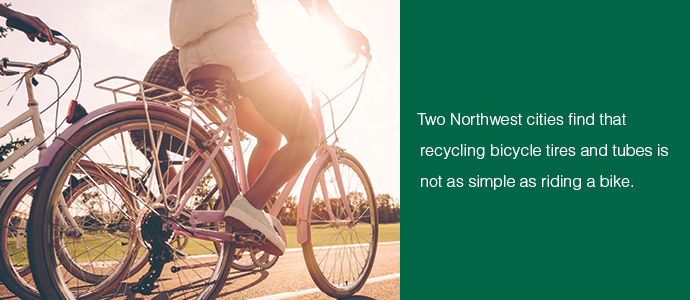
It is amazing how people’s faces light up when they first learn an unexpected item is recyclable. We have observed this response often during our ongoing development of a regional bicycle inner tube and tire recycling pilot in the Seattle region. Yet positive vibes alone don’t pave the road to success.
Full Circle Environmental was hired by the Washington cities of Redmond and Bellevue to provide technical assistance to help businesses reduce waste, improve recycling and divert organic materials. Beyond conducting this outreach, Redmond and Bellevue directed our field team to identify and pursue innovative opportunities to divert hard-to-recycle materials from landfill.
During conversations with staff at bike shops, our field team heard that bicycle tubes and tires represent a significant proportion of their waste stream. They asked us for recycling options, expressing their unanimous desire to reduce waste and shrink their garbage bills. This seemingly simple request led us down a nearly two-year road with many bridges to cross and hills to climb.
The current landscape
Other hard-to-recycle materials, such as paint, electronics, lights, medications and batteries, are already being addressed in Washington state through extended producer responsibility (EPR) policy frameworks, so there is precedent for managing something like bike tires through EPR.
Vehicle tires are being managed through EPR programs in multiple Canadian provinces and European countries. In 2011, Tire Stewardship British Columbia began recycling bike tubes and tires in partnership with the Canadian Independent Bike Retailers Association. Including bike tubes and tires is voluntary in this product stewardship program, but in response to the cycling community seeking more sustainable disposal options, Tire Stewardship successfully integrated the collection of these materials into the existing system of vehicle tire recycling. Schwalbe, a German tire and tube manufacturer, is also in the midst of rolling out tube-to-tube recycling systems in several European countries.
Clearly, initial efforts are being made to integrate bike tubes and tires into a circular economy, but is having a product stewardship program in place a necessary prerequisite for success? If not, could developing a small-scale pilot both achieve measurable material diversion and pedal the EPR conversation a little closer to reality?
Having assessed the policy backdrop and confirmed the strong local cultures of both cycling and recycling, our team dove helmet-first into researching recycling options for bicycle tubes and tires.
What are they made of? How can they be collected, consolidated, shipped, and processed? Who would want these materials, and how would they be used? Who could pay to keep this wheel spinning?
The following sections take you on a ride through what we have learned so far. Conversations with ownership and staff at Redmond and Bellevue’s six bike shops provided valuable insights that helped shape the evolving pilot program, and ongoing discussions with two collection and recycling companies helped our team address some of the questions above.
Collection
Determining where used tubes and tires are generated was the first step toward planning an appropriate collection system. While residences and popular bike paths can serve as sources of generation, our team steered toward an initial focus on bike shops in order to simplify the collection and consolidation of materials.
Many used tubes and tires are discarded at bike shops because people bring in their bike after experiencing a puncture to buy new gear and have it professionally installed. Bike shops typically perform sales and service, making them key leverage points through which new products flow to consumers and old products are exchanged and discarded.
We learned tubes are more commonly discarded than tires because tires are designed for durability, whereas the lightweight and flexible tubes get damaged more easily. Store estimates range from 20 to 100 tubes per month compared to five to 40 tires, depending on seasonal variability and the size of the shop. Among the four bike shops in Redmond and the two in Bellevue, we estimate 120 to 600 tubes and 30 to 240 tires are generated each month.
The vast majority of bicycle inner tubes are made almost entirely of synthetic “butyl” rubber (isobutylene), with a brass valve stem used to inflate and deflate the tube. Similar to car tires, bike tires contain a mix of rubber, metal wire, fabric fibers and fillers. The dimensions of bike tubes and tires vary widely, with typical tubes weighing just under half a pound and tires weighing between 0.5 and 2.5 pounds.
When considering what kind of collection system might adequately capture these items, Full Circle reached out to Ridwell and DTG Recycle, two collection and recycling companies that manage hard-to-recycle materials in the Pacific Northwest. Discussions are ongoing as to whether a milk-run system to collect from each bike shop or a hub-and-spoke drop-off system with a central consolidation point would be preferable.
Another potential collection option would leverage Ridwell’s existing residential doorstep subscription service. Bike tubes and tires could be added to Ridwell’s list of periodically collected specialty items, potentially capturing 15% to 20% of these materials generated in Redmond and Bellevue (as estimated by bike shop staff). Expanding its subscription service directly to the cities’ bike shops would be a new step into the commercial space for Ridwell, but given the motivation of shop staff to divert multiple hard-to-recycle materials, including metal components, Ridwell is not opposed to bike parts this expansion.
DTG currently operates a number of recycling facilities near Redmond and Bellevue that process a variety of hard-to-recycle materials, including wood, electronics, mattresses, car tires and expanded polystyrene. In addition to operating a fleet of collection trucks, DTG also has experience running special collection events for hard-to-recycle items. Members of its team are actively exploring the development of systems for collecting, consolidating and shipping bike tubes and tires.
Our team also reached out to the county-managed Jerry Baker Velodrome, a bicycle racing track in Redmond. Velodrome representatives have expressed preliminary interest in serving as a hub where tubes and tires could be collected and consolidated. A hub-and-spoke system with regular drop-offs to the velodrome is favored by the bike shops, most of which are located nearby.
Processing and end markets
As most nascent circular economy endeavors demonstrate, a steady supply of capturable materials does not guarantee that processors and end markets exist. This has proven true for bicycle tubes and tires generated in the Pacific Northwest, with dead ends thwarting several potential recycling pathways.
Conversations with DTG initially uncovered potential tube and tire processors to which we sent samples for testing. We first explored the possibility of including bike tires and/or tubes with DTG’s existing shipments of car tires to a Canadian company that processes crumb rubber into tire-derived fuel, floor mats and landscaping products. They determined the samples would not work in their regrind machinery. We offered samples to an Atlanta-based vehicle tire processor that creates micronized rubber powder; they declined testing because they did not have a current customer interested in the processed material they would generate. And a tire retread recycling operation in the Midwest received the samples, but has yet to send word on the outcome of any processing they may have undertaken. While the promise of folding bike tires into an existing vehicle tire recycling system sounded efficient on its face, it appears we spoke too soon.
We reached out to a local cement kiln, which burns whole vehicle tires for fuel, but a representative indicated that bike tires and tubes are too small to be worthwhile fuel; the kiln prefers large tires from automobiles, trucks and heavy-duty construction vehicles. (We recognize the combustion of tire-derived fuel entails negative impacts on human health and the environment, but EPA guidance proclaims it a more beneficial use of waste tires than discarding them in a landfill, especially if high-carbon fossil fuels, such as coal, are replaced.)
Rubber-modified asphalt is another commercial use of tire rubber, but without a cost-effective material processor, and with applications of this product having not yet gained traction in the Pacific Northwest, this would be an option for later down the road.
Diversion opportunities are more readily available for inner tubes than they are for bike tires. Alchemy Goods, which upcycles tubes into bags and accessories, has agreed to accept tubes collected through this pilot if they are shipped to its facility in Boulder, Colo. Several Seattle-area bike shops, including REI in Bellevue, already send them used tubes. Small-scale local manufacturers of upcycled products, such as Metamorphic Gear and Refugee Artisan Initiative, have also expressed interest in experimenting with tube material.
Funding
Even when collection systems, feasible processing pathways and viable end-market products have been identified, funding will remain a critical component to the program’s forward movement, particularly given that recovered material values are not high enough to cover collection, shipping and processing costs.
But who will pay? Our team identified early on that consumer fees are unlikely to be a viable funding approach. Many bike shops operate on slim margins, and while they might be willing to absorb the opportunity costs associated with separating and storing used tubes and tires, they largely expressed an unwillingness to add charges on the sale of new tubes and tires to cover shipment costs, citing to store policies and operational constraints.
DTG, interested in establishing cost-efficient material recovery and processing, has proposed a potential fee for collection and consolidation services. Similarly, Ridwell employs a fee-for-service model that could be adapted to capture bike tires and tubes from bike shops or residences. However, in the absence of end markets or clear economic feasibility, Ridwell has not yet committed to participating in our pilot’s collection operations.
Policy solutions
Extended producer responsibility frameworks and other policy approaches could ultimately answer the funding question.
Connecticut recently passed a first-in-the-nation EPR program for vehicle tires, which fell somewhat flat given its exclusion of bike tires and tubes. The Washington State Department of Ecology manages a waste tire program, funded by a required $1.00 disposal fee added to the sale of each “new replacement vehicle tire” in the state.
Incorporating bike tires and tubes into this program could yield substantial benefits, such as engaging consumers and retailers around recycling and upcycling, increasing program revenues, spreading awareness of problems stemming from dumped tires, supporting the regional and statewide development of end markets for recycled tire rubber and enabling more bike tire and tube diversion programs to be initiated and expanded.
We have also reached out to bike and tire manufacturers, as well as to the national trade association for bicycle manufacturers, with no clear engagement to date. Overall, while general interest in supporting end-of-life tire and tube management has been expressed by a number of stakeholders, this program is still leaning on its kickstand, awaiting producer support in the form of internalizing the end-of-life management costs of their products.
Blazing the trail
As this pilot program slowly gains momentum, we envision it expanding to cover dozens of other Seattle-area bike shops and divert increasingly significant quantities of materials. Bike shops see a strong alignment between the pilot and their products and services, their ethics and their customers’ desire to embrace sustainable behaviors.
Our pilot paves a pathway toward establishing a circular economy for bike tubes and tires in the Pacific Northwest. Bike shop staff, cycling enthusiasts and local collector/recyclers are excited to move forward as funding for tube shipments and end markets for tires can be solidified. Once those elements are in place, we can shift this program into high gear!
Adam Ellner is a project manager at Full Circle Environmental. He can be reached at adam@fullcircleenvironmental.com. David Stitzhal is the president of Full Circle Environmental and managing partner at Signalfire Group. He can be reached at stitzhal@fullcircleenvironmental.com.
The authors are particularly grateful for the leadership, support and creativity of Micah Bonkowski, solid waste and sustainability program administrator for the city of Redmond (mbonkowski@redmond.gov); Stacey Auer, environmental program administrator for the city of Redmond (slauer@redmond.gov); and Erin Hislop, utilities conservation and outreach program administrator for the city of Bellevue (ehislop@bellevuewa.gov).
This article appeared in the August 2023 issue of Resource Recycling. Subscribe today for access to all print content.