This article appeared in the April 2021 issue of Resource Recycling. Subscribe today for access to all print content.
There are a number of metrics we could use to try to assess the unprecedented year that was 2020. When it comes to determining the economic stability of recycling, a logical place to start is the tried-and-true earnings report.
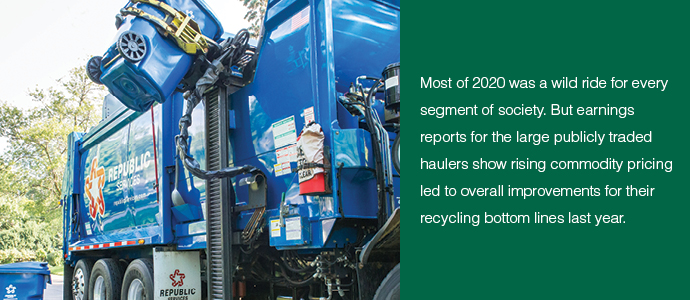
Analysis in this area indicates that for the biggest waste companies, 2020 was fairly strong overall in the recycling category. Higher commodity prices boosted recycling revenues for Waste Management, Republic Services and North America’s other largest haulers last year.
The five largest residential waste and recyclables haulers recently released their fourth-quarter and full-year 2020 financial results. The publicly traded giants all pointed to higher average recyclables prices last year.
The prices helped drive overall recycling revenues. For example, Waste Management and Republic Services, the largest and second-largest companies, respectively, each reported 2020 recycling revenues up by about 8%.
Some of the results showed that prices were particularly high in the fourth quarter, a continuation of last summer’s trend of rising commodity values. On earnings calls, hauler executives added that prices have continued to show strength in 2021.
The following are the latest results from Waste Management, Republic Services, GFL Environmental, Waste Connections and Casella Waste Services.
Waste Management
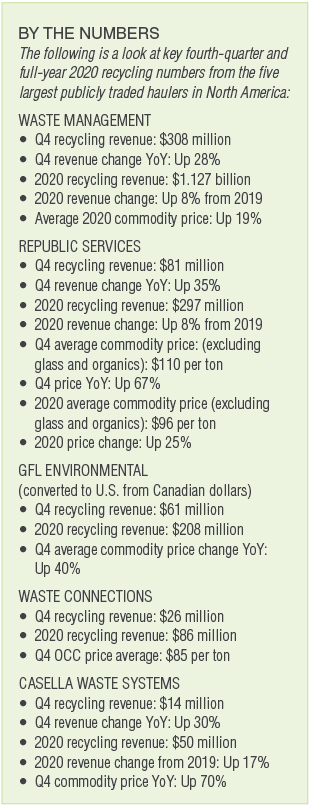
Waste Management’s recycling business brought in $308 million in revenue during the fourth quarter of 2020, up 28% year over year. For the full year, the recycling business reported $1.127 billion in revenue, up 8% over 2019.
According to the company’s annual report, the average price of recyclables flowing through company MRFs in 2020 was 19% higher than the year before. The company attributed the 2020 results to COVID-19 affecting supply and demand for recyclables, increasing prices for some key materials.
At the end of 2020, the average market prices were still at or below the historical averages, the report noted. That being said, during a Feb. 18 call with investment analysts, Waste Management President and CEO Jim Fish noted that 2021 has started with commodities “on a strong upward trajectory, and many experts believe this to be the start of a long-term trend.” (Publicly traded paper mill operators also said in recent earnings calls they expect OCC prices to increase throughout this year.)
Waste Management’s annual report touched on export versus domestic markets, pointing to China’s latest move to shut down virtually all recyclables imports as of this year, as well as the Jan. 1, 2021 implementation of the Basel amendment, which could drastically complicate the scrap plastics trade. But Waste Management said the impacts are mitigated by the fact it no longer exports residential recyclables.
The company also stated that, because a higher percentage of its overall commodity sales are now targeted at domestic markets, the company’s freight costs have decreased.
Waste Management last fall acquired Advanced Disposal Services and sold some operations to GFL Environmental. After those transactions, Waste Management operates 103 MRFs (this number includes C&D debris sorting facilities).
Recycling now makes up nearly 8% of Waste Management’s total revenue. Overall, the company brought in $4.067 billion during the fourth quarter, up 6% year over year, and $15.218 billion for the full year, down nearly 2% from 2019, according to a press release from the company.
Waste Management’s annual report also provided pro-forma financials showing how the 2019 and 2020 operating revenues would have looked had the Advanced Disposal acquisition and related divestitures occurred as of Jan. 1, 2019, rather than in late-October 2020. That data provides a sort of apple-to-apple theoretical comparison between 2019 and 2020. The pro forma showed Waste Management could have brought in $16.192 billion in revenue in 2020, down nearly 3% from the year before.
Republic Services
Republic, meanwhile, noted its recycling business brought in $81 million in revenue during the fourth quarter of 2020, up 35% year over year. For the full year, the recycling business brought in $297 million in revenue, up nearly 8% from 2019.
In a press release, Republic Services noted that the fourth-quarter average recovered commodity price (excluding glass and organics) hit $110, up from $66 during the fourth quarter of 2019 – that represents a gain of 67%.
For the full year, the average price was $96 per ton, up 25% from 2019, according to the company’s annual report.
During a Feb. 22 call with investment analysts, Donald Slager, Republic’s CEO, noted that the higher commodity prices generally help Republic negotiate with municipalities for contracts that ensure the company gets paid “a fair return” to collect and sort recyclables. In short, when markets are strong, processors are able to entice communities with commodity sales rebates under those contracts.
“As commodity prices get higher, it’s easier to talk to customers, particularly in municipalities, about getting that model,” he said.
Republic’s annual report noted that Republic Services MRFs sorted and sold 2.1 million tons of recyclables last year (excluding glass and organics). An additional 2.2 million tons were collected by Republic and delivered to third parties. About 78% of total weight flowing through Republic MRFs is fiber, including OCC, ONP and mixed paper.
As of the end of last year, Republic had 76 MRFs.
Recycling now makes up about 3% of Republic’s total revenue. Overall, Republic’s total revenue was $2.573 billion during the fourth quarter, roughly flat year over year, and $10.154 billion for the full year, down 1% from 2019.
GFL Environmental
During the fourth quarter of 2020, GFL’s recycling business brought in $77 million Canadian (about $61 million USD; all GFL numbers below have been converted to U.S. dollars). That was up from $32 million during the fourth quarter of 2019, or an increase of 90% year over year.
For the full year, the Toronto-headquartered company’s recycling business brought in about $208 million in revenue, up from $75 million in 2019 (acquisitions contributed to the year-over-year increases in these numbers), according to the company’s annual report.
Like the other haulers, GFL reported that higher commodity prices gave the company a boost.
GFL’s Canadian solid waste operations (recycling is part of the company’s solid waste operations) experienced a revenue jump of about $172 million in 2020; most of that increase was because of acquisitions, but higher commodity values did contribute nearly $4 million.
GFL’s U.S. solid waste operations enjoyed a revenue increase of about $457 million from 2019 to 2020; again, most of that was from acquisitions, but higher recyclables prices did contribute nearly $5 million to the increase, the annual report shows.
According to a press release, GFL’s solid waste business experienced 4% year-over-year organic revenue growth during the fourth quarter of 2020 (organic growth excludes the impact of acquisitions). Of that 4%, higher commodity prices contributed 0.7 percentage points.
On a Feb. 23 call with analysts, Luke Pelosi, GFL’s chief financial officer, said the fourth-quarter blended commodity price was nearly 40% higher year over year. The price was up 15% from the third quarter of 2020.
“As we continue moving our contracts towards a fixed-price processing model, we will see less volatility in our results tied to movements in OCC [and other commodities],” he said, according to a transcript from Seeking Alpha.
GFL has acquired multiple companies in recent years, including Canada Fibers, WCA Waste Corporation and a number of operations from Waste Management and Advanced Disposal Services. As of the end of last year, GFL owned 28 MRFs across North America.
Recycling now makes up over 6% of GFL’s total revenue. Overall, the company’s revenue was $3.316 billion in 2020, up 25% from 2019 (again, mostly because of acquisitions).
Waste Connections
Waste Connections’ recycling business brought in $26 million in the fourth quarter of 2020, up 95% year over year, according to a press release. For the full year, the recycling business brought in $86 million in revenue in 2020, up 34% from 2019 (acquisitions contributed to the large jumps in revenue), according to the company’s annual report.
Waste Connections also reported high commodity values last year. Revenue from commodity sales increased by about $4 million in 2020, primarily because of higher OCC prices and greater residential volumes, the annual report shows. That was partially offset by a decrease in commercial volumes and lower average prices for scrap plastics and aluminum.
According to a Feb. 18 call with analysts, Mary Ann Whitney, the company’s chief financial officer, said the fourth-quarter OCC prices averaged $85 per ton. OCC ended the year at about $90 a ton and has since been over $100 a ton, she said.
Recycling now makes up less than 2% of Waste Connections’ total revenue. Overall, the company’s revenue was $5.446 billion in 2020, up 1.1% from the year before.
Excluding the impact of acquisitions, however, the total revenue decreased by 2.6%. Waste Connections acquired 42 garbage and recycling companies in 2019 and 2020.
Casella Waste Systems
Casella’s recycling business brought in $14 million in revenue during the fourth quarter, up 30% year over year. For the full year, the recycling division recorded $50 million in revenue, up 17% from 2019.
In the fourth quarter, the year-over-year recycling revenue growth was almost entirely due to higher selling prices for recovered commodities, data in a press release shows.
In 2020, recycling revenues increased by $7.4 million, according to the company’s annual report. Of that amount, $3.5 million came from higher commodities prices (mostly OCC and paper), $1.8 million from higher recycling processing fees, $1.1 million from the acquisition of a recycling operation and $1.0 million from greater commodity volumes.
During a Feb. 19 call with analysts, Ned Coletta, Casella’s chief financial officer, said the average commodity price in the fourth quarter was up by 79% year over year, mainly because of higher OCC and mixed paper prices, as well as higher metals prices. Partially offsetting those were lower scrap plastics prices.
As of the end of January, Casella had 20 MRFs. Last year, the company’s recycling business (including its brokerage division) sorted and/or marketed over 600,000 tons of recyclables, according to the annual report.
Recycling now makes up about 7% of Casella’s total revenue. Overall, the company brought in $775 million in revenue in 2020, up 4% from 2019.
Jared Paben is the associate editor of Resource Recycling and can be contacted at jared@resource-recycling.com.