





Convincing more people to recycle, and more effectively, is possible with the right behavioral marketing, said a university professor on Thursday at a conference in Lancaster, Pennsylvania.
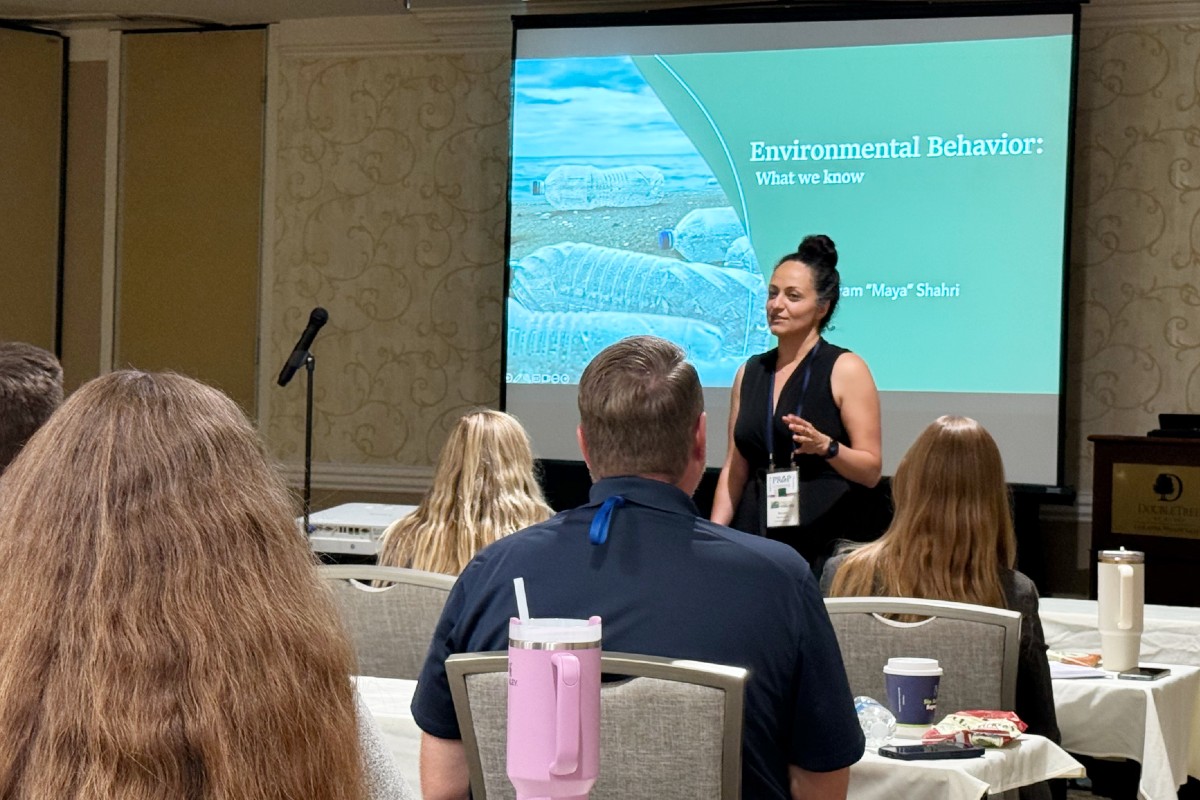
Maryam Shahri, an assistant teaching professor of agricultural and biological engineering at Penn State University, spoke at the Annual Recycling & Organics Conference of the Professional Recyclers of Pennsylvania (PROP).
Shahri said studies show more than 80% of Americans say they recycle, yet actual participation and diversion rates are much lower across the country.
Shahri said people assume human beings are logical animals that always act to further their own interests. In reality, that’s often not the case, she said.
“We know non-conscious brain activity starts before a person feels an intention to act,” said Shahri. “This shows that much of our behavior is involuntary and connected to our unconscious.”
That doesn’t mean behavior can’t be influenced, it just means having an understanding of human nature is required, she said.
What won’t work is scolding, said Shahri. “Suspend moral judgment,” she said. “Nobody has ever changed anybody by looking down on them.”
What seems to work on the surface, but fails to lead to lasting change, is punishment and fear, said Shahri. So, for example, ticketing people for not recycling properly could result in short-term behavior change, but it leads to resentment over time and could fail to scale up to other desirable behaviors.
What does work is articulating a good reason to change, said Shahri. “Not ‘don’t kill the environment.’ Someone needs to really believe change is necessary.” That reason should be presented as a story. The more vivid and attention-getting, the better. Why should a resident recycle? Highlight that reason and don’t deviate, she said.
Next is to present a clear path to change. Lower the cost and remove barriers where possible. “Simplify,” said Shahri. “And throw the brochures out, no one reads that. Nobody wants knowledge, ChatGPT is readily available.”
Shahri also advised tapping into people’s desire to belong. One study found that when a hotel put a sign in rooms stating that 90% of people in this hotel reuse their towels it greatly increased the reuse rate.
Another tip is to really understand the community you are trying to reach. Don’t rely on experts too much, Shahri advised, because they can be myopic. Instead survey the community directly through focus groups and ethnographic studies. Find out what their specific pain points are and why they might not recycle.
When you do launch a campaign make sure it has a discrete beginning, middle and end, Shahri said, and collect data. If you can make the desired behavior (such as recycling) the default that will get more participation than asking people to opt in, she noted.
Also be aware that behavior often shifts when people join crowds, which can mean different approaches in dealing with large events.
During a separate panel at the PROP conference Thursday Ayodeji Oluwalana, a waste reduction and recycling program manager at Penn State, shared some specific learnings from his campus. What led to increased recycling participation were co-locating a recycling bin with every trash bin, color coding signs, back-of-house compost at food service points and custodial flagging of chronic problems.
What didn’t work were text-heavy labels, new signage in food zones without adding compost collection and one-time trainings in high turnover buildings.