
Researchers in Hawaii are testing whether discarded fishing nets and household plastics can be incorporated into asphalt roads without increasing microplastic pollution, according to findings presented at the American Chemical Society’s (ACS) spring meeting in Atlanta.
The work centers on whether plastic debris collected in Hawaii can be used in road construction as the state contends with limited recycling capacity, pressure on landfill space and a steady flow of marine debris.
“This work investigates whether it’s responsible to use recycled plastics in Hawaii’s roads,” Jeremy Axworthy, a researcher at the Center for Marine Debris Research at Hawaii Pacific University, said in a statement. “By reusing plastic waste that is already in Hawaii, we can reduce the environmental and economic impacts of transporting waste plastics from the islands, incinerating it or dumping it in Hawaii’s overflowing landfills.”
The Hawaii Department of Transportation asked the research team to do two things: provide derelict fishing nets removed from Hawaii’s marine environment for recycled plastic-modified asphalt, and measure possible microplastic shedding from pavement made with plastic material versus standard styrene-butadiene-styrene-modified pavement. According to the ACS Hawaii’s roads have predominantly been paved with polymer-modified asphalt since 2020 because it offers greater resistance to cracking, rutting and water damage.
Jennifer Lynch, the center’s director and team lead, said derelict fishing gear is the largest contributor to Hawaii’s marine debris problem. She said the center’s Bounty Project, which pays licensed commercial fishers to remove debris, has taken 84 tons of large derelict fishing gear from the Pacific Ocean to date. About 90 metric tons of plastic trash have reportedly been removed from the waters and beaches of Hawaii, and that more than a metric ton of fishing nets has been paved into Hawaiian roads.
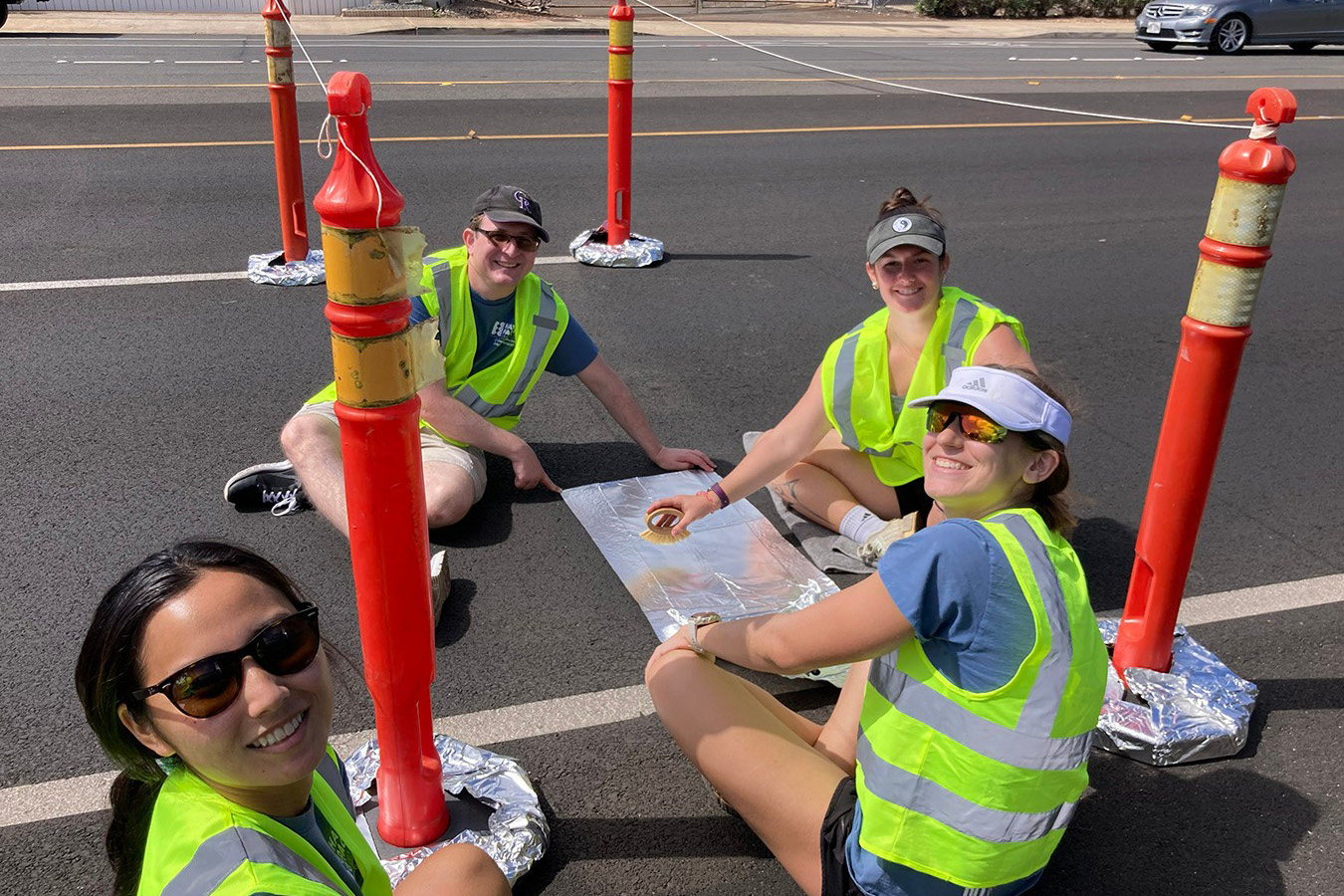
For the road trials on Oahu, a local paving company laid residential road sections using asphalt containing standard styrene-butadiene-styrene, repurposed polyethylene from Honolulu recycling containers and polyethylene from fishing nets, according to the ACS. After about 11 months of regular traffic, Lynch’s team collected road dust from each section and analyzed simulated stormwater from the test areas to assess microplastic shedding.
Initial tests showed pavement made with recycled polyethylene did not release more polymers than the control pavement made with styrene-butadiene-styrene, the ACS said. Axworthy said to Reuters, “In that trial, we found no release of polyethylene from the pavements that had the recycled polyethylene in them compared to the controls.” Microplastic-sized particles were detected, but very few were identified as polyethylene regardless of pavement type.
“We’re extremely concerned about the shedding of plastics or other chemicals into the environment,” Lynch told Science News. The ACS also reported the team is comparing polymer shedding from the pavement with polymer shedding from tires in road dust, and Lynch said the initial analytical results showed tire wear overwhelming the polyethylene signal.
More work is needed on long-term durability and Axworthy added that the road was “holding up great” at the four-year mark and felt like a normal fairly new asphalt road, without major cracks or potholes.