





Resource Recycling
  • The Latest
  • Analysis
    • All
    • Certification Scorecard
    • Industry Announcements
    • Opinion
    Feds to develop repairable computer donation program

    The whitebox blind spot in PC recycling

    Analysis: circular design still elusive in laptops

    PC shipments grew in Q1, but questions remain

    The independent ITAD at a crossroads

    The independent ITAD at a crossroads

    Certification Scorecard — Week of April 20, 2026

    Apple Watch on product box.

    Wearables are coming and ITAD isn’t ready

    Certification Scorecard — Week of April 13, 2026

    EV Battery Pack - Sergii Chernov-Shutterstock

    Redwood, Rivian deal fuels US infrastructure plans

    Bloom ESG and e-Stewards roll out critical metals metric

    Colorado regulators suggest mid-range EPR scenario

    Why collaboration on plastic waste still matters

  • Conferences
  • Publications

    Other Topics

    Textiles
    Organics
    Packaging
    Glass
    Brand Owners

    Metals
    Technology
    Research
    Markets
    Grant Watch

    All Topics

Subscribe
No Result
View All Result
Resource Recycling
  • The Latest
  • Analysis
    • All
    • Certification Scorecard
    • Industry Announcements
    • Opinion
    Feds to develop repairable computer donation program

    The whitebox blind spot in PC recycling

    Analysis: circular design still elusive in laptops

    PC shipments grew in Q1, but questions remain

    The independent ITAD at a crossroads

    The independent ITAD at a crossroads

    Certification Scorecard — Week of April 20, 2026

    Apple Watch on product box.

    Wearables are coming and ITAD isn’t ready

    Certification Scorecard — Week of April 13, 2026

    EV Battery Pack - Sergii Chernov-Shutterstock

    Redwood, Rivian deal fuels US infrastructure plans

    Bloom ESG and e-Stewards roll out critical metals metric

    Colorado regulators suggest mid-range EPR scenario

    Why collaboration on plastic waste still matters

  • Conferences
  • Publications

    Other Topics

    Textiles
    Organics
    Packaging
    Glass
    Brand Owners

    Metals
    Technology
    Research
    Markets
    Grant Watch

    All Topics

Subscribe
No Result
View All Result
Resource Recycling
No Result
View All Result
Home Recycling

Before the Bin: Breaking down food date labeling

Stefanie ValenticbyStefanie Valentic
April 20, 2026
in Recycling
Towfiqu ahamed barbhuiya

Towfiqu ahamed barbhuiya/shutterstock

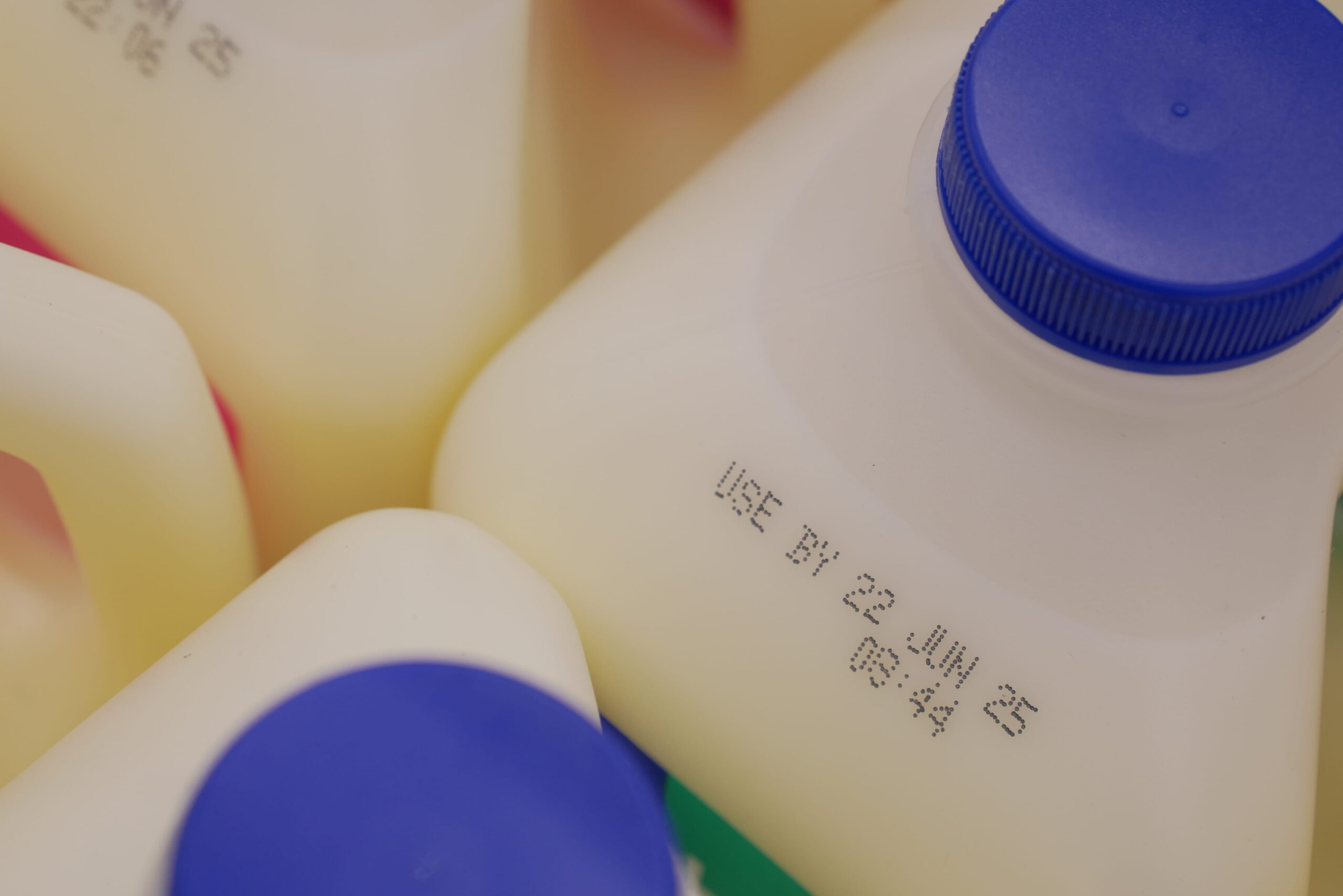
You’ve probably done it. You open the fridge, spot the “sell by” date on a perfectly good carton of milk, and pour it down the drain, just to be safe.

These small decisions, when multiplied across millions of households, add up to more than 3.5 million tons of food thrown out every year in the United States due to date label confusion alone, according to ReFED.

And it’s entirely preventable.

Think about the last time you threw something out because the date on the package made you nervous. Maybe it was a block of cheese or a carton of eggs, perfectly edible and safe to eat, but you tossed it anyway. You’re not alone.

Americans waste an estimated $19.2 billion worth of food every year not because it’s gone bad, but because nobody can agree on what “best by,” “sell by,” and “use by” actually mean.

The thing is, most date labels have nothing to do with food safety. They’re a manufacturer’s best guess at peak freshness and nobody is required to use them consistently, meaning there’s no standardization with how the expiration on two different packs of deli meat, for example, should be labeled. 

Decades in the making

Part of the problem has been building for decades. When the refrigerator became a household staple in the 1950s, the average model held 8 to 12 cubic feet of food. Today’s standard fridge holds nearly double that, and with more space to fill, more food gets lost in the back, forgotten until a date stamp determines its fate.

And years of inflation haven’t helped. Grocery bills are up nearly 30% since 2020, and yet billions of dollars worth of still-edible food keeps ending up in the trash.

Inflation didn’t just empty wallets. It changed how Americans shop, cook and think about the food sitting in their refrigerators.

So, what’s the solution? It starts with understanding what those date labels are actually telling you and what they aren’t. Most of them have nothing to do with safety.

They’re a manufacturer’s estimate of peak quality, and learning the difference between “this food is past its best” and “this food is unsafe to eat” can save a household hundreds of dollars a year.

Nate Clark, communications and content manager at ReFED, says the financial pressure of the last few years has already started pushing people in that direction.

“People started taking actions to maximize the value of the food they were already purchasing and sort of extend their grocery dollars.”

That means checking what’s already in the fridge before heading to the grocery store, planning meals around what needs to be used up first and knowing that a carton of milk a day past its sell-by date can still go in the bowl with your cereal.

Clark adds that reducing food waste doesn’t have to feel like a chore.

“People can reduce their food waste for whatever reason they really want to, whether that is environmentally motivated or financially motivated, because their neighbors are going hungry and they’re throwing out a perfectly good rotisserie chicken,” he says.

The big fix

The problem goes beyond household habits. The labeling process itself is broken, and legislation is quickly becoming a piece of the puzzle.

The federal Food Date Labeling Act, currently making its way through Congress, would standardize date labels across the country, replacing the current patchwork of inconsistent terms with a single, uniform system.

ReFED estimates the change alone could save consumers at least $1.3 billion annually and help retailers save $253 million through better inventory management.

The state of California, which is known for pioneering major movements for waste and recycling legislation in the US, passed its own date labeling law last year.

With every major food producer doing business in the state, which has the fourth largest economy in the world, the industry is already feeling pressure to get ahead of a federal standard before a state-by-state patchwork makes things even more complicated.

Clark says the timing has never been better to make a change in your food purchasing and consumption habits, and the bar to get started is lower than most people think.

“There are so many opportunities that every individual can take to make a reduction,” he said. “It’s inexcusable at this point to waste a third of the food that we produce and have one in seven people be food insecure.”

Know before you throw

A good place to start is knowing what those labels actually mean, which can be found on the USDA website.

“Sell by” is a message to the retailer. It tells the grocery store how long to keep the product on the shelf. It says nothing about whether the food is safe to eat after that date.

“Best by” is about quality, not safety. It’s the manufacturer’s estimate of when the product will be at its peak flavor or texture. Neither is an expiration date. Neither means the food is bad.

Until Congress gets a uniform system across the finish line, consumers are largely left to navigate a confusing and inconsistent labeling landscape on their own. The labels weren’t designed with your grocery bill in mind. But your purchasing decisions are yours, and so is what goes in the bin.

Next time you reach for that carton of milk or block of cheese, take a second look. Think before the bin.

Editor’s Note: Before the Bin is a monthly column for everyday consumers about the small choices that keep food, money and resources out of the trash.

TweetShare
Stefanie Valentic

Stefanie Valentic

Stefanie Valentic is an award-winning journalist who has covered the waste and recycling industry for more than five years. Throughout her career, she has led editorial teams and served as a keynote speaker, moderator and panelist at numerous trade shows and conferences.

Related Posts

Prescription drug bottles

National Prescription Drug Take Back Day is Saturday

byBrian Clark Howard
April 24, 2026

The federal government is urging people to properly dispose of their unwanted medications to protect human health and the water...

Feds to develop repairable computer donation program

The whitebox blind spot in PC recycling

byDavid Daoud
April 24, 2026

Small brand PCs can present unique challenges at end of life.

AT&T, Compudopt expand e-recycling program

AT&T, Compudopt expand e-recycling program

byAntoinette Smith
April 23, 2026

The communications giant will have more than 200 retail collection points, and the Texas nonprofit will process and distribute old...

Circular Services opens $61m MRF in North Texas

byStefanie Valentic
April 23, 2026

The Dallas Metroplex has a new $61 million MRF. Circular Services launched operations at the 120,000-square-foot facility this week. Construction...

Birch Plastics gets FDA green-light for post-industrial PP

LyondellBasell upgrade to PreZero assets on hold

byAntoinette Smith
April 23, 2026

The company is currently optimizing operations at the existing mechanical recycling facility, which it bought in 2024.

What Netflix’s ‘Plastic Detox’ gets wrong – and right

byKeith Loria
April 23, 2026

Advocates are excited about the attention brought on plastics by the documentary, but scientists say more nuance is needed.

Load More
Next Post
Growth challenges drive M&A for packaging

Growth challenges drive M&A for packaging

More Posts

Birch Plastics gets FDA green-light for post-industrial PP

LyondellBasell upgrade to PreZero assets on hold

April 23, 2026
The independent ITAD at a crossroads

The independent ITAD at a crossroads

April 22, 2026
Towfiqu ahamed barbhuiya

Before the Bin: Breaking down food date labeling

April 20, 2026
Industry group: Help us find the plastic bale volumes we need

PET bales sink further as other grades firm 

April 15, 2026
EPR fees are a market signal. Here’s what they’re telling you.

Oregon DEQ flags 250 producers for RMA noncompliance

April 21, 2026
EPR fees are a market signal. Here’s what they’re telling you.

EPR fees are a market signal. Here’s what they’re telling you.

April 10, 2026

Google pilots reuse kits to extend device life

April 21, 2026
Battery recycler Ascend Elements files for bankruptcy

Battery recycler Ascend Elements files for bankruptcy

April 13, 2026
Data erasure firm expands wearable device capabilities

Apple hits 30% recycled content, debuts new recovery tech

April 17, 2026

NERC launches hub to promote PCR demand 

April 15, 2026
Load More

About & Publications

About Us

Staff

Archive

Magazine

Work With Us

Advertise
Jobs
Contact
Terms and Privacy

Newsletter

Get the latest recycling news and analysis delivered to your inbox every week. Stay ahead on industry trends, policy updates, and insights from programs, processors, and innovators.

Subscribe

Welcome Back!

Login to your account below

Forgotten Password?

Retrieve your password

Please enter your username or email address to reset your password.

Log In

Add New Playlist

No Result
View All Result
  • The Latest
  • Analysis
  • Recycling
  • E-Scrap
  • Plastics
  • Policy Now
  • Conferences
    • E-Scrap Conference
    • Plastics Recycling Conference
    • Resource Recycling Conference
    • Textiles Recovery Summit
  • Magazine
  • About Us
  • Advertise
  • Archive
  • Jobs
  • Staff
Subscribe
This website uses cookies. By continuing to use this website you are giving consent to cookies being used. Visit our Privacy and Cookie Policy.