






As year-end policy activity slows and the federal government shutdown lingers, municipalities across the US and Canada continue pushing forward recycling and reuse systems.
This November, learn how Denver is implementing its Waste No More ordinance. Also covered:
- The first Canadian territory to launch producer responsibility program (EPR) for packaging.
- Right-to-repair advances across North America
- EPR compliance challenges facing producers.
Send me an email with a topic you’d like to see covered in future editions of Policy Now, or just to discuss current legislative efforts. I look forward to the conversation.
–Stefanie Valentic, Editor, Policy Now at Resource Recycling.
Denver heads to waste no more with new ordinance
Denver has begun implementing its community-led Waste No More ordinance, sweeping legislation designed to transform the city’s waste collection system toward a circular economy model.
Given the compressed timeline between passage and enforcement, city officials established key milestones leading up to the deadline of September 1, 2026.
“At least six different city agencies will be involved in developing rules and regulations and implementing the ordinance,” said Tay Dunklee, manager of zero waste and circular economy for Denver’s Climate Action, Sustainability and Resiliency department.
In a three-part series, Resource Recycling speaks with stakeholders who advocated for and are now working to roll out the legislation in the Mile High City. Part one features a Q&A with Tay Dunklee from the city of Denver, examining the enforcement and education needed.
Read more at Resource Recycling.
California GPI gets boost and Yukon EPR begins for packaging
Two policy moves in North America are pushing producer responsibility and domestic manufacturing. In California, the Glass Packaging Institute praised Governor Gavin Newsom for signing AB 899, a law that extends and increases market-development payments for glass bottle makers.
The measure, authored by Assembly member Rhodesia Ransom, aims to bolster in-state production and address price pressure from imports of wine and food containers from Asia.
“California’s action on AB 899 sets a model for how states can invest in circular, resilient manufacturing,” said Scott DeFife, president of the Glass Packaging Institute. He said prioritizing domestic glass production will reinforce supply chains, reduce environmental impact and support jobs tied to the state’s food and wine industries.
In Canada, Circular Materials said the Yukon will launch the territory’s first extended EPR program for household packaging and paper on November 1. The producer-led system shifts the cost and management of recycling to the businesses that supply those materials. Circular Materials said the plan was approved on February 1 and followed engagement with municipalities, First Nations, residents and service providers to reflect the territory’s infrastructure and geography. In Whitehorse, curbside service continues and Raven ReCentre will accept packaging and paper drop-offs in November as the temporary depot closed on October 31.
“As the first territory in Canada to adopt EPR, this is an important milestone for the North,” said Allen Langdon, CEO of Circular Materials. “We look forward to working together to strengthen local recycling systems, improve recycling rates and environmental outcomes.”
Together, the developments show policymakers and industry groups advancing producer-funded recycling and local manufacturing to keep materials in circulation, support jobs and improve program performance.
New Hampshire submits packaging legislation for 2026
New Hampshire is the first state in the US to pre-file a packaging bill for the new year.
The new filing, HB 6688, aims at revising packaging guidelines for the recycling of plastic film, though no other details nor the text have been published, according to the Sustainable Packaging Coalition.
New Hampshire’s previously proposed EPR bill, HB 1630, failed in the House in 2024 after setting ambitious goals that were deemed problematic for being too tightly modeled after ideal models from environmental groups, not the industry sector.
The bill would have set up a producer responsibility organization, require producers cut packaging by 50% over 10 years and reach a 70% recycling rate in 12 years.
Philadelphia sets 10-cent plastic bag fee
City council members in Philadelphia have passed a long-debated bag fee aimed at reducing the number of plastic bags circulating in the municipality.
The bill targets grocery stores and retailers, aiming to improve signage and improve the city’s current plastic bag ban, which went into effect in 2021. Although the 10-cent fee was approved by council members, it remains unclear whether Mayor Cherelle Parker will approve it.
EU to drive global demand for recycled plastics
A new study from commodity intelligence firm ICIS and a Chinese industry association explores the impacts of European regulations on global demand for recycled plastics in packaging, automotive and textile applications.
Implementation of the EU’s Packaging and Packaging Waste Regulation (PPWR) and upcoming legislation in other sectors will drive a sharp increase in demand for recycled content, particularly for PE, PP and PET, according to the study from London-headquartered ICIS and CPCIF, which represent China’s petroleum and chemical industry.
Right-to-repair talks surge forward
Right-to-repair legislation is gaining traction, with Washington and Texas solidifying measures in 2025.
“If you bought it, you own it and you should be able to fix it,” said Chris Bross, founder and president of Tierrabyte, at the 2025 E-Scrap Conference.
Since 2022, California, Colorado, Connecticut, Maryland, Minnesota, Nevada, New York, Oregon, Texas and Washington have enacted legislation related to the repair of electronic devices.
Over a third of the country by population now has some form of right-to-repair law, said Liz Chamberlain, director of sustainability at iFixit, adding that some states including Connecticut are passing without the need to advocate for action.
“The Connecticut bill was actually kind of an exciting one for us as a movement. We didn’t have a lobbyist in Connecticut. We weren’t involved in that law. It got included in the big omnibus and passed without us having to do anything. First time that happened,” she said.
In addition, the environmental benefits of extending device lifespans, such as reducing electronic waste, are becoming more evident. Most replacement parts pay off their environmental cost within days to weeks of use, Chamberlain said.
“If we as Americans kept our phones for one year longer, it would be the carbon equivalent of taking 636,000 cars off the road,” she said.
Colorado’s EPR rollout enters next phase of development
The group overseeing Colorado’s upcoming recycling system overhaul is moving forward with new plans to boost participation statewide.
During a recent webinar, the Circular Action Alliance (CAA) outlined its education and outreach strategy under Colorado’s extended producer responsibility law. The Producer Responsibility for Statewide Recycling Act requires packaging and paper producers to join the PRO in order to sell products in the state.
Working with existing data and information gathered from more than 1,000 residents in a recent survey, CAA identified barriers to recycling participation and strategies to increase recycling rates. Among them was cost, which factored into a recycling rate of only 16%, according to Colorado’s Department of Public Health and Environment, or about half the national average.
The new EPR law will take funds from manufacturers to establish a free residential recycling system for residents in 2026; plans are to expand access to small businesses by 2030. The goal, organizers say, is to make sure participation is strong once those programs roll out.
Read more at Resource Recycling.
RecycleOn Oregon opens first drop-off hard-to-recycle site
Hard-to-recycle materials may soon find a new use in Oregon thanks to a first-of-its-kind recycling center now open there.
The RecycleOn Oregon center in Ashland opened this month, the first of more than 140 planned in the state. The center is the product of a collaboration between Circular Action Alliance (CAA), the producer responsibility organization (PRO) that administers the state’s EPR law for packaging, and West Coast collection and processing company Recology.
The centers will accept plastic film, EPS foam, shredded paper, plastic buckets and other items that can’t be traditionally recycled.
CAA operates RecycleOn Oregon, the public-facing EPR educational clearinghouse. The Plastic Pollution and Recycling Modernization Act requires paper and packaging companies to spur and fund recycling initiatives such as RecycleOn.
Read more at Resource Recycling.
Oregon offers first test as EPR rules take shape
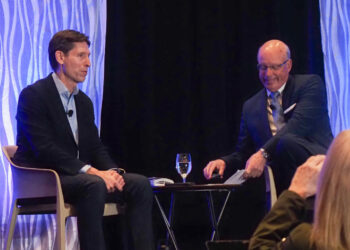
At the Paper and Plastics Recycling Conference in Chicago, industry leaders said EPR programs for packaging are changing how the US handles residential recycling, but warned that uneven state rules will slow the transition.
Moderator Bill Moore, president of Moore and Associates, opened the workshop and framed the stakes for producers, materials recovery facilities and mills that are preparing for new reporting and funding flows. He said one core premise of EPR is that the funding model for residential recycling services shifts away from the local level.
“EPR is supposed to fund residential recycling programs, which are currently coming at taxes or fees,” Moore said during the session. “But EPR has a lot of costs associated with it and I suspect there will be a lot of passing on.”
Read more at Resource Recycling.
Packaging policies require collaboration, harmonization
Lynn Dyer, executive director at Ameripen, opened her presentation at APR’s fall meeting with a reminder about packaging policy.
“First and foremost, we need to remember, why are we using packaging? It’s there to protect something. It’s there to contain something. So we can’t lose focus. We can’t be pushing policies that are going to ultimately not allow us to do that,” Dyer told attendees in Salt Lake City, Utah.
APR owns Resource Recycling, Inc., publisher of Plastics Recycling Update.
A major challenge is the patchwork of different state-level requirements that create compliance difficulties for companies.
Read more at Plastics Recycling Update.
More editions from Policy Now