




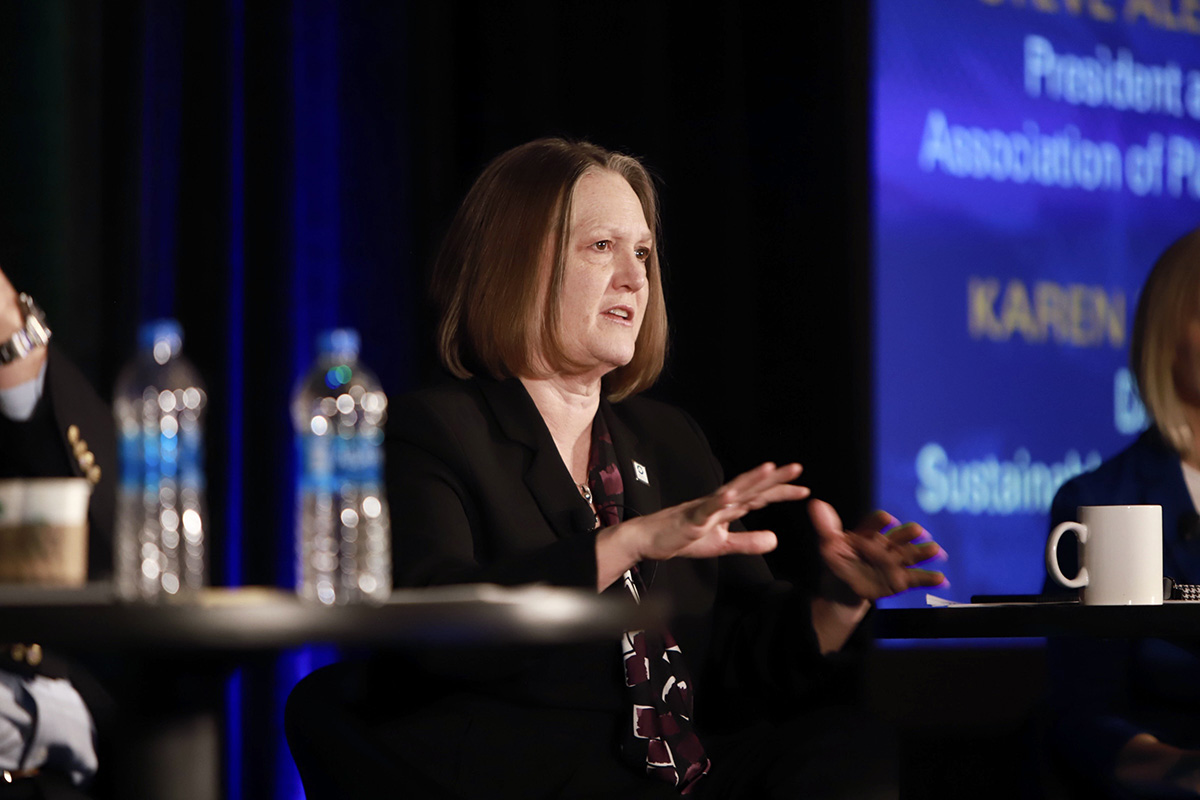
A warm welcome back to “Women in Circularity,” where we shine a light on women moving us toward a circular economy. This month, I was pleased to connect with a leading voice and policy innovator in sustainable materials management: Heidi Sanborn. Heidi is the executive director of the National Stewardship Action Council, a national nonprofit organization that advocates for a responsible circular economy using extended producer responsibility (EPR) and other policy tools. With nearly four decades of experience, Heidi is often referred to as the “godmother of EPR” in the US. She has helped pass more EPR laws than anyone else in the US, building coalitions, inspiring new voices and creating solutions that deliver real results.
You’ve been a powerful voice in shaping circular economy policy in the US. What first motivated you to focus your career on waste reduction and how has your journey evolved over time?
From an early age, I noticed how casually we treated waste and littered our natural areas. It troubled me deeply to the point that I would pick up all the litter in our local park and I started a newspaper recycling route with my red wagon, collecting newspapers from neighbors. And my dad would help me load them into our Town & Country station wagon and drive to the paper recycling station in Wilmington, Delaware—where we weighed the car in and out and got paid for every pound we recycled.
My parents are scientists and taught me how to compost too, and we had to deal with neighbors that were worried about rats so I learned about NIMBY-ism [“not in my backyard”] early on and how to manage those discussions. Over time, I realized this was a systems problem, not just an individual behavior issue. That understanding led me into policy—because that’s where we have the biggest opportunity to shift responsibility to upstream, require producer accountability and design waste out of the system. My career has really evolved from raising awareness to building and passing laws all across the US that make systemic change possible.
As the founding director of the National Stewardship Action Council a decade ago, you’ve led major efforts to advance EPR and corporate accountability. What’s one achievement you’re especially proud of that moved the needle on producer responsibility?
I’m especially proud of helping thoughtfully and democratically negotiating and passing California’s SB 54, the strongest and fairest producer responsibility law in the nation—as it was written, negotiated and passed. It was the product of years of coalition building and tough negotiations from everyone involved, from companies to policymakers, environmental organizations, recyclers, waste haulers and local communities.
SB 54 not only requires producers to fund recycling and plastic pollution reduction but also created a national model for how bold EPR laws can be written and implemented prioritizing source reduction.
Today, I’m also one of the leaders working to hold CalRecycle and Governor [Gavin] Newsom accountable for implementing the law as it was passed—without carveouts or loopholes—so that Californians can fully realize its economic and environmental benefits. But this work isn’t just about California. Through the National Stewardship Action Council, we’ve taken the movement nationwide, and what happens here has ripple effects for other states that are passing and implementing EPR laws, as California has almost 40 million people and drives markets as the world’s fourth largest economy.
You’ve helped craft legislation, build coalitions and influence national conversations. Is there one project or policy effort that stands out as especially transformative?
I am most proud of sponsoring and passing SB 212 in California—still the only full EPR program in the nation for medications and needles. That was a full internalized cost EPR program fighting Big Pharma and required us to pass 12 local EPR ordinances and withstand a court challenge against Alameda County, the first county to pass EPR for medications, all the way to the US Supreme Court. No one thought we could beat them, and we did!
It’s so important because it goes to show that you don’t need the most money or lawyers, you need to have the will and stamina to fight for what is right to protect public health from fueling drug addiction or flushing medications into our water system and our workers from needlesticks.
More recently, we have co-sponsored SB 501 and SB 561 in California—two of the first EPR laws in the country addressing household hazardous waste and the only proposed EPR program in the world for explosive marine flares. Not only is the marine flares law the first of its kind in the world, both of these bills protect workers, public health, the environment, and ensure fairer markets by requiring producers to take responsibility for managing these difficult waste streams.
And we’re increasing awareness of issues around worker safety and public health on a national stage from household hazardous waste to marine flares to lithium-ion batteries and more. We should not have the fourth most deadly industry in the nation— it’s time to fix that by removing toxics and dangerous products from waste streams by making sure we have convenient and proper management systems for them!
What trend or development in the circular economy policy space are you most excited about right now—and what should people be paying closer attention to?
I’m excited about the momentum around “turning off the spigot” of waste, be it through reuse systems or product or packaging redesign. Recycling is essential, but it is not the most cost-effective answer—and while recycling is part of a circular economy, it is not a circular economy in itself. That’s why I’m honored to lead the National Stewardship Action Council, the nation’s only nonprofit dedicated exclusively to advancing the full spectrum of circular economy solutions. We convene companies, communities, policymakers, NGOs and the public to build systems that prioritize durability, repair, recycling, rethinking, redesigning and reuse.
I’d encourage people to watch how refill pilots and right-to-repair policies are gaining traction—these are the systemic shifts that will make waste prevention mainstream. Truthful labeling is also extremely important at improving the public trust of the product management system.
Do you have any recommendations for folks to stay informed and engaged in circularity?
Honestly, the best way is simple—get involved! Join us at the National Stewardship Action Council and connect with local groups to stay inspired and active.
MaryEllen Etienne is the creator of “Women in Circularity.” Etienne works on the Market Transformation and Development team for the US Green Building Council. She has over 20 years of experience in sustainability and is a champion of the circular economy.