






Resource Recycling
  • The Latest
  • Analysis
    • All
    • Certification Scorecard
    • Industry Announcements
    • Opinion

    Certification Scorecard — Week of June 1, 2026

    IT asset disposition and electronics recycling: Now and then

    $60 billion in AI servers will create an ITAD challenge

    The independent ITAD at a crossroads

    DMD acquires ITAD firm Lifespan, outlines acquisition strategy

    Packaging policy is not one-size-fits-all

    Packaging policy is not one-size-fits-all

    Industry announcements for January 2026

    Industry announcements for June 2026

    Europe’s recyclers miss most of the critical materials

    Europe’s recyclers miss most of the critical materials

  • Conferences
    • Resource Recycling Conference
    • Plastics Recycling Conference
    • E-Scrap: The Longevity Conference
    • Textiles Recovery Summit
  • Publications
    • E-Scrap News
    • Plastics Recycling Update
    • Policy Now
    • Resource Recycling
    • Other Topics
      • All Topics
      • Brand Owners
      • Critical Minerals
      • Glass
      • Grant Watch / RFPs
      • Markets
      • Organics
      • Packaging
      • Research
      • Technology
      • Textiles
Subscribe
No Result
View All Result
Resource Recycling
  • The Latest
  • Analysis
    • All
    • Certification Scorecard
    • Industry Announcements
    • Opinion

    Certification Scorecard — Week of June 1, 2026

    IT asset disposition and electronics recycling: Now and then

    $60 billion in AI servers will create an ITAD challenge

    The independent ITAD at a crossroads

    DMD acquires ITAD firm Lifespan, outlines acquisition strategy

    Packaging policy is not one-size-fits-all

    Packaging policy is not one-size-fits-all

    Industry announcements for January 2026

    Industry announcements for June 2026

    Europe’s recyclers miss most of the critical materials

    Europe’s recyclers miss most of the critical materials

  • Conferences
    • Resource Recycling Conference
    • Plastics Recycling Conference
    • E-Scrap: The Longevity Conference
    • Textiles Recovery Summit
  • Publications
    • E-Scrap News
    • Plastics Recycling Update
    • Policy Now
    • Resource Recycling
    • Other Topics
      • All Topics
      • Brand Owners
      • Critical Minerals
      • Glass
      • Grant Watch / RFPs
      • Markets
      • Organics
      • Packaging
      • Research
      • Technology
      • Textiles
Subscribe
No Result
View All Result
Resource Recycling
No Result
View All Result
Home Plastics

Flexibles players push for collaboration, balance

Antoinette SmithbyAntoinette Smith
March 31, 2026
in Plastics, Recycling
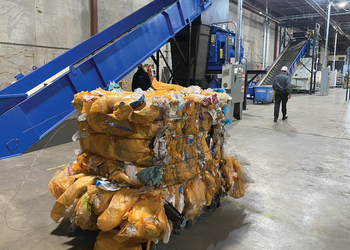
Flexibles players push for collaboration, balance

Photo courtesy of Charter Next Generation

Perhaps more than other formats, flexible packaging has faced backlash amid a wave of US legislation aiming to decrease reliance on fossil fuels and reduce plastic waste. 

Since its inception, flexible packaging has been touted as energy efficient, taking up less space and weighing less, to help reduce emissions from transportation. However, the format also has been characterized by the use of mixed materials – a polymer outer layer, a thin aluminum foil layer and another polymer layer – that make recycling a challenge. 

As such, flexible packaging stakeholders including Charter Next Generation (CNG) and others including the Flexible Packaging Association (FPA) have seen customers seek monomaterial solutions, to help ensure recyclability. This shift has occurred despite brands scaling back plastics goals, a change in US policy priorities, and increased costs stemming from macroeconomic and geopolitical pressures. 

Kristin Edie, CNG director of sustainability and regulatory, said the material sciences firm is seeing an increase in demand from customers concerned with source reduction requirements, especially in California. 

The first step tends to be downgauging, or making film thinner, but this approach is feasible only to an extent, she said. “PCR is really a great approach for them to meet source reduction targets of 10%,” of which 8% can be PCR, she said. “Customers are definitely seeing PCR as an avenue to meet the source reduction goals without needing to further downgauge the packaging.” 

CNG joined the US Flexible Film Initiative (USFFI) in March as an associate member, only the second packaging manufacturer after Emerald Packaging. 

Coalition members provide funding for recyclers to launch initiatives for film and flexible packaging, starting with California. These subsidies are meant to bridge the gap between the cost to recycle plastics and the price at which companies can sell the recycled material at profit.

Designing for recyclability

Most states will assign lower fees for single-material packaging to help ensure recyclability and meet recycling rate targets, a practice known as eco-modulation, Edie said. 

“But it still requires trials and testing because a lot of mixed material solutions have been used by companies for many years and they have a lot of confidence in that.” For example, the brand owner may be concerned that a monomaterial package will not be strong enough.

In an annual FPA survey, members have cited the qualities “recycle ready” and “all PP or PP/PE” as top priorities since the 2023 FPA report, with “PCR” not far behind, despite the concepts taking a backseat to economic pressures in 2025, CEO Dan Felton said in March at the Sustainability in Packaging conference.

The sustainability “trend may be a momentary setback, and sustainability will likely continue to be a major driver for brand owners in the mid- and long-term future,” both globally and regionally, Felton added.

Food applications

Food packaging is a major outlet for film and flexibles, Felton said during the March conference. Flexibles represent 20% of the US packaging market – second only to corrugated cardboard – and around half of that share is used for food applications, according to FPA’s upcoming 2025 State of the US Flexible Packaging Industry Report. 

Edie said building public confidence about using PCR in food-grade applications requires more analysis, to provide science-based safety data. CNG is currently testing different batches of PCR to validate its performance, as well as to determine which grades are the most compliant from a regulatory perspective, she added. 

And while incorporating PCR may involve added cost, bigger companies tend to accept the business case, Edie said. “They also are facing bigger estimates on their EPR fees, and big brands feel they are going to be the ones called out if they’re not compliant, more than small companies,” she said.

That higher profile position results in bigger brands employing rigorous processes to ensure product safety, which “doesn’t happen overnight,” she said. As an example, she visited a key PCR supplier’s factory to conduct food safety audits and check that the applicable US FDA Letter of New Objection (LNO, or NOL) meets full compliance standards, and to follow up with extensive lab testing on the PCR.

“Regulators are very well-intentioned and the NGOs have their point of view, which I completely understand,” but goals often collide with the practical realities when executed at the retail level, she said. 

One example is California’s SB 343, known as the “truth in labeling” law, scheduled to take effect Oct. 4, but in mid-March an industry coalition filed suit, seeking to block enforcement. 

FPA said in a March 17 statement that flexible packaging used in a wide range of consumer goods including food and household products helps to preserve and protect products and provide convenient packaging solutions. “SB 343 restricts our ability to provide important recycling information and relies on standards that do not always reflect real world recycling conditions,” the organization said in the statement.

Prior to the filing, Felton said at the March conference that FPA – which is part of the coalition –  “generally opposes state-led compostability and recyclability labeling laws due to interstate commerce issues unique to packaging manufacturing and product distribution.” While FPA supports the PACK Act and other federal initiatives, it opposes “most” recycled content mandates proposed so far “because we don’t think they’re thoughtful or mindful of the unique challenges around flexible packaging.” 

He noted that laws treat films and flexibles inconsistently – for example, Oregon supports collection depots and alternative methods while California’s approach is to ban these formats. Like many recycling stakeholders, FPA is seeking harmonization among the various state-level packaging laws. 

Collaboration to balance sustainability, performance

With some stakeholders opting to pursue paper-based alternatives for flexible packaging, Edie said there’s room for collaboration, to ensure materials are both sustainable and practical. 

“We don’t want to increase food waste as we try to reduce the packaging and wind up shortening the shelf life of a product,” she said. “That’s where industry could provide more data, like how this material extends shelf life by so many days. So I think as an industry, we may say those things, but we need the data to take to the regulators. We want to be science-based.

“Could paper packaging have a film lining for food safety reasons, so there’s some source reduction but still is meeting the needs of the product? Those are the kinds of things where meeting in the middle is actually some of the great opportunities that exist here,” she said. 

“If the industries can come together, that’s probably where the greatest opportunity is.”
Tags: Film & Flexibles
TweetShare
Antoinette Smith

Antoinette Smith

Antoinette Smith has been at Resource Recycling Inc., since June 2024, after several years of covering commodity plastics and supply chains, with a special focus on economic impacts. She can be contacted at [email protected].

Related Posts

Packaging policy is not one-size-fits-all

Packaging policy is not one-size-fits-all

byDan Felton, president and CEO, Flexible Packaging Association
June 1, 2026

Flexible Packaging Association head Dan Felton makes the case for smart policy to suit the large, diverse sector.

Film and flexibles recycling needs collaboration

byBrian Clark Howard
May 29, 2026

Experts from the Film & Flex Recycling Alliance, US Flexible Film Initiative (USFFI), Delterra, The Recycling Partnership and Circular Action...

Film end user boasts greater sales

Trex points to strength from recycled film feedstock

byAntoinette Smith
May 8, 2026

Despite persistent softness in the construction sector, the deck and railing company is leaning into marketing and innovation to convert...

PureCycle sees long-term upside from Iran war

PureCycle sees long-term upside from Iran war

byAntoinette Smith
May 7, 2026

War-related supply constraints have pushed virgin resin prices much higher while feedstock bales for recycled PP have seen less dramatic...

Wineries help create model for film recycling

Wineries help create model for film recycling

byAntoinette Smith
April 7, 2026

A collaboration between California wineries and the recycling value chain has provided a closed-loop model the partners aim to see...

ag plastics field

Ag industry holds potential for recycling feedstock

byStefanie Valentic
March 24, 2026

With less than 15% of US agricultural plastics currently being recycled, insiders say the gap between what's possible and what's...

Load More
Next Post
Paper giant closes Texas containerboard mill

International Paper plans $225m Mississippi plant

More Posts

Machinex

Longview mill tragedy raises broader questions for fiber, recycling sectors

May 29, 2026
Recycling industry addresses Beyond Plastics report

Recycling industry addresses Beyond Plastics report

May 26, 2026
Fire at an EMR recycling facility in Camden, New Jersey May 29, 2026.

EMR faces shutdown calls after numerous fires

June 2, 2026
The independent ITAD at a crossroads

DMD acquires ITAD firm Lifespan, outlines acquisition strategy

June 2, 2026
What a report on Starbucks cups reveals about recycling

What a report on Starbucks cups reveals about recycling

May 26, 2026
War, not demand driving polymer pricing

War, not demand driving polymer pricing

June 2, 2026
Q1 containerboard exports drop by 19%

What SB 54 looks like from the packaging floor

June 1, 2026
California extends compostable labeling law

California bills crack down on false recycling, compostable claims

May 29, 2026
IT asset disposition and electronics recycling: Now and then

$60 billion in AI servers will create an ITAD challenge

June 3, 2026
BASF, Encina expand circular feedstock partnership

BASF, Encina expand circular feedstock partnership

June 3, 2026
Load More

About & Publications

About Us

Staff

Archive

Magazine

Work With Us

Advertise
Jobs
Contact
Terms and Privacy

Newsletter

Get the latest recycling news and analysis delivered to your inbox every week. Stay ahead on industry trends, policy updates, and insights from programs, processors, and innovators.

Subscribe

Welcome Back!

Login to your account below

Forgotten Password?

Retrieve your password

Please enter your username or email address to reset your password.

Log In

Add New Playlist

No Result
View All Result
  • The Latest
  • Analysis
  • Recycling
  • E-Scrap
  • Plastics
  • Policy Now
  • Conferences
    • E-Scrap Conference
    • Plastics Recycling Conference
    • Resource Recycling Conference
    • Textiles Recovery Summit
  • Magazine
  • About Us
  • Advertise
  • Archive
  • Jobs
  • Staff
Subscribe
This website uses cookies. By continuing to use this website you are giving consent to cookies being used. Visit our Privacy and Cookie Policy.