


A scientific review panel has given the green light to several different technologies to recycle post-consumer PET and polyolefins into 100% recycled-content food and drink packaging.
Over the past six months, a panel at the European Food Safety Authority (EFSA) has reviewed PET recycling technologies from EREMA, Kreyenborg and Starlinger. The committee, which is called the Panel on Food Contact Materials, Enzymes and Processing Aids (CEP), also reviewed multiple closed-loop HDPE and PP recycling projects, and it rejected a proposal to recycle production scrap.
In the European Union, recycled plastics can only be used in food and beverage packaging if they’re first reviewed by the EFSA for safety.
Twice a year, Plastics Recycling Update covers the panel’s opinions. The most recent roundup was published in June 2022. The following are CEP determinations that have been published since then.
(Note: In all the PET recycling processes below, the inputs are washed and dried PET flakes derived from post-consumer food and drink containers. The CEP approvals allow the RPET to be used in 100% recycled-content food and drink packaging.)
Multiple EREMA processes
The CEP gave a thumbs-up to a number of reclaimers seeking to use EREMA recycling technologies to recycle PET.
On May 18, the panel approved two applications to use the EREMA Basic process. One application came from Austria-based EREMA itself, and the other came from Société Générale de Recyclage (SGR) of France.
That process involves continuously feeding PET flakes into a reactor equipped with a rotating device, running in a vacuum under high temperature. The flakes spend a set amount of time in the reactor before they’re continuously conveyed into an extruder. In the extruder, they melt, and the product is then filtered and pelletized.
On May 18, the CEP approved another application from EREMA for the company’s MPR + DS technology. Much like EREMA Basic, this process involves feeding flakes into a reactor equipped with a rotating device, running in a vacuum under high temperature. The flakes remain for a set time in the reactor, where they’re crystallized. Then, they’re introduced into a twin-screw extruder, where they’re melted and then extruded into pellets or sheets.
Finally, on May 18, the panel approved EREMA’s application for the MPR technology. The application covers the first part of the MPR + DS technology detailed above, where flakes are processed in a reactor equipped with a rotating device.
The panel also greenlit an application to use EREMA’s Vacurema Prime process. The approval was given to Bangladesh Petrochemical Company on May 17.
Through the Vacurema Prime process, flakes are introduced into twin batch reactors, where they’re heated for a set time. In the reactors, possible contaminants are vaporized and the PET flakes are crystallized. The twin reactors then essentially take turns moving the flakes into a continuous reactor in an ongoing back-and-forth process.
In the continuous reactor, the flakes are further heated and decontaminated. Then the flakes are moved into an extruder, where they’re melted and the melt is filtered before the plastic is pelletized.
Kreyenborg’s infrared approach
The CEP approved four different applications to use Kreyenborg IR Clean+ technology to recycle post-consumer PET.
This technology involves heating and decontaminating PET flakes by means of an infrared rotary dryer under airflow, up to a defined temperature. Then, the flakes are further decontaminated in a finisher under airflow and high temperature.
On July 8, CEP approved applications for Paccor Polska of Poland, Amhil Europa of Poland, AR Packaging Flexibles of Sweden and Petainer Lidköping of Sweden.
The two Polish companies and AR Packaging Flexibles intend to use the PCR in thermoformed trays and cups to hold beer, juices, fruits, vegetables, desserts, and cooked and uncooked meats and dairy products, with or without hotfill. The packaging is not intended to package drinking water.
For its part, Petainer Lidköping is proposing to use the PCR in containers for drinking water, carbonated beverages, coffee, kombucha, beer, wine and fruit juices, with or without hotfill.
Numerous Starlinger technologies
The panel also approved a number of different PET recycling technologies from Starlinger.
First, CEP gave the OK to three applications to use the Starlinger deCON process. Through the deCON process, flakes are preheated in a batch reactor before they’re fed into the solid state polycondensation (SSP) reactor, which runs continuously under vacuum. The CEP’s decision notes that the process is run with specific temperature, pressure, gas flow rate and residence time parameters.
For this process, the CEP approved an application from U.K. company Kalex Films on May 19, an application from Greiner Packaging of Ireland on May 19, and an application from Irish company Polyfab Plastics on Sept. 15.
Greiner Packaging issued a press release noting that the EFSA has approved the decontamination process used by Greiner Packaging U.K. and Ireland at its recycling plant in Dungannon, Northern Ireland.
“This is a significant and hugely important step in our journey to use increasing amounts of recycled material in our food-grade packaging,” Julie Eller, the company’s U.K. sales director, said in the release.
The release noted the company has invested over 3.7 million British pounds (about $4.5 million) into its new PET decontamination and extrusion line. The line will help the packaging producer achieve its goal of at least 30% recycled content in all products, according to the release.
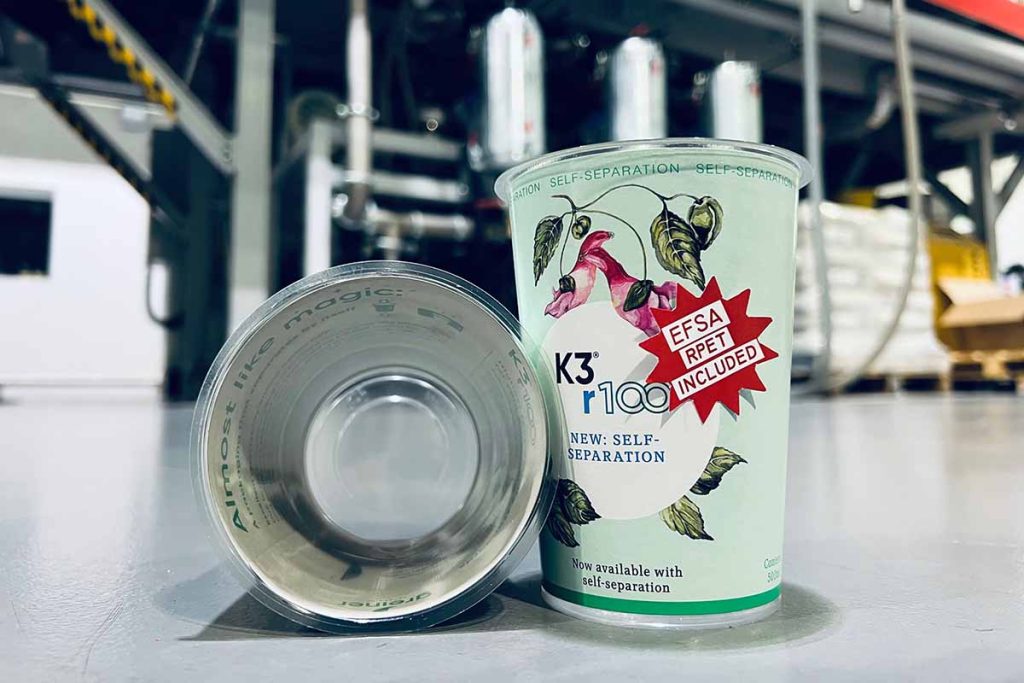
The new integrated line is also able to recycle PET trays, not just PET bottles. The equipment allows Greiner Packaging to produce its K3 brand of containers with 100% RPET. The K3 line has a PET container with a paper-based label wrapped around it; the sleeve is designed to separate from the PET before the container reaches optical sorters, according to the release.
In September, Greiner Packaging acquired Serbian PET flake producer ALWAG, which will be renamed Greiner Recycling.
The CEP also approved five applications from reclaimers planning to use the Starlinger iV+ technology.
In this process, the flakes are continuously dried and crystallized in a reactor under air flow and high temperature. Afterward, the flakes are fed into an extruder under high temperature and vacuum for a time, and then the plastic is pelletized. The pellets are then crystallized at high temperature in a continuous reactor under atmospheric pressure. Finally, the crystallized pellets are preheated in a reactor before they’re moved into a semi-continuous SSP reactor running under vacuum at high temperature for a set amount of time.
On May 19, the CEP approved applications to use this technology from Greenpet of Mexico, Circularpet IV80 of Spain, Ganesha Ecosphere of India and Extremadura TorrePet of Spain. On July 8, it approved a similar application from Brunetti Packaging of Italy.
Finally, the panel on July 8 approved an application to use Starlinger’s PET direct iV+ technology. The application came from U.S. company Verdeco Recycling Group.
In this process, the flakes are first pelletized, and then the extruded pellets are crystallized in a continuous reactor with inert gas flow for a specific amount of time. Then, the pellets are further heated and introduced semi-continuously into the SSP reactor running under vacuum, where they remain for a predefined residence time.
Closed-loop polyolefin recycling proposals
The CEP approved applications to recycle HDPE and PP crates and box pallets back into the same products, with tight feedstock source control in each case.
The panel on May 19 greenlit an application to use a recycling process called “Cajas y Palets en una Economia Circular” (CAPEC), which translates to boxes and pallets in a circular economy. The application, which came from a Spanish company of the same name, involves recycling pre-cleaned crates of food-grade HDPE and PP into new crates at up to 100% recycled content. The new crates would also be used to store fruits and vegetables at room temperature or below.
The recycling process is simple: The sorted and cleaned crates are shredded into flakes, which are washed with potable water at room temperature and then dried by a centrifuge, ground and packed in bags. Or, if the desired output is pellets, the crates are shredded, washed with potable water at room temperature, dried by a centrifuge, ground, extruded, filtered and packed in bags.
The resulting flakes or pellets may or may not be blended with virgin HDPE or PP before dye is added and the plastic is injection molded into new crates.
Later, on July 8, the panel approved an application for a recycling process from Spanish company LOGIFRUIT. The company is looking to recycle post-consumer HDPE and PP crates that hold fruits, vegetables, packed meats, fish, dairy products and bakery products.
Again, the recycling process is simple: Damaged crates are pre-cleaned, sorted and ground. The flakes are further washed with water, dried and packed. Later, they may or may not be blended with virgin HDPE and PP before they’re injection-molded into new crates.
The number of reprocessing cycles is low, the application notes, because crates have a lifetime of 120 uses or more, and only about 4% of them break each year.
Finally, on May 18, the CEP approved an application to recycle HDPE box pallets used by slaughterhouses to store and transport packed and unpacked meats into new box pallets for the same use. The application was submitted by Dutch company Kunststof Recycling Nederland.
Again, the recycling process is simple and involves shredding the box pallets and then removing metals. The shredded pieces are then ground, de-dusted, packed in big bags and labeled. The plastic may or may not be blended with virgin HDPE before Dolav Plastic Products molds it into new box pallets.
Production scrap proposal rejected
The panel on Sept. 15 rejected an application from U.K. company Loop Polymers to recycle PE and PP production scrap from food packaging manufacturing into new food packaging.
The company had applied to recycle printed offcuts and scrap. Through the process, the scrap would be hand sorted, washed, and wet- or dry-ground into flakes, which would be washed in friction vessels to remove inks, coatings and adhesives. The resulting flakes would be used at up to 30% recycled content in new PP or PE products, according to the application.
But the panel wasn’t convinced by the data it was provided.
“The applicant has not demonstrated by appropriate evidence that the recycling process is able to reduce contamination of the input PE or PP offcuts and scrap with printed ink and coating systems to a concentration that does not pose a risk to human health,” according to the decision.