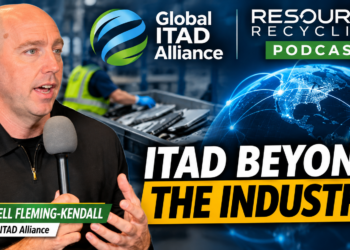




On the floor at E-Scrap: The Longevity Conference in New Orleans, Uriah Kiser talks with Dan Wang of Toyoshima Green Tech, whose booth featured robots that disassemble electronics and harvest chips from circuit boards.
Dan explains how his semiconductor background led him to the U.S. — “a mine for e-waste” — to harvest chips, critical metals like tantalum and rare earths like neodymium and praseodymium. He walks through falling robot costs, why human-plus-robot teams outperform human-only lines by the end of the day, and his case that robotics can bring jobs back to the U.S. with roughly a six-month payback.
Like, comment, subscribe, and turn on notifications so you don’t miss the next conversation on the Resource Recycling Podcast.
Transcript of episode 13: The Resource Recycling Podcast
Host: Uriah Kiser, Resource Recycling | Guest: Dan Wang, Toyoshima Green Tech
Uriah: Hey everyone, welcome back to the Resource Recycling Podcast. I’m Uriah Kiser, here with Dan Wang from Toyoshima Green Tech, and you are doing some really cool things with robots. I really appreciate you being here at E-Scrap with us in New Orleans and coming on the Resource Recycling Podcast. How are you today?
Dan: So far so good. It’s always a good time to connect with suppliers and downstream.
Uriah: There are so many things happening here in New Orleans, and you have one of the most interesting booths at the conference. If you look right behind us, we have robots, and we’re going to tell you all about them. But first, Dan, recap for me how you got into this business, because you saw an opportunity in U.S. circuit boards.
Dan: My background is semiconductor manufacturing, not refurbishing. I know that in Asia we use a lot of refurbished chips, and most of that resource comes from the U.S. The second source is Europe and the third is Japan. So I thought if I want to do this business, it’s better to go to the source. If you want to generate electricity, it’s better to generate it at the coal mine. The U.S. is like a mine for e-waste, for chips and rare metals. That’s why 10 years ago I decided to come to the U.S. to do chip harvesting. That’s our background, and it’s still our main source of profit.
Uriah: The company came from Taiwan and Japan, and you’re now in Dallas, right?
Dan: Yes.
Uriah: Talk about that and your move to Dallas and how you operate.
Dan: My background is semiconductor manufacturing, but a long time ago this was actually technology from the U.S. [unclear: company name], and the company is still there. They had a branch factory in Taiwan, in [unclear: city]. My father was president there for eight years, so he had the technology. Then the company decided to stop producing it themselves, and my father kept the technology. That’s why I can do this.
Uriah: And you’re using robots to extract chips. Walk us through what’s going on here. Can we see the robot move? Can we see him do his thing?
Dan: The robots are very critical for e-waste. Why? Everybody knows the value. You have chips, you have good boards, you have gold, copper and rare metals. Everybody knew it before me, but they couldn’t do anything because they didn’t have a robotics background. I happen to have a robotics background and a semiconductor background, so I was the first one to promote this. Before me, no one. But after I started, we got a lot of followers, here and in China. With robotics, we can disassemble devices here in the U.S. and harvest chips, critical metals like tantalum, and rare metals like neodymium from e-waste. Without robotics, no chance, because the labor cost was way too high. Now robot prices are about 30 percent of what they were five years ago, and AI is increasing the power of the robots. Those two things together make it happen.
Uriah: You have a great perspective on AI and what it means for the future, and I want to get to that. But first, these robots used to be very expensive, and they’ve come down in price. Let’s talk about that.
Dan: Compared to three years ago, the price has dropped to almost 30 percent. A robot like this, if we buy the components and assemble it ourselves, is only about $15,000. The whole unit is about $55,000. That’s it. And usually you can get the investment back within six months.
Uriah: I’ve heard you talk about comparing a production line of only humans with one of humans and robots together. Talk more about that.
Dan: In the beginning, at 10 in the morning, the human team is faster than the human plus robot team. After 10, the speed is equal. But after two o’clock in the afternoon, the robot plus human team is much faster than just humans, because the humans get tired.
Uriah: Or get bored, or sit on their phone and start scrolling.
Dan: Yes. And they have to go to the bathroom.
Uriah: That’s right.
Dan: At the end of the day, comparing the human plus robot team with the pure human team, the difference in output is 300 percent.
Uriah: Wow. That’s a lot of difference. We talk a lot about AI and how it’s being incorporated into our daily lives, from driving our cars to healthcare. A lot of people look at something like this and wonder, is this going to replace me? Is this going to take away my job? And you say probably not.
Dan: No, it will create more jobs. First, we now know that humans plus robotics is better than pure humans. Second, every robot needs a person to take care of it, so it still keeps the job here. A three-person team and a one-robot, one-person team do the same thing. So three jobs become one, and that looks like a reduction. But think about it: after you use robotics, your labor cost is down to the same as China. The jobs you had to outsource to China, the Philippines, Malaysia, now they can come back to the U.S. If the labor cost is the same in China and the U.S., and you have to pay shipping, which is so expensive now, why produce there?
Uriah: So this is about creating opportunity in the U.S.
Dan: Yes. Jobs will be created. Short term, no. But in the long term, business comes back. Production comes back.
Uriah: And you also make the argument that within six months it pays for itself. Talk about that.
Dan: Exactly. That’s because of the price drop. It used to be $55,000; now it’s $15,000. For example, a router like this one weighs about a pound, and you get about 80 cents per pound for it. After disassembly, you get the chip and you get the tantalum, which is a critical metal. Some even have rare metals. So it’s worth about $2.20 to $3. Subtract the 80 cents, and the difference is about $2.20. One day is 600 pieces, so your net income is about $1,200 a day. Think about that. The robot is $15,000, the total is $55,000, and you’re getting $1,200 a day. Over 22 working days, that’s about $24,000, so you could say two months to get it back. But you have labor, rent, electricity, depreciation, repairs. So to be conservative, we say six months, and you get all the money back.
Uriah: I appreciate you talking about it and showing it to us. If people want more information about Toyoshima, where should they go? How can they contact you? Tell me so we can get it all in the description of the podcast.
Dan: You can reach me at dan@toyoshima.com. That’s my email. My phone number is 972 210 5326.
Uriah: And do you pick up the phone?
Dan: Yes, I pick up.
Uriah: Amazing. Nobody picks up the phone anymore.
Dan: I still use the phone. [laughter] It’s also a WhatsApp number, so if you need videos, I can share them with you through WhatsApp. It’s the same number.
Uriah: Thank you, Dan. This has been a lot of fun. Thank you for coming on the Resource Recycling Podcast.
Dan: Thank you.
Uriah: If you want more conversations like this about the cutting edge of robotics, here at E-Scrap in New Orleans, give us a like, share this video, and hit that bell notification and subscribe button so you know when we’re talking circularity right here on the Resource Recycling Podcast. I’m Uriah Kiser. We’ll see you on the next one. See y’all.