

Resource Recycling
  • The Latest
  • Analysis
    • All
    • Certification Scorecard
    • Industry Announcements
    • Opinion

    Diversion Dynamics: Secondhand exports slow down fast fashion

    Certification scorecard for the week of March 2, 2026

    Industry announcements for January 2026

    Industry Announcements for March 2026

    HP receives ocean plastics certification

    HP Inc. earnings point to memory inflation challenge

    Certification scorecard for the week of Feb. 23, 2026

    Umicore highlights strength in recycling, catalysis

    Apto, Tusaar partner on rare earths recovery

    Apto, Tusaar partner on rare earths recovery

    Certification scorecard for the week of Feb. 16, 2026

    Sims Lifecycle leverages hyperscale decommissioning

    Sims Lifecycle leverages hyperscale decommissioning

  • Conferences
  • Publications

    Other Topics

    Textiles
    Organics
    Packaging
    Glass
    Brand Owners

    Metals
    Technology
    Research
    Markets
    Grant Watch

    All Topics

Subscribe
No Result
View All Result
Resource Recycling
  • The Latest
  • Analysis
    • All
    • Certification Scorecard
    • Industry Announcements
    • Opinion

    Diversion Dynamics: Secondhand exports slow down fast fashion

    Certification scorecard for the week of March 2, 2026

    Industry announcements for January 2026

    Industry Announcements for March 2026

    HP receives ocean plastics certification

    HP Inc. earnings point to memory inflation challenge

    Certification scorecard for the week of Feb. 23, 2026

    Umicore highlights strength in recycling, catalysis

    Apto, Tusaar partner on rare earths recovery

    Apto, Tusaar partner on rare earths recovery

    Certification scorecard for the week of Feb. 16, 2026

    Sims Lifecycle leverages hyperscale decommissioning

    Sims Lifecycle leverages hyperscale decommissioning

  • Conferences
  • Publications

    Other Topics

    Textiles
    Organics
    Packaging
    Glass
    Brand Owners

    Metals
    Technology
    Research
    Markets
    Grant Watch

    All Topics

Subscribe
No Result
View All Result
Resource Recycling
No Result
View All Result
Home E-Scrap

Offset’ effort connects telecoms and African e-scrap collectors

Dan LeifbyDan Leif
January 10, 2019
in E-Scrap
E-scrap collection in Uganda.

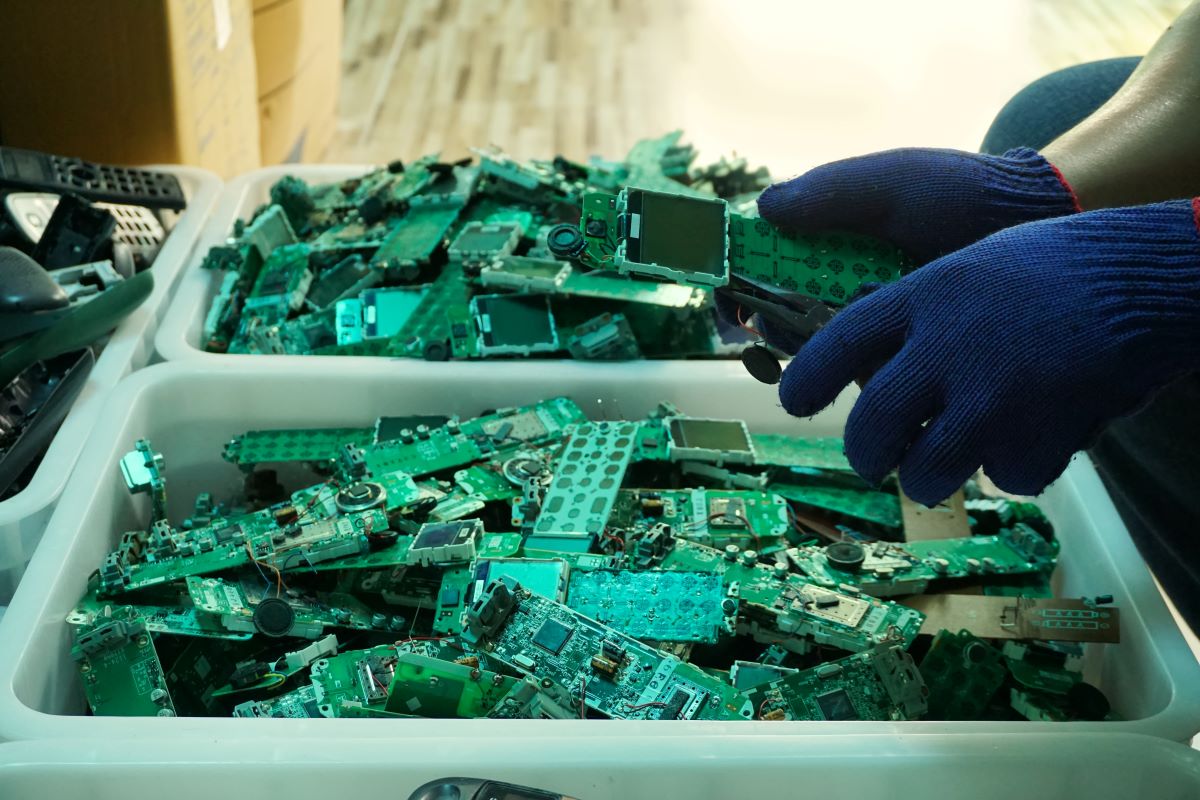
In Uganda, cell phones are collected as part of Closing the Loop.

In Uganda, end-of-life cell phones are collected before being shipped for recycling.

Tech companies are seeing boosted demand for environmental leadership, and e-scrap management concerns continue to mark developing countries. An enterprise in Europe is working to help out on both fronts.

Closing the Loop is a Netherlands-based business that contracts with T-Mobile and other wireless industry stakeholders to provide those companies with a mobile device “offset” program.

Under the model, wireless providers, phone retailers and others add a small fee to the cost of a new phone. Closing the Loop uses that money to work with informal recycling networks in a handful of African countries to collect end-of-life devices, shipping them to Umicore and other recyclers in the EU for processing.

Companies funding the initiative can then promote the fact that for each new product they put on the market, an old one has been collected and processed through proper channels. To date, the effort has collected roughly 2 million devices.

“It’s a one-for-one business model,” said Joost de Kluijver, founder and director of Closing the Loop. “It’s based on both extended producer responsibility and carbon offsetting concepts. We tried to make those good models more practical and more tangible for this market.”

No simple task

Closing the Loop is entering complex territory in establishing and scaling up the mobile offset concept. For years, global stakeholders have encountered barriers when attempting to take funding and materials recovery strategies from wealthier parts of the world and then leverage them in poorer areas.

A used cell phone recycling business in Rwanda.
A collection point in Rwanda.

According to De Kluijver, the goal of Closing the Loop is to allow informal traders to continue to move material and support their livelihoods, but to ensure safe and secure final disposition.

“We want people working in [Ghana’s] Agbogbloshie or Lagos to still do what they’re doing,” he said. “We shouldn’t be trying to roll out a European system; it won’t work. We need to include the African context and African reality. But at the point where that reality starts having a negative effect, that’s where we can make it better. Our approach puts no one out of a job.”

In 2017, U.S.-based Fair Trade Recycling launched an offset initiative that aimed to fund e-scrap collection in Ghana. But that program looked to draw funding from exporters of used material, making it different from the Closing the Loop model of collecting income from companies that push sales of new devices.

After doing work on a water project in Tanzania, De Kluijver launched Closing the Loop as a nonprofit venture in 2012 and transitioned it to a commercial business in 2014. Initially, the idea was to generate revenue entirely from the value of commodities recovered from phones in Ghana, Nigeria and Uganda.

But the economics of that approach didn’t work because it was so costly to try to set up new collection networks. “We lost money there,” said De Kluijver. “Let’s just call it ‘learning money.'”

In 2016, the business pivoted toward the current offset model with corporate backing.

Closing the Loop charges its telecom partners 2 to 5 euros per phone collected. That income allows the business to work with collectors in five African countries – Cameroon, Ghana, Rwanda, Uganda and Zambia. According to De Kluijver, collectors in the system are paid more for end-of-life phones and components than they would be if they relied on existing pathways.

He noted that in Zambia, the business pays 5 to 7 euros per kilo of intact phones. “We didn’t find anyone there paying anywhere near the price,” he said. In Rwanda, Closing the Loop is able to pay about 10 percent more for old phones than local buyers, he said.

Relationships on the ground

Much of the work done by Closing the Loop thus far has involved developing relationships with small-scale traders who help Closing the Loop build collection networks.

“In their country, they have dozens or sometimes several hundred people in their networks,” said De Kluijver. “We estimate 2,000 to 3,000 people have benefited from being part of our supply chain.” He said collection networks now include individuals, churches and repair shop owners.

Closing the Loop founder Joost de Kluijver sits in a shipping container.
Joost de Kluijver, founder and director of Closing the Loop.

Meanwhile, the companies backing the program have a sustainability-oriented story they can tell customers. Such positioning is becoming increasingly important in the mobile market.

“A lot of customers are wanting sustainable consumption,” said De Kluijver. “Our partners are able to reach a new customer group simply by adding a small fee for each phone they are selling.”

In addition to T-Mobile, Closing the Loop has partnered with professional services firm KPMG Netherlands, which supplies mobile devices to its employees and wanted to be able to show it was consuming technology in an environmentally responsible way, De Kluijver said.

And he noted the concept is starting to garner attention from governments in Europe, such as the city of Amsterdam.

Ultimately, Closing the Loop wants to be able to establish a system in which metals recovered from end-of-life phones are tracked through the recycling process and moved back into the supply chain for new mobile products.

Such an infrastructure at scale is still years away, De Kluijver acknowledged. But he noted that mobile companies are becoming increasingly attuned to the upsides of circular IT.

“I believe the telecom industry is the first global industry that could really become waste free,” De Kluijver said. “The more customers we support, the more waste we can collect. And that allows us to become more and more a metal producer – an urban mining one.”

Photos courtesy of Closing the Loop.

 

Tags: EPRMetalsMobile Devices
TweetShare
Dan Leif

Dan Leif

Dan Leif is the managing editor at Resource Recycling, Inc., which publishes Resource Recycling, Plastics Recycling Update and E-Scrap News. He has been with the company since 2013 and has edited different trade publications since 2006. He can be contacted at [email protected].

Related Posts

Common goal of responsible end markets: transparency 

Common goal of responsible end markets: transparency 

byAntoinette Smith
March 5, 2026

Panelists from state government, Circular Action Alliance and a reclaimer explored the particulars of REMs at the 2026 Plastics Recycling...

Emerging US EPR programs spark harmonization talks

Washington designates CAA to lead EPR implementation

byStefanie Valentic
March 4, 2026

The state is the sixth to name Circular Action Alliance as the producer responsibility organization for its packaging EPR law.

Fireside Chat at PRC features CAA chief

Fireside Chat at PRC features CAA chief

byAntoinette Smith
March 4, 2026

The CEOs of the Association of Plastic Recyclers and Circular Action Alliance held a candid, spirited discussion at the 2026...

Mint, HP close loop on recycled copper

byScott Snowden
March 3, 2026

Mint Innovation produced certified closed-loop copper from HP end-of-life electronics, marking a traceable batch return to new laptops and expanding...

California selects Landbell USA as PRO for textile EPR

byStefanie Valentic
March 2, 2026

CalRecycle has tapped European recycling veteran Landbell USA to lead the nation's first textile EPR program.

State policy is redefining plastics recycling in the US

Policy Now March 2026: CalRecycle selects textile EPR PRO

byStefanie Valentic
March 2, 2026

Legislators are working to sharpen the rules governing how products can be marketed as compostable, recyclable or reusable and avoid...

Load More
Next Post
Our top stories from December 2018

Our top stories from December 2018

More Posts

Rising containerboard demand comes as OCC prices taper

November 5, 2024

Paper giants foresee continuing rise in OCC prices

August 28, 2023

North American paper mills discuss demand, OCC pricing

May 15, 2023
Chinese processing group details goals for US visit

AMP lays out vision of next-generation, AI-driven MRFs

July 24, 2024
Fireside Chat at PRC features CAA chief

Fireside Chat at PRC features CAA chief

March 4, 2026

Mint, HP close loop on recycled copper

March 3, 2026

California selects Landbell USA as PRO for textile EPR

March 2, 2026

Nova launches recycled PE grades from Indiana plant

March 3, 2026
PureCycle sees easing headwinds to R-PP adoption

PureCycle sees easing headwinds to R-PP adoption

March 3, 2026
PET bales stacked for recycling.

Evergreen closing RPET plants in Ohio, New York

February 24, 2026
Load More

About & Publications

About Us

Staff

Archive

Magazine

Work With Us

Advertise
Jobs
Contact
Terms and Privacy

Newsletter

Get the latest recycling news and analysis delivered to your inbox every week. Stay ahead on industry trends, policy updates, and insights from programs, processors, and innovators.

Subscribe

Welcome Back!

Login to your account below

Forgotten Password?

Retrieve your password

Please enter your username or email address to reset your password.

Log In

Add New Playlist

No Result
View All Result
  • The Latest
  • Analysis
  • Recycling
  • E-Scrap
  • Plastics
  • Policy Now
  • Conferences
    • E-Scrap Conference
    • Plastics Recycling Conference
    • Resource Recycling Conference
    • Textiles Recovery Summit
  • Magazine
  • About Us
  • Advertise
  • Archive
  • Jobs
  • Staff
Subscribe
This website uses cookies. By continuing to use this website you are giving consent to cookies being used. Visit our Privacy and Cookie Policy.