




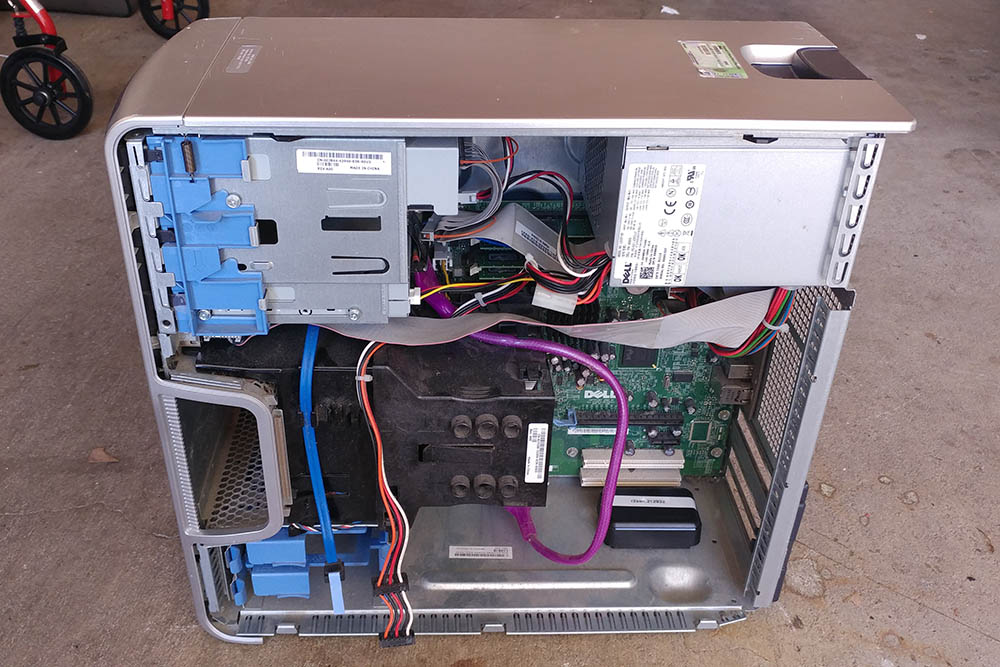
A computer tower with a tracking device provided by the Green Tracking Service (device at lower right).
A U.S. company has begun providing an e-scrap tracking service so processors and OEMs can see where their downstream vendors are sending devices. One processor is already regularly using the service.
San Francisco Bay Area analyst firm Dennis Ward Enterprises (DWE) earlier this month announced the launch of its Green Tracking Service, which it says helps companies verify proper recycling downstream, protect their brand reputations and ensure they’re meeting certification requirements.
Company CEO Dennis Ward told E-Scrap News the goal is also to build data on where e-scrap is being sent. The electronics recycling industry measures progress by weight processed, he said, but he sees room for adding other metrics.
“If we can get more visibility in how the e-waste is being moved, what’s happening to the focus materials, what’s happening to the hazardous materials, that would help as well, in addition to the weight,” Ward said.
The service is now being used by Wisconsin-based processor Dynamic Recycling. And Sustainable Electronics Recycling International (SERI), the group that administers the R2 recycling standard, is now looking at it as a potential tool to help verify certified companies’ compliance with R2.
For Dynamic, the service helps reduce risk, said Miles Harter, company CEO. “Certainly some of our large clients really appreciate it, too, because they have that extra confidence that we’re doing things right,” he added.
How it works
The Green Tracking Service provides small trackers powered with special nickel-metal-hydride batteries, which are safer in shredders than lithium-ion batteries, Ward said. The hermetically sealed devices are affixed to the electronics via adhesives or powerful magnets. They report their location once a day for up to a year or so, he said. They communicate with satellites but can also connect with cell towers if a GPS signal is unavailable. They also send an alert when removed from a device.
A sample screenshot of a tracking map from Green Tracking Service.
DWE’s software can also send alerts when devices enter specific areas of concern. As an example, Ward said a processor could be notified when a device has been shipped to Guiyu, China. Guiyu has gained infamy for low-tech recycling practices and the resulting pollution and human health problems, although Chinese authorities have cracked down on illegal processors in the area.
DWE charges $80 per tracker and $15 a month for a subscription to the software dashboard. Ward said the pricing is such that his company wants to speed adoption by the industry.
“The more trackers that are out there, the better the data that we get,” he said. “That’s really where we want to go.”
Growth of trackers
E-scrap tracking technologies jumped to the forefront of industry conversation starting in May 2016. That’s when watchdog group Basel Action Network (BAN) first announced it had placed over 200 trackers in broken electronics in the U.S., dropped them off for recycling, and monitored where they went. It was part of BAN’s ongoing e-Trash Transparency Project, which aims to expose companies exporting broken electronics overseas. On May 24, BAN revealed that it has also placed trackers in scrap electronics in Europe. It followed devices from Europe to sites in Thailand.
The e-Stewards certification standard is also using the trackers to verify whether certified companies are complying with the standard’s downstream requirements.
SERI has been talking with Ward about using the trackers to help verify R2 compliance. A tracking program was one of several priorities identified by SERI in its recently released strategic plan.
DWE, a firm that helps companies with systems integration and deploying smart and connected devices, first began looking at offering an e-scrap tracking service after Ward met a Dynamic Recycling representative at a robotics show in San Jose, Calif. in September 2016. The Dynamic staffer was looking for a solution to help fulfill R2’s requirements related to downstream vendors, Ward said.
In early 2017, DWE began searching for and testing trackers. By the latter half of the year, it had settled on which trackers it wanted to purchase and supply.
Reducing risks
Dynamic, DWE’s first Green Tracking Service customer, came on board in April 2017, Ward said. The company has locations in Wisconsin and Tennessee, both of which are certified to R2.
Harter said his company has been working with GPS trackers for about a year and a half, even before signing up with DWE. “The No. 1 reason that we started it to begin with was just purely from a risk standpoint,” he said.
His company has a solid audit program and compliance team, he said, “but if anything bad happens, we want to make sure we’re doing everything we can to keep ahead of it.”
While not the first vendor Dynamic has worked with, DWE is the latest and best, Harter said. In the past, his company has found it difficult to find devices that pingback consistently. “It’s definitely the best one we’ve had, and we’ve experimented with a lot of them,” he said.
Dynamic added language to forms for its downstream vendors notifying them that Dynamic may implant trackers in devices, Harter said. The company is randomly putting a few of them in devices each month.
Harter estimated Dynamic spends $65,000 to $70,000 a year on its tracker program, including costs associated with research and development, implementing processes and procedures, follow-up work and more. His company continues to roll out the program.
“In our minds, the people that use these things and get proactive on it are probably going to have a better chance than the people that don’t, because it’s a risky world,” Harter said.
Other potential users
Ward said he’s started talking with electronics manufacturers about the Green Tracking Service; DWE even had a couple of pre-pilot projects with one OEM.
Jason Linnell, executive director of the National Center for Electronics Recycling, said he could see the service proving useful for anyone hiring or overseeing recycling companies – state governments, manufacturers and others – so they can track material downstream.
“It might also be useful for tracking whether out-of-state material is making its way into state programs where they shouldn’t,” Linnell said.
SERI has been working with Ward for a number of months, said John Lingelbach, SERI’s outgoing executive director.
“Our aim has been to get a better understanding of GPS trackers and how they can help reduce the risks and liabilities of corporate customers and recyclers with respect to mismanagement of material by downstream vendors,” Lingelbach said. “Of course, of particular concern are illegal exports. SERI is still evaluating how trackers could effectively be used in the context of a certification program – there are both logistical and evidentiary hurdles. In the meantime, however, it does appear that trackers can be used effectively by the private sector.”