This article originally appeared in the April 2019 issue of Resource Recycling. Subscribe today for access to all print content.
While many communities have implemented recycling and composting programs to divert waste from landfills, few have implemented sustainable waste management solutions that recover, reuse or transform waste locally.
At the same time, global constraints on exporting recyclable materials are driving more communities to explore domestic solutions and innovative technologies to both manage waste and create new jobs, research and businesses.
How can governments and other recycling stakeholders take steps to ensure that material collected in a jurisdiction finds an end market nearby? This is the industry transformation that must take place to truly establish a circular economy.
A project in one Upper Midwest county is demonstrating a path forward.
Grew out of goal
Four years ago, Michigan-based Kent County Department of Public Works (DPW) set a bold goal to divert 90 percent of county-generated trash from landfills, including its own South Kent Landfill, located 12 miles south of Grand Rapids. Kent County DPW currently processes over 1 billion pounds of waste every year and estimates 75 percent of the waste entering the landfill could be reused or recycled, with an additional fraction having potential to be converted to energy or fuel.
Additionally, it’s a fact that millions of dollars in reclaimable resources are buried in the landfill every year. A 2016 study by the West Michigan Sustainable Business Forum found the value of Michigan-generated municipal solid waste discarded into landfills and incinerators exceeded $386 million annually.
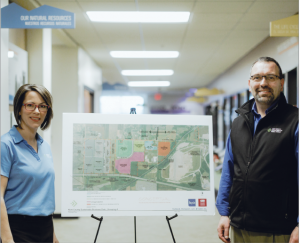
As a first step, Kent County DPW began to develop a plan for a Sustainable Business Park that would become a vital part of achieving its 90 percent reduction goal.
Over the past 30 years, Kent County DPW has purchased 250 acres of property adjacent to the landfill under the assumption that it would need to expand landfill operations to meet disposal demand. Instead of beginning the permit process to expand the South Kent Landfill, the county set out on a drastically different path that aims to shift the local materials management paradigm.
The goal of the Sustainable Business Park is to attract companies and partners that specialize in recovering discarded materials, reusing and recycling the recovered materials, or recovering the energy of those discards. It would also create opportunities for complementary businesses, startups and entrepreneurs to tap into these reclaimed or converted materials and transform them into intermediate or final products – items such as clothing, automotive components, animal feed and much more.
There are many benefits of that kind of development. First, the plan will help Kent County DPW maintain capacity in the current landfill while turning toward a new model to manage trash. At the current rate, the South Kent Landfill is expected to be full in less than eight years.
Second, the business park would create opportunities for economic development, education and research, agriculture and recreation. As companies seek more sustainable solutions that are healthy for both the environment and the bottom line, and as consumers become more aware of companies that prioritize sustainability, the Sustainable Business Park would help drive efforts to boost the local economy and promote sustainability throughout the community.
Third, the business park would become a destination for the community to experience firsthand a sustainable materials management system where waste materials are smartly leveraged.
Getting project off the ground
In the fall of 2017, Kent County DPW hosted a series of conversations with community members, business leaders and key stakeholders with the help of local and national experts. The dialogue was led by Gershman, Brickner & Bratton, Inc. (GBB), a waste management consultant. Over the course of a year, Kent County DPW worked to gather input from waste haulers, local businesses, community leaders and other key stakeholders who would help inform the master plan.
Throughout the process, the combination of community stakeholders and technical experts allowed Kent County DPW to lay out a practical plan for the critical infrastructure needed to support a regional circular economy while leveraging private-sector development. The ambitious plan also incorporated ways to attract businesses to localize the entire recycling or conversion process. In addition to waste management, the plan outlined goals for preserving land, expanding research and generating and using renewable energy.
As part of the planning process, Kent County DPW released a request for information (RFI) to gauge interest from businesses in becoming part of the Sustainable Business Park. Twenty-three responses were received from more than 30 businesses around the world.
“We received responses from a wide variety of businesses, organizations and developers working in waste recovery and related industries,” said Jennifer Porter, senior project manager for GBB. “The proximity of the property adjacent to South Kent Landfill, a major transportation artery and a rail line positions this park to host a variety of complementary businesses that could convert waste materials into usable products like fuel pellets, plastic beads, textiles and more.”
After a year of community engagement and planning, Kent County DPW and its waste management planning team presented the Sustainable Business Park master plan to the Board of Public Works. The plan received unanimous approval in October 2018.
“The Sustainable Business Park is an important step in the right direction to finding alternatives to landfilling waste,” said Dar Baas, director of Kent County DPW.
“The Board of Public Works’ approval of this master plan indicates broad support for moving toward implementing a practical, innovative approach to managing our waste while creating jobs in our region.”
Initial areas of focus
The master plan recommended three projects that can be implemented immediately to help address the growing amount of waste going into local landfills. These projects include processing construction and demolition (C&D) waste, implementing “ash mining,” and composting organic waste.
There are two companies interested in developing an ash-mining facility in the park. The selected company would pay the county for metals pulled from the ash created at the county-owned waste-to-energy facility, which burns refuse to create electricity. More than 1 million tons of combustor ash is already in place at the landfill. It is estimated leftover metals may have a value near $1,000 per ton.
On the C&D waste front, Kent County DPW is developing plans for processing the material. And there is also movement on implementing a composting facility to capture the estimated 30 to 35 percent of waste entering the landfill that is organic.
In spring 2019, Kent County DPW will continue the business development process as it formally evaluates relationships with companies that bring the right combination of experience and solutions to the Sustainable Business Park, including those who already responded to the RFI.
And in March 2019, the Kent County DPW announced its partnership with The Right Place, a West Michigan economic development organization, to help attract businesses and investment to the business park.
West Michigan is home to companies known for their strong commitment to sustainability. Nearly 150 acres of the park will be available for manufacturers or others that see upsides to locating near waste processing or recycling facilities or might benefit from local energy production. To that end, a team has been assembled to market the site and find the right mix of complementary tenants.
Replicating the concept elsewhere
Gathering community and stakeholder input was a key part of the Sustainable Business Park planning process in Kent County. As other communities look to develop and implement similar plans in their regions, similar engagement should be a top priority.
Kent County DPW first brought together national and local experts to analyze necessary improvements, costs, funding sources and a proposed implementation schedule for the business park. A number of community listening sessions were also held to gather feedback from community members, business leaders and waste haulers.
These conversations were an important part of ensuring all stakeholders had the opportunity to weigh in on the planning process. This included the formation of an advisory council that helped guide decisions throughout the planning process and ensured support for the final plan.
With this information, Kent County DPW was able to develop a plan that will guide the community over the next three years as it decides how to turn away from landfilling as the primary disposal approach. With DPW’s guidance, local leaders will determine the environmental legacy that community members will leave.
The Sustainable Business Park will play an essential role in protecting the environment, bringing value to what is currently discarded, and reducing the impact of waste for generations to come in West Michigan.
Kristen Wieland is the communications and marketing manager for the Kent County (Mich.) Department of Public Works. She can be contacted at kristen.wieland@kentcountymi.gov.