




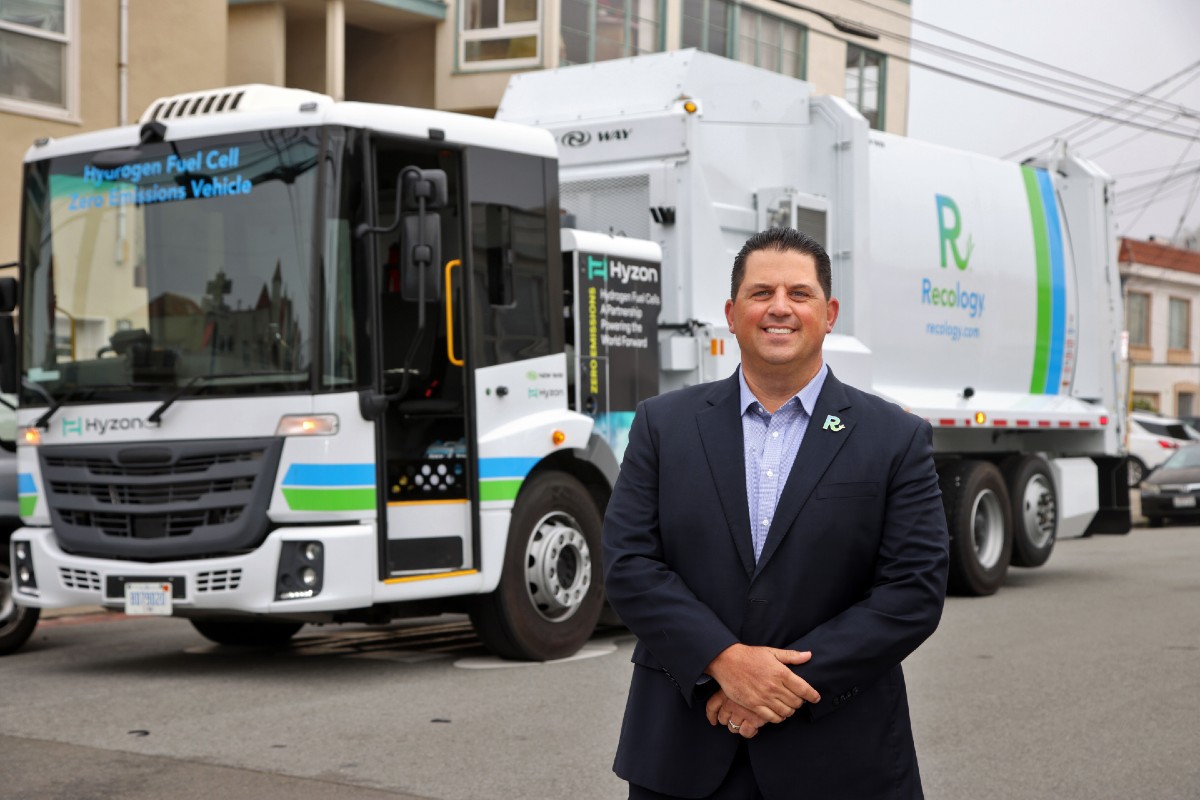
Sal Coniglio has seen a lot of change in his 6.5-year tenure as CEO of Recology. He said the San Francisco-based hauler and recycler has transformed along with an industry that’s seen rapid adoption of technology, the spread of extended producer responsibility (EPR) legislation, and increased public interest.
“Regulation and state policy has really created a lot of opportunity for our company,” said Coniglio in an exclusive interview. “We never looked at it as barriers or obstacles.”
He added, “For us, good policy starts with clear goals and operational reality.”
Coniglio said his approach to working with legislators and regulators “is to bring what we see every day in our business into those policy conversations right away.” He pointed to the buildout of EPR programs for packaging in three states in which Recology operates: California, Oregon and Washington.
“While each state, each program is doing things differently, we’re applying those lessons across the organization to help create that consistency where possible,” he said.
State by state
Oregon’s EPR rollout is “going really well,” said Coniglio. “Oregon’s a good example of where funding these programs has now created a lot of opportunity to capture recycling that normally wasn’t going to be captured.”
He specifically pointed to the state’s creation of new RecycleOn Oregon centers for dropoff of hard-to-recycle materials. Recology partnered with Circular Action Alliance on the first center in Ashland, which opened last fall, with about 140 more to come.
Washington state’s EPR packaging rollout is premature to comment on, Coniglio said, with “a lot to be worked on there.” California “is getting real close,” he said, with the recent end of the rules phase and the buildup to implementation. Coniglio said Recology is well positioned to work with the state in its aggressive recycling goals because of its long history there. “A lot of that is based on the three-bin system, which we implemented and designed in San Francisco 35 years ago.”
The next step, he said, is implementation and “learning from the real world experiences and what improvements need to be made, rather than re-debating should we move forward.”
Bigger picture, Coniglio said “policy sets the destination, but businesses like Recology help build the road to get there.” And success depends on continuous dialog with regulators and legislators, he said, both early in the process and throughout implementation.
Coniglio added that now is a promising time to expand recycling programs, backed by EPR, because the industry has matured over recent decades and is now bolstered by new technologies like AI sorters and automation.
“If you were to expand EPR aggressively 30 years ago, it would have been very challenging,” he said.
That’s because much of the processing work of recycling relied on manual labor. Processors were sorting 10 tons an hour, with high contamination. Now operators are doing 50 tons an hour, and resulting in cleaner products. And there are more public outreach pathways, Coniglio added. So programs can scale quicker.
Growth in organics
Coniglio said Recology is also well positioned to support California’s ambitious goals for organics recycling through SB 1383. The company started the first curbside organics collection program in North America, back 35 years ago, and has been building that business since. The company is now one of the largest composters on the West Coast. “We’re processing over a million tons a year of organic waste into finished compost that we’re selling out,” Coniglio said.
Key to that success has been demand from California’s massive agricultural industry, from vineyards in Napa to produce farms in the Central Valley. The established end markets in the state have been able to absorb the additional diversion brought by SB 1383, he said.
Another factor in Recology’s success on organics has been the long-term hauling contracts — on the order of 10 to 15 years — that the company has secured with municipalities.
“All these programs require a lot of capital investment, and we need these long-term commitments to pay for that infrastructure,” said Coniglio.
On the debate over compostable plastics, Coniglio said Recology does accept and process them in many of the company’s compost operations, though questions remain over how the end markets respond. Compost customers want to ensure they are getting a good product, and one that isn’t contaminated with non-compostable plastics, which can be hard to separate. Plus, the length of time it takes to break down compostable plastics can be a challenge, particularly for a system that is producing compost in as few as 20 days thanks to advanced technology.
“So it’s a huge debate,” said Coniglio. “We do accept it. I prefer we didn’t, because we want to make sure that we could still have an end market.”
Education and outreach
Recology is well known for its extensive public outreach and education work, from tours of its facilities to tabling at events and San Francisco’s Environmental Learning Center. Coniglio said, “Our best education has been when we connect one clear action with what actually happens to the material once it leaves the bin.”
In 2025, the company conducted nearly 35,000 waste reviews with customers, more than 9,000 site visits and hundreds of tours. The company also does extensive direct mail and social media. But Coniglio finds in-person events most impactful, from his colleagues speaking to homeowners’ associations, conservation groups and Rotary clubs.
Consistency on what consumers are putting in the bin is a key message, and reducing contamination. Another goal is reducing the number of lithium-ion batteries going into general recycling, which can cause dangerous fires that threaten workers and equipment.
Coniglio said another concern that keeps him up at night is safety on the road for his drivers, in a world that is increasingly frenzied and full of distractions like mobile devices. The rise of food delivery services, with many of the couriers on bikes, has also made roads more hectic.
One Recology program Coniglio is particularly proud of is the company’s artist-in-residence programs, which started in the early 1990s. Accomplished artists are invited to make art out of materials collected by the company and share with the public. Nearly 400 artists have been supported to date.
“It’s another way to make waste and recycling and diversion more visible in an unconventional way,” said Coniglio.
Coniglio said he is proud to work with the 4,500 employees of Recology every day. The company was founded in 1920 and went employee-owned in the mid-1980s.
Coniglio said he got his start in the industry at 20, when he took a job as a weighmaster at a transfer station, while in and out of community college. At that job he “fell in love with this industry.”
He spent 15 years with a family-owned waste company in northern California, where he had many different roles, from MRF supervisor to route manager to environmental compliance. He started at Recology about 10 years ago, first as a general manager in Chico, and rose through the ranks.
“I just fell in love with the people, the industry, the trucks and the recycling aspect of it,” he said.