













This article appeared in the June 2023 issue of Resource Recycling. Subscribe today for access to all print content.
Gone are the days when tonnage alone was the measure of a successful recycling program. Thanks to analytics from websites, apps, waste audits and more, today’s two-way feedback loops empower program managers to learn with unprecedented specificity about recycling matters that confuse residents. However, data is useful only if it is used.
Akin to a solid waste management plan sitting in a dusty binder on a shelf, available data can grow “virtual cobwebs” if it is not regularly tracked and employed for active engagement. Start from the beginning by evaluating available data, look for gaps and set some goals to make the most of all the numbers at your disposal.
Gamification prevents contamination
In 2019, the city of Alexandria, Va. implemented its Waste Smart 20-year strategic plan and set a five-year goal to reduce by 5% the total solid waste collected per household from its nearly 20,200 residential customers. To increase education and decrease recycling contamination, the city launched a comprehensive directory of recycling items through its “Waste Wizard” and recycling sorting game, promoting the game in local news stories, at schools and at public events.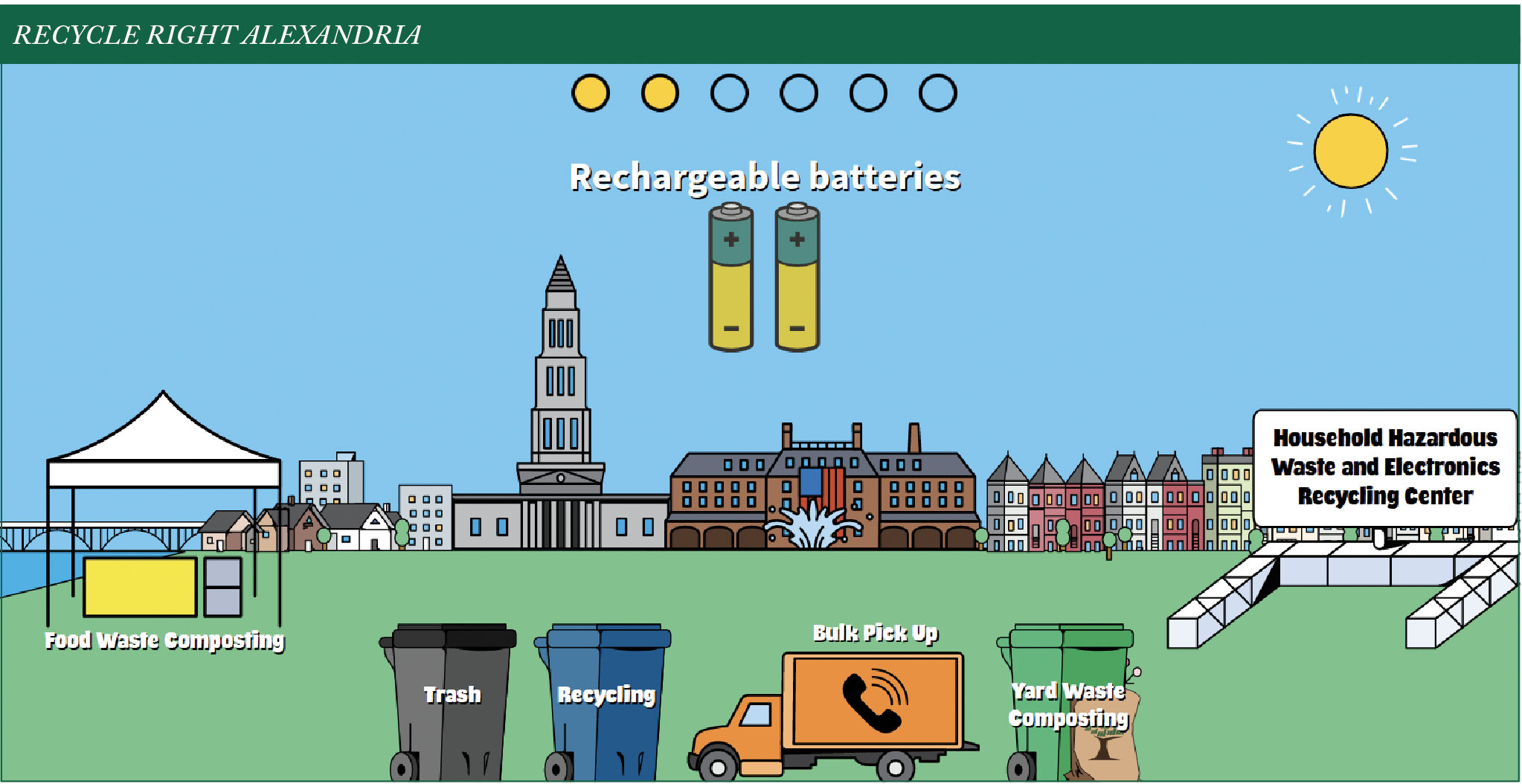
The Recycle Right Alexandria game (alexandriava.recycle.game) informs city staff, in the aggregate, about player interaction. The game teaches children aged seven and up to sort recyclables, yard waste and trash and provides only positive feedback – if the user guesses incorrectly, they get to keep trying until they get it right.
“We realized through the sorting game that many people were confused about what to do with oil filters, pool chemicals and other household hazardous waste (HHW),” said Helen Lee, environmental program manager for the city of Alexandria.
More than 28,500 people have played Recycle Right from its rollout in 2019 to April 2023, with players spending an average of 12 minutes on the game. More than 1,700 players have proudly printed certificates proving they’ve completed five levels. For context, a review of more than 10 large and small municipalities’ data reveals the average time most residents will spend on a recycling web page ranges from less than a minute to two minutes and 50 seconds.
Alexandria’s team regularly checks the game’s statistics with an analytical eye to gain insights about which items most confound residents. According to that data, several items designated for Alexandria’s HHW and Recycling Center were frequently misplaced by players. Oil filters were sorted incorrectly by 62% of players, pool chemicals by 61% and cables by 58%.
“Using this data, we decided to update our Household Hazardous Waste brochure to be more visual, with icons and graphics,” said Lee.
While a game is one tactic for encouraging behavior change, simply measuring programmatic success on gameplay alone would provide an incomplete picture.
Analyzing waste and recycling streams provides a more comprehensive view of whether educational messages are sticking. Each year, city officials in Alexandria conduct a materials recovery facility (MRF) sort to understand what is in their stream. Alexandria even goes deeper in this data process with a residue audit to learn about missed recyclables and “wishcycled” items. Five years ago, the city’s residue was between 15% and 16%. The most recent 2022 audit shows it closer to 11%.
“Looking at residue was important to us so we could understand if our specific education messages precluded people from putting the wrong items in the bin. We see common themes from our audits and inquiries we get on the app and on social media,” said Lee.
For its efforts on Recycle Right, the Resource Recovery Division received the Virginia Recycling Association’s “Show Me the Way” award, which recognizes organizations that have taken actions to make a positive impact on people’s understanding of how to recycle.
Preventing waste in the first place
Recycling alone would not enable Alexandria to reach its 5% solid waste reduction goal. Thinking outside of the bin, the city created its own “Alexandria Reuse Directory.” Initially established as a cloud-based spreadsheet, the directory is now a visual map that employs GPS to point users to the options closest to their locations if they want to look for ways to reduce, reuse and drop off items not accepted in curbside recycling.
The Reuse Directory is a simple interactive map with reuse categories for donation, repair, drop off, refill, food donation and package-free shopping. It also displays medication and plastic bag drop-off locations. The site has garnered 51,900 views as of spring 2023.
“We like how easy this is to use and the benefit of promoting local businesses committed to reuse,” said Lee. “We aren’t able to see which locations were viewed but it does help to see the popularity of the tool.”
The tools work in tandem with one another. For example, the Waste Wizard points to the reuse directory. By combining multiple focused educational efforts such as the directory, Waste Wizard and brochure, Alexandria saw a more than 27% increase in participation at its HHW drop-off center compared to five years ago.
A canadian case study
The city of Kamloops, British Columbia, a small municipality on Canada’s west coast, is striving to meet the province’s contamination goal of 3%. To accomplish this, Kamloops uses a variety of outreach and contamination monitoring methods. As part of its provincial extended producer responsibility regulations, managed by Recycle BC, the city performs daily inspections of both curbside and multi-family recycling carts using seasonal staff and at least two full-time cart and bin inspectors.
The inspector team pilot-tested Routeware, a non-public-facing recycling cart audit app, to determine contamination by route. The goal is to educate residents on what is accepted and what is not. When items that are not accepted are found in carts or bins, they are pulled out and left at the curb in clear bags so that residents can see what they have missorted. By allowing the team to observe what gets sent back, the cart audit indicates areas where education messages may fall short.
Recycle BC also conducts regular random audits of Kamloops’ material and provides a “Contamination Scorecard.” The scorecard provides contamination rates for curbside materials from 27,000 homes and the 12,000 multifamily residences, noting not-accepted material, incompatible material and hazardous material. Overall performance from 2020-22 has the city at 11% not-accepted material for the curbside program and 8.8% for the multifamily program.
The city of Kamloops added its own Waste Wizard search in the fall of 2017. Then in 2021, it promoted its own version of the sorting game through outreach and a contest. The contest offered a $100 gift card to Footprints Eco Store & Refillery and one year of free compost drop-off to two randomly selected residents who completed the game.
The promotions helped draw attention to the sorting game, with the ultimate hope of decreasing contamination. During the contest period, the game was played 890 times. Through the contest, combined with regular recycling engagement, the city saw its lowest rate of non-accepted material, 7%, according to quarterly audits by Recycle BC.
And just like in Alexandria, Kamloops residents spent longer on their website learning about recycling – an average of 5 minutes and 22 seconds, with 9,600 games completed.
“Recycling is so confusing, so I love the sorting game. It is a great tool for our residents to learn how to recycle properly,” said Marcia Dick, Solid Waste Reduction Coordinator for Kamloops. “Also, seeing our numbers continue to grow with people who want reminders is astounding. Right now, 31% of households are signed up to get reminders.”
Solid scheduling
Website widgets and apps have always been known to provide information about collection schedules. Born from two Canadian companies more than a decade ago to manage recycling and waste collection schedules, these technologies replaced antiquated paper schedules and served to answer the burning question, “When should I set my recycling bin or waste container at the curb?” As technology evolved, so did the multitasking capabilities of these apps and embedded website widgets, growing to include text notifications for holiday collection or regular recycling collection reminders.
In January 2023, the Metropolitan Government of Nashville, Tenn., changed its curbside recycling schedule from monthly to every-other-week collection for the 109,261 households served by single-stream recycling carts. Metro Nashville launched the Nashville Waste and Recycling App in March 2021, ahead of the collection change. The city’s Zero Waste team used a promotional campaign to drive traffic to the app and web widget, encouraging residents to sign up for reminders about their new collection days and to clarify collection schedules.
This campaign was invaluable for the 28,615 residents – more than one-quarter of those served – who signed up to receive reminders. Roughly 8,000 signed up in just three months following the new schedule announcement. After launching the app and a new recycling education campaign, Metro Nashville’s 46% contamination rate was drastically reduced to 21.6% in 2022.
Metro Nashville also partnered with Nobody Trashes Tennessee, a Tennessee Department of Transportation initiative, to sponsor the Get Rowdy Recycle! Game (nashvilletn.recycle.game). Despite the admittedly passive promotion of the game, more than 3,000 Nashville residents played it for an average of five minutes.
“We hooked them with the calendar option, and they stayed to use the directory, routing map and our Get Rowdy Recycle! game,” said Jenn Harrman, Zero Waste program manager.
Marrying static and digital mediums
In Tampa, Fla., recycling coordinator Shelby Lewis and recycling specialist Edgar Castro Tello – the “dynamic diversion duo” – continually implement innovative approaches to curbing contamination. The pair create social media videos, conduct neighborhood-focused cart-tagging campaigns and drive traffic to their mobile app. Listening to their residents’ social media comments, flipping recycling lids and encouraging multiple two-way communication outlets are all critical.
“Social media has been an important tool in promoting programs,” said Lewis. “People are willing to comment and share their opinion whether it is positive or negative.”
When Tampa launched its Waste Sort app in 2021, Lewis and Castro Tello went all-in on promoting it with a goal of 5,000 downloads. Results have far exceeded their expectations. A little more than a year later, there have been 9,343 downloads of the app and more than 100,000 first-time visitors have used the widget online.
The multilingual residents of Tampa have viewed the app in 13 languages other than English. “It’s helpful to see how many people are accessing this in other languages,” said Lewis. “We make sure everything we put out is in English and Spanish, at least.”
The insight of additional languages that allow for access to the wizard could result in outreach to more than just Tampa’s Spanish-speaking residents.
Don’t overlook traditional mediums like static bus benches and bill inserts. Coupling conventional mediums with digital media calls to action, such as QR codes, is a recipe for effective outreach.
Overall, between scans from their solid waste vehicles, social media ads, bill inserts and static bus bench ads, the QR code that brings users to the app download saw 13,061 unique scans between America Recycles Day 2021 and the spring of 2023. The city tracked which type of media produced the code scan.
“Our biggest ROI was QR codes on bus benches,” said Castro Tello. “The tracked scans showed which locations were most successful. We had 700 scans to our mobile app download during our Fall 2022 campaign.”
To combat contamination in targeted areas, the city also partnered with The Recycling Partnership to launch a cart-tagging campaign of 5,000 homes, which resulted in a 40% decrease in contamination for those homes. Using multiple educational touchpoints is pivotal in creating sustained behavior change.
Now what?
To measure success, start with simple tips to make data analysis more impactful. The following can help dust off those virtual cobwebs:
Look at your situational analysis; understand and actively use the available data (website/social media analytics, app data, waste/recycling audits, phone logs, etc.).
Set goals according to a timeline and anticipate an increase or decrease to measure campaign success.
Implement digital analytics from websites, social media and waste apps as tools in a toolbox that should be harmonized with other data sources such as recycling/waste audits, surveys or other tangible signs of behavior change.
Communicate internally with solid waste staff, communications departments and other municipal stakeholders, as well as with external stakeholders and the public.
When updating programs, whether adding or subtracting offerings, update all resources, websites, maps, social media and search apps.
Those still perplexed by the plethora of available data can attend a two-hour interactive workshop inviting participants to think strategically to reach their target audiences. Learn more at the Resource Recycling Conference during the “Using Digital Data to Guide Program Decisions” session, to be held Aug. 14 in Orlando, Fla.
Marissa Segundo is a principal and chief strategist at Transformations PR. She can be reached at [email protected].
Molly Schweers is an award-winning freelance writer and communicator specializing in solid waste and recycling. She can be reached at [email protected].
This article appeared in the June 2023 issue of Resource Recycling. Subscribe today for access to all print content.