




This article appeared in the March 2023 issue of Resource Recycling. Subscribe today for access to all print content.
The Florida Recycling Partnership Foundation and the University of Florida recently announced the results of a study examining the environmental and business impacts of discontinued municipal recycling systems in Florida.One aim of the study was to quantify the effects of commodity market values and degrees of contamination on the recycling system. Another was to compare the impact on the greenhouse gas (GHG) emissions and costs associated with a typical Florida household’s waste management under different recycling programs.
Modeling costs and emissions
A spreadsheet-based model was developed to estimate three items: costs, mass flows and the potential GHG emissions associated with a single-family residential home in Florida in 2011, 2015 and 2020. The three items were estimated for several components of the waste management system, including single-stream curbside collection of recycling and garbage, single-stream materials recovery facility (MRF) processing, MRF residuals, garbage disposal in a landfill and garbage disposal at a combustion facility.
Most of the data used to estimate the mass flows for each year was retrieved from the Florida Annual Solid Waste Reports published by the Florida Department of Environmental Protection (FDEP) and from a previous Florida Recycling Partnership Foundation study where outbound MRF composition and contamination rates were estimated. The mass flow dispositions for 20 material categories collected as garbage and recyclables were estimated for a single-family household.
Measuring the costs to collect single-stream recyclables and garbage is complex because there are many interlinked parameters, and they are region-specific. Uncertainty in quantifying collection costs was minimized by compiling robust data (for example, MRF processing fees, disposal tipping fees and monthly historic commodity values) and developing a method that considered multiple parameters.
Life cycle assessment (LCA) is a tool that quantifies the environmental benefits or burdens associated with a material throughout its life cycle. For the purposes of applying an LCA for a waste management system, only the end-of-life management stages are included (that is, collection of waste, processing at a facility, landfilling, incineration, etc.).
Typically, these processes will be associated with GHG emissions, but an offset is possible when recycled materials are used in place of virgin resources, or when the electricity generated from combustion or landfill gas reduces the use of fossil fuel energy sources. A GHG emissions factor was created using existing waste management-based LCA models (for example, the U.S. EPA WARM model, the North Carolina State SWOLF model or the RTI International MSW-DST model).
The study was conducted over a five-month period to measure the impact of discontinued recycling programs on Florida municipal budgets and waste management-based GHG emissions. It also evaluated the influence of recycling commodity prices on Florida’s recycling system and explored alternative recycling models for use in the state.
In Florida, when waste is collected at the residential curb, it is hauled and then disposed of at a landfill and/or a municipal solid waste (MSW) incineration facility (usually known as a waste-to-energy or WTE facility). Also collected at the curb are recyclables, which are transported to a MRF to be sorted and marketed for use as secondary feedstocks in product manufacture.
The total estimated annual cost of household waste management from 2011 to 2020 ranged from $167 per household per year to $230 per household per year. The model developed for the study relied on robust datasets, so data on solid waste management costs from across Florida was compared to the model’s estimates as a form of model validation. The results of this comparison showed that the data trend generally followed the modeled estimates for these years, where 2020 showed the greatest annual cost of the three and 2011 showed the lowest.
The average GHG emissions footprint for a Florida single-family household’s waste management ranged from negative 0.02 to negative 0.09 metric tons of CO2 equivalent (CO2e) per household annually, depending upon the composition of the recyclables stream. Notably, the resulting net GHG emissions offset was due to recycling. There is vast offset potential, approximately 0.30 to 0.43 metric tons of CO2e per household per year, which comes from using recycled materials as production feedstocks instead of virgin resources.
The cost of discontinuing programs
Over the last several years, recycling processing costs at MRFs have increased from about $50 per ton to over $100 per ton, leading some municipalities to question whether they should eliminate their recycling programs altogether.
At least six cities in Florida, including Deltona, Bradenton and Deerfield Beach, have ended curbside recycling for residents. Deltona, for example, ended its curbside recycling when the cost of processing and recycling paper products reached $80 per ton.
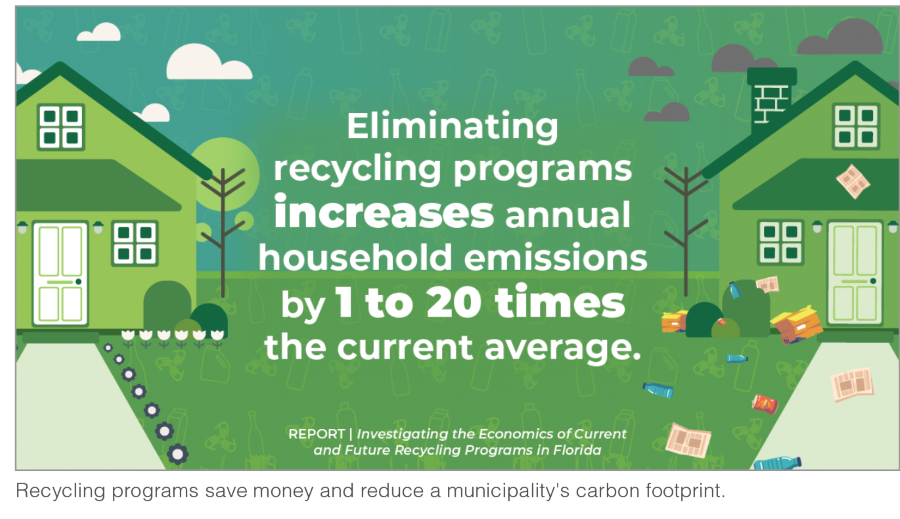
Among our report’s key findings is that discontinuation of recycling systems offered little cost savings for cities – roughly $1 to $12 per household per year. However, eliminating recycling systems increases annual household waste management-based GHG emissions by roughly one to 20 times the current average.
After all, community curbside recycling systems only account for 16% to 26% of the overall cost of waste management systems in Florida. If the items are not being recycled, they must go somewhere else – usually a landfill.
Targeting high-value recycling commodities
The recycling industry has reached a tipping point, and going forward, it will be important to determine a cost-effective recycling program that allows us to reduce our environmental impacts and make better use of our resources.
To accomplish this, Florida municipalities should consider a market-based recycling system, which means targeting high-value recycling commodities, such as newspaper, cardboard, aluminum cans, steel cans and plastic bottles, jugs and tubs, to generate savings and mitigate the impact of waste on the environment.
According to the study, a market approach could generate significant savings of $12 to $37 per household per year and could reduce annual household waste management-based GHG emissions by nearly 4.0 to 5.5 times the current average
Prioritizing high-value recycling commodities can benefit both Florida’s recycling programs and its environment. Metals, such as aluminum and steel from cans, represent less than 1% of Florida’s recycling stream, yet they offer significant GHG emissions offsets if they are better prioritized for collection.
By recycling high-value recycling commodities, cities can achieve the same GHG emissions reductions as recycling as much as 40% of the total waste stream if recycled at high rates – the equivalent of taking 145,000 gas-powered vehicles off the road for one year.
Education and outreach are vital
Many Americans are confused about the recyclability of certain materials, which currently results in higher recycling costs. Municipalities should work with stakeholders across the board – residents and businesses; and recycling processing and collection partners; national, regional and local environmental groups – to invest in these vital education programs.
Recycling programs allow citizens to return plastic, metal, paper and other materials to be broken down, redesigned and reused for a less resource-and-emissions-intensive economy. By collecting high-value recycling commodities, Florida could provide producers with enough recycled materials to meet 100% of their recycled content targets.
Keyna Cory is the executive director of the Florida Recycling Partnership Foundation, a coalition of companies that promotes recycling and sustainable business practices. She can be reached at keyna@flrecycling.org. Dr. Malak Anshassi is an assistant professor at Florida Polytechnic University in the Department of Environmental Engineering. She can be reached at manshassi@floridapoly.edu. To learn more about the study, please visit flrecycling.org.
This article appeared in the April 2023 issue of Resource Recycling. Subscribe today for access to all print content.