





This article appeared in the January 2019 issue of Resource Recycling. Subscribe today for access to all print content.
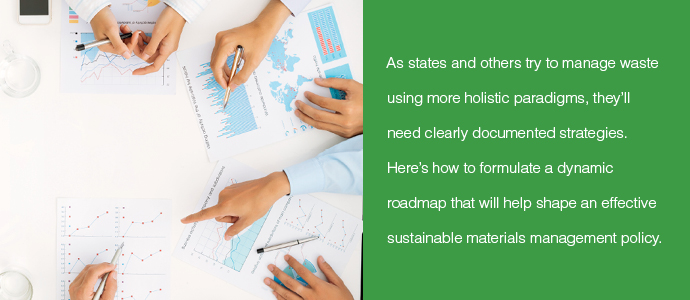
There is a saying that failing to plan is planning to fail. More states and local governments as well as private entities are taking that mantra to heart when it comes to sustainable materials management (SMM).
SMM is a concept being embraced by officials in both the public and private sectors who want to think more holistically about the impact of materials throughout their entire life, including but not limited to end-of-life management. According to the U.S. EPA, SMM “aims to use and reuse materials in the most productive and sustainable way across entire life cycles by minimizing the amount of materials involved, reducing the use of toxic materials, and minimizing overall environmental impacts, while balancing with economic constraints.”
With that in mind, government officials who may have drafted solid waste management plans in the past are now developing SMM plans. These documents help ensure that, first, goals for managing materials are developed. From there, the plans lay out the ways programs and activities can be implemented to thoughtfully and strategically reach SMM objectives.
An SMM plan can be relatively broad, but it should be further detailed through an action plan. Ideally, update reports will subsequently be provided to the governor, legislature or the commissioner of the state’s environmental protection agency.
This step helps ensure accountability and inspire progress. In addition, a plan should be updated at least every 10 years.
Thus far, two states – Oregon and Tennessee – have pushed forward SMM plans. A look into their processes and goals can help all waste and recycling leaders better frame their own paths forward.
Oregon paves the way
Oregon is a pioneer in adopting SMM. The Oregon Department of Environmental Quality (DEQ) developed “Materials Management in Oregon: 2050 Vision and Framework for Action,” which was adopted by the state’s Environmental Quality Commission in December 2012. The Vision component describes the ideal that will be achieved by 2050, and the Framework describes actions that will be taken to achieve the ideal, via the following channels:
- Foundations, a realm that includes setting goals and measuring outcomes, supporting and performing research, and securing stable funding.
- Policies and regulations.
- Collaboration and partnerships.
- Education and information.
The Oregon plan considers resource constraints, life cycle impacts and source reduction. The goal is to consider those concepts and others to encourage decision-making that takes into account a multitude of factors throughout the life of the product, not just at the end of its useful life.
It’s also important to note that the holistic approach was developed with the input of a Materials Management Workgroup that included insights from members with diverse backgrounds.
In the years since the plan was adopted, Oregon DEQ has published reports on a number of research projects that have helped stakeholders in the waste and packaging industry grasp the power of life cycle analyses and other data tools in policy and product development.
Recently, for instance, the agency published a 106-page report on research that suggests several popular packaging attributes – including “recyclable” and “recycled content” – do not consistently result in products that have lower impacts on the environment (see article for more).
Tennessee emerges as a leader in the Southeast
In 2015, another state in a different corner of the country also put pen to paper to advance SMM.
The Tennessee Department of Environment and Conservation (TDEC) that year produced its “2015-2025 Solid Waste and Materials Management Plan.” The process included three rounds of public input sessions held across the state (some of which could be joined remotely via closed-circuit television). At the same time, residents, businesses and others could add input via TDEC’s website. This public engagement was critical to understanding the viewpoints of Tennessee’s businesses, citizens, local governments and public interest groups. These perspectives were carefully considered when crafting the plan.
 Larry Christley, program manager in TDEC’s Division of Solid Waste Management, Materials Management Programs, believes strongly that materials generated in Tennessee should be regarded as resources to be used locally for manufacturing, to the greatest extent possible, enabling environmental and economic benefits to be accrued in the state.
Tennessee’s strong manufacturing base, much of which centers around the automobile industry, can help support markets for recovered materials. Work completed by the Southeast Recycling Development Council (SERDC) helped strengthen the link between recovered materials and economic growth.
Tennessee’s plan is organized around the following eight objectives:
- Update goals and measure progress.
- Increase access to and participation in recycling.
- Enhance processing and end markets.
- Increase diversion of organics.
- Support new diversion technology.
- Expand and focus education and outreach.
- Ensure sufficient and environmentally sound disposal.
- Develop sustainable funding sources for sustainable materials management.
For each broad objective, strategies to achieve the objective are presented, with tactics describing how to move those strategies forward. Additional materials supporting the plan also include a broad “implementation strategy” that indicates time frames and potential partners for each tactic.
Additionally, expectations are tiered, such that densely populated areas are expected to provide a higher level of service to citizens than rural communities, due to cost effectiveness.
Putting the plan to good use
According to Christley, TDEC selects two or three objectives to focus on annually while still making some progress on others.
Staff refers to the plan routinely, using it as it was intended, not simply a box to check off upon its completion. TDEC has made progress in meeting all eight objectives and 33 of 35 strategies. TDEC has also conducted workshops with local governments to describe the plan to help ensure local strategies and activities support the state plan. Some of the major efforts have included the following actions by the state:
- Addressed food waste, including source reduction, and leveraged grants and partnerships to direct consumable food to those in need.
- Encouraged composting of organic waste in lieu of landfilling.
- Provided grants to local governments to help them improve recycling programs.
- Further developed hub-and-spoke systems to make recycling more cost-effective in rural areas of the state.
- Developed and launched the Tennessee Materials Marketplace to help generators of materials find a second life for goods, in concert with the
- U.S. Business Council for Sustainable Development (166 companies have registered to date).
- Provided training to local recycling coordinators.
- Conducted outreach and training to increase the number of facilities and local governments reporting, and the quality/consistency of the data.
- Streamlined the annual progress report update process to TDEC.
- Assisted state agencies in increasing recycling and waste minimization activities, thus leading by example.
- Clarified reporting requirements for transfer stations through passage of legislation and passing regulatory changes to ensure recycling facilities provide data.
- Awarded top-five population counties and communities with recycling rebates while also targeting grant dollars to provide curbside recycling and trucks.
- Provided training and a workshop regarding recycling and end markets for scrap tires.
Attributes of the plan and its supported activities have also accelerated progress in some more general areas. For instance, there is now more transparency in how TDEC is moving toward its goals. Monthly progress is tracked and reported to the governor annually.
In addition, the plan has helped spark greater collaboration, including regional planning and public-private partnerships.
Stakeholder input has also expanded. And, most importantly, the action-oriented nature of the plan and its supplemental materials – clearly outlined tactics, action items and partner possibilities – has helped TDEC efficiently and effectively launch projects to support the objectives.
TDEC is still working to improve reporting and the quality of data reported to the agency by local governments and facilities before it revisits the state’s quantitative goals. Traditional weight-based diversion goals seem outdated, given the focus on SMM to take the entire life cycle of products into account when making assessments. However, alternative quantitative goals are challenging to identify, and such goals may vary depending on the entities involved.
In adopting the attributes of the plan, TDEC has begun to work more collaboratively with local governments and the private sector. The agency sees itself as a resource and partner, not just a regulator.
A tool that is worth the effort
An SMM plan itself will not solve all of a region’s material use challenges. It is a roadmap, not a magic wand.
Nonetheless, the tool can be an incredibly helpful means of spurring action, promoting collaboration and partnership building, and working efficiently. While some states have eschewed updating or developing plans due to time and resource constraints, they might find that devoting the energy to lay out a vision will pay back in spades.
Susan Bush is a consultant with RSE USA. She helps public and private entities achieve their sustainability goals, and she was the primary author of TDEC’s SMM plan. She can be reached at sbush@rse-usa.com or 401-782-6710.