



This article originally appeared in the March 2018 issue of Resource Recycling magazine. Subscribe today for access to all print content.
As the recycling industry reels over China’s new standards on plastic recyclables imports, cities are looking for answers. Some proposed solutions hold exciting promise – examples include doubling down on reduction efforts and expanding domestic recycling infrastructure. Others, however, are both impractical and potentially dangerous for the environment and future of the industry.
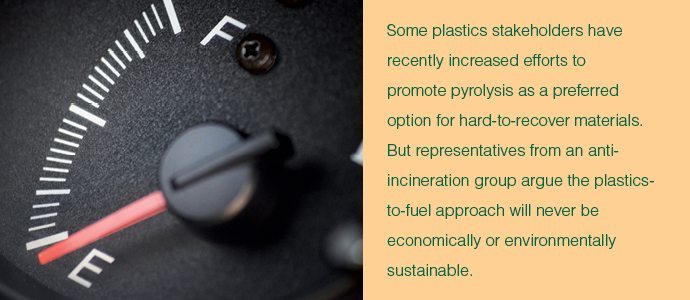
For instance, in this time of crisis, petrochemical companies and some of their partners have been quick to extol the supposed virtues of pyrolysis, also known as plastic to fuel. The American Chemistry Council, Chevron Phillips Chemical, Dow Chemical and Procter & Gamble are particularly vocal supporters. The major question to ask is this: Would pyrolysis mitigate our plastic pollution problem, or just enable further production?
Driving inefficiency, not solutions
The petrochemicals industry has invested heavily in expanding its infrastructure to make more virgin plastic. According to projections laid out in the 2017 academic paper “Production, Use, and Fate of All Plastics Ever Made,” by 2050 the total volume of plastic ever produced will reach 34,000 million tons (over four times what has been produced so far) and will make up 15 percent of the global carbon budget. Meanwhile, that same study determined only 9 percent of all plastics produced to date have been recycled. It is clear that significant intervention is needed to scale back the amount of plastic produced, and efforts are also needed to design better products that fit into a circular economy.
Instead of answering international pressure to phase out the production of non-recyclable plastic, certain industry actors have instead pushed the idea of pyrolysis. Plastics-to-fuel initiatives are incredibly costly, in part because they are energy-intensive. Furthermore, claims that these plants have “zero toxic emissions” are questionable given the variability and toxicity of numerous additives within the plastics that would enter these facilities. A more practical approach is to cost-effectively and safely contain non-recyclable plastic, study it and find alternative designs so that these products and materials are phased out of production and replaced with more sustainable solutions.
Let’s first delve into the inefficiency of pyrolysis, both in terms of economics and energy use. According to a 2014 article in Renewable Energy World, pyrolysis costs a whopping $8,000 to $11,500 to produce only 1 kilowatt of energy, twice the cost of photovoltaic solar energy for the same output, according to the U.S. Energy Information Administration (Department of Energy). Moreover, waste feedstocks for pyrolysis often require pre-treatment steps, such as shredding and drying, that can consume significant quantities energy. And unlike mass burn incinerators, which rely on oxygen to sustain their fires, the starved-oxygen environments in pyrolysis demand additional energy inputs.
Creating a fuel from fossil fuel-based material and using fossil fuels to power the process can hardly be counted as “renewable” energy.
On the economic side, it’s important to remember that building the collection, sortation and processing infrastructure to convert targeted materials to fuel would mean billions of dollars of investment – money that would be spent to essentially justify the existence of non-recyclable plastic packaging and products. And even if governments and industry stakeholders were to build all this infrastructure, it’s unclear if it will be able to actually absorb the existing and expanding plastic production.
In an op-ed in the January issue of Resource Recycling, a representative from Chevron Phillips Chemical touted plastic-to-fuel processes as a stepping stone to plastic-to-plastic chemical recycling. But that opinion piece also stated that it would take decades for the technology, end markets and infrastructure to develop to scale. Such a development effort will be costly, and it may not even be logistically and technologically feasible. A GAIA 2017 analysis, “Waste Gasification & Pyrolysis: High Risk, Low Yield Processes for Waste Management,” noted that $2 billion has already been invested in similar projects that closed or were canceled.
In addition to significant capital, these projects require significant material loads. Industry leaders like Dow Chemical and Chevron Phillips Chemical say pyrolysis facilities need a steady stream of particular plastic types, necessitating further extraction and production of low-quality plastic. Creating a fuel from fossil fuel-based material and using fossil fuels to power the process can hardly be counted as “renewable” energy. Pyrolysis enables a more complicated way to extract and burn fossil fuels that take a brief sojourn as a piece of plastic. But at the end of the day, pyrolysis of plastic would be emitting greenhouse gases.
Concerns over emissions
There is also reason to question whether pyrolysis techniques are as low in emissions as advertised. According to several studies (Ortuno et al., University of Alicante, 2013; Conesa et al, Journal of Applied and Analytical Pyrolysis, 2009), pyrolysis of plastic can lead to an increase in total toxicity. This reality is based on the fact that heating various plastics and additives to high temperatures can lead to emissions of persistent organic pollutants (POPs) such as dioxins and PCBs. Other emissions include lead, arsenic, mercury and heavy metals; polycyclic aromatic hydrocarbons, such as those produced from the combustion of flame retardants; and other pollutants subject to regulatory scrutiny.
Even if those pollutants are successfully captured or neutralized, they must go somewhere, either into the product itself or into byproducts such as fly ash, char, slag and waste water (which would need to be captured in filtration systems and then disposed of, adding additional cost burdens). In fact, according to a 2012 study commissioned by the American Chemistry Council, “One major problem [with pyrolysis] is the amount of residual waste produced that may call for landfill disposal is about 15 to 20 percent of the overall feedstock used in the process.”
Research has also shown plastic-derived fuel produces higher exhaust emissions than diesel, and it has a higher sulphuric content than both gasoline and diesel (Kalargaris et. al, Energy Vol. 131, 2017; Khan et. al, Journal of Environmental and Public Health, 2016). Furthermore, combustion of gases and/or fuels potentially containing toxins such as dioxin and heavy metals could occur in off-site industries and vehicles that may undergo even less stringent monitoring than incinerators.
Repercussions in local programs
In spite of these myriad concerns about the wisdom of using such a disposal method for plastics, plastic-to-fuel has gained increased attention in light of the challenges that municipalities are facing to deal with the mounting piles of plastic recyclables that they can no longer ship to China.
The Hefty Energy Bag program is problematic for several reasons, not least of which is that the use of plastic as fuel is being marketed as “recycling,” going against the National Recycling Coalition’s clear definition of the term.
As a result of National Sword, last year officials in Boise, Idaho announced they would no longer be collecting plastics Nos. 3-7. However, they quickly changed their tune in the beginning of January, proclaiming Boise residents would actually be able to include more material types in their recycling, thanks to a partnership with Dow Chemical and Keep America Beautiful in which those entities would bring the Hefty Energy Bag program to the city. In this initiative, residents are instructed to place low-value plastics in an orange bag at the curb, which will be sent to a pyrolysis plant in Salt Lake City to be converted to synthetic fuel oil (the bags are separated from the rest of the recycling stream at the local materials recovery facility).
That program may sound appealing at first glance, but it is problematic for several reasons, not least of which is that the use of plastic as fuel is being marketed as “recycling,” going against the National Recycling Coalition’s clear definition of the term. In fact, late last year, a group of MRF operators wrote an open letter urging the Institute of Scrap Recycling Industries not to make the Hefty bags acceptable for MRF collection, citing contamination concerns, which are at an all-time high due to China’s new policies.
Additionally, the group expressed worry that accepting non-recyclable materials for collection along with recyclables would undermine community trust and education efforts, which cities and MRFs have been working tirelessly for over 40 years to establish. By collecting these problem materials, citizens are falsely given the impression that these items will be recycled into new products.
The program’s previous rollout in Omaha, Neb. also drew criticism, with the Missouri Valley Group Sierra Club calling the Energy Bag program “greenwashing.” In fact, since last October, 60 recycling operators, environmental groups, city agencies and academic institutions have signed a pledge stating that they will not support Energy Bag if it is proposed in their cities.
An opportunity for real innovation
The plastic-to-fuel approach should not be used as a way to shift the onus off of the companies that produce the hard-to-recover plastic products that helped lead China to close its doors to recyclables in the first place. Rather than variations on incineration, now is the time to invest in innovative waste reduction and recycling programs and create the conditions for redesign.
Instead of shipping off our plastic burden to Asian countries, we can work to increase our domestic recycling capacity, creating green jobs and lowering our carbon footprint in the process. A big part of this effort would be identifying and phasing out problem products and making smart decisions on waste management protocol. In a 2008 study prepared for the Massachusetts Department of Environmental Protection, the Tellus Institute reported that on a per ton basis, mechanical recycling brings carbon dioxide-equivalent reduction benefits that are 18 times those delivered by gasification/pyrolysis facilities.
Complicated and potentially dangerous techno-fixes like plastic-to-fuel processes distract from the bold solutions that we need in the wake of China’s ban. This pivotal moment in global plastics recycling should spur an honest dialogue about how we produce and consume, and it should push us to work toward truly closing the loop on the materials we manage.
Monica Wilson is the policy and research coordinator for the Global Alliance for Incinerator Alternatives (GAIA) and can be reached at monica@no-burn.org. Claire Arkin is GAIA’s campaign and communications associate and can be reached at claire@no-burn.org. GAIA’s latest statement on issues surrounding plastics production, recycling and pollution can be found no-burn.org/recyclingisnotenough
The views and opinions expressed are those of the author and do not imply endorsement by Resource Recycling, Inc. If you have a subject you wish to cover in an op-ed, please send a short proposal to news@resource-recycling.com for consideration.