





This story originally appeared in the January 2017 issue of Resource Recycling.
Subscribe today for access to all print content.
Recycling markets are down. Recycling rates are stagnant. And recycling as a whole has received some negative press over the last year.
Clearly, materials management needs some fresh energy – and reliable revenue streams. Reuse may hold the key.
The rapidly evolving reuse landscape is vast and exciting. We’ve long been accustomed to “traditional reuse” – shopping at thrift stores, for example, and refillable mugs for to-go coffee. But the sector now also includes concepts such as upcycling, building adaptation and the sharing economy.
These trends can have significant impacts. By extending product life cycles, reuse conserves resources and lowers greenhouse gas emissions and pollution associated with new product manufacturing.
Reuse also offers innovative business models that benefit the social good. It plays an invaluable role in providing low cost items for lease, rent or purchase. Examples can be seen in clothing, building materials, business equipment, vehicles, auto and equipment parts, and more.
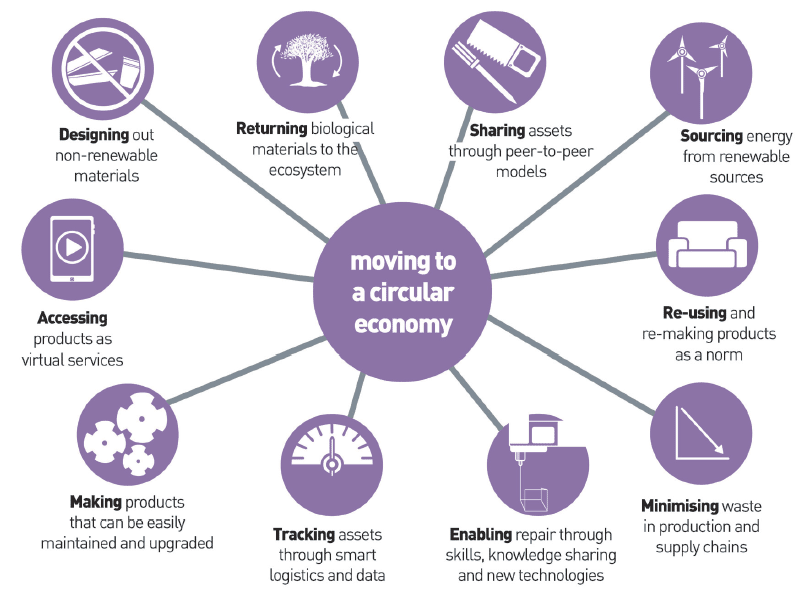
As noted by MaryEllen Etienne in “The Far Reach of Reuse” (a feature in the September 2016 edition of Resource Recycling), the reuse sector is already aligned with the goals of a circular economy. With recycling markets in a slump, communities can benefit by increasing the practice of reuse. In an otherwise slow-growth economy, reuse and sharing businesses often thrive.
How to take action locally
Public agencies, nonprofit organizations, institutions and businesses can all help expand reuse in local communities by sponsoring ongoing reuse programs. Such initiatives include repair cafés, reuse events and community-wide tag sales. An emphasis on the value, functionality and quality of durable, repaired and reused items can help enhance consumer confidence in the benefits of reuse.
Creating a local reuse working group can jumpstart dialog between stakeholders to expand reuse efforts and promote the sharing economy. The group can explore the environmental and economic opportunities of reuse models and programs, investigate regulatory barriers and potential changes that can be made to foster reuse, and devise incentives for reuse entrepreneurs and businesses.
Communities can also help promote reuse with online listings of reuse activities, thrift stores and building reuse stores. Simply promoting the use of durables (and leading by example by making sure local leaders are seen at meetings with refillable water bottles and coffee cups) can go a long way. Another strategy is offering reusable items, such as shopping bags, as promotional giveaways. Switching to reusable serviceware in schools, institutions and corporate cafeterias is another positive step for advancing reuse.
Meanwhile, resuse businesses can be bolstered through direct financial support from public agencies – low-cost financing, targeted funding for capital projects or programming, tax abatements, and other incentives can all help. Eliminating or reducing permitting and licensing fees is another strategy.
Technical assistance and business guidance in the development or improvement of business plans can assist startup reuse businesses. Another strategy is to offer entrepreneurs help in navigating the permitting and regulatory process. Business incubator programs and job fairs can help with recruiting and training employees, and trade shows with a focus on reuse can be innovative and effective ways of providing publicity.
By creating reuse and recycling hubs or zones within a community, public agencies will play key roles in fostering collaborations and partnerships. Investment forums for reuse entrepreneurs to meet with economic development staff and private investors are also beneficial.
Evaluating the full economic potential
Evaluating waste streams with reuse in mind is important for providing an analysis of what reusable items may be available for capture. Collaboration between reuse enterprises and solid waste and recycling facilities can provide reusable material streams to be harnessed by reuse enterprises. Establishing incentives such as pay-as-you-throw collection (in which residents are charged more for larger trash volumes) can spur reuse as well.
Furthermore, metrics that better measure the economic benefits and job opportunities created through repair, refurbishing and upcycling must be better understood and adopted. Going beyond diversion potential, such studies measure real economic and job growth opportunity. Looking at reuse as an economic and community driver can be a nexus for partnership building and developing alternative funding sources.
Communities can also gauge the potential for leveraging funds and potential partners or sponsors by assessing the impacts of projects that may enhance tourism, the arts or entertainment. Targeted reuse programs may also serve to attract entrepreneurs, teachers, artists, and others, further contributing to economic and community development.
Small-scale and community-based programs, including repair cafés and tool lending libraries, offer the most positive and sustainable models to move reuse forward. Public monitoring of reuse programs and businesses – and promoting those which provide the most benefits to communities, the economy and the environment – will help move reuse in the right direction.
On the legislative front, right to repair or fair repair movements could push reuse in significant ways. Several right to repair bills have been proposed, both in the United States Congress and in some state legislatures, to require automobile manufacturers to provide the same information to independent repair shops as they do to dealer shops.
Other right to repair legislation focuses on copyright issues. Current copyright law allows manufacturers to block access to tools or code that might facilitate access to copyrighted software. Such policy stymies repair, which often involves modification of parts and settings as well as customization of embedded software.
New models of taxation that account for environmental externalities associated with consumer goods production can promote both the circular economy and sharing models that best benefit society and the environment.
Similarly, public policies that foster more ecologically sound design of products can move us closer to a sustainable circular economy. A true reboot of materials management requires the adoption of policies, incentives and practices that embrace positive models of sharing by extending the life spans of consumer goods through increased durability and opportunities for repair. Sharing and peer-to-peer economy entrepreneurs who demand more ecologically designed goods can also influence upstream manufacturing.
Leaders of the pack
A number of communities and other stakeholders have begun taking concrete steps to leverage the power of reuse.
In Austin, two city departments, Resource Recovery and the Economic Development Department, joined forces to launch the Recycling Economic Development Program. The effort provides access to capital for reuse companies, including innovation cash prizes for reuse entrepreneurs. It has also launched the Austin Materials Marketplace, connecting businesses with unwanted materials to those that can use that waste in their own processes.
In other areas, local governments have adopted procurement policies that include preference for reusable or refillable items. Examples include San Mateo County, Calif.; Seattle; and Spokane, Wash. Seattle also promotes deconstruction over demolition when appropriate through reduced permit fees and fast tracking the permit process. The City also requires waste diversion reports by certain construction and demolition waste generators.
On the state level, the Oregon Department of Environmental Quality has embraced the concept of sustainable materials management, with a clear mandate to advance waste prevention – reduce and reuse – in its programming. This includes development of a “Strategic Plan for Reuse, Repair, and Extending the Lifespan of Products in Oregon.”
The Massachusetts Institute of Technology Office of Sustainability (MITOS) is facilitating a collaborative, multi-departmental working group process for MIT to develop and model campus-based solutions that address the challenges posed by climate change and resource scarcity around the planet. An essential step is assessing MIT’s “urban metabolism,” including material flows to, from and around campus. Studying urban metabolism allows researchers to determine resource consumption patterns and variables. These metrics can point to investment and policies that advance reuse and sustainable consumption.
Finally, a variety of groups are making key impacts. The Repair Association promotes right to repair legislation at both the state and federal levels. The Electronic Frontier Foundation defends civil liberties in the digital world with a focus on copyright issues. Electronics repair site iFixit is well known for its leadership in advancing repair, including free guidance and sales of parts and tools. The organization launched a successful campaign to legalize cell phone unlocking, winning key exemptions for repair from the U.S. Copyright Office.
Fueling the triple bottom line
Reuse allows for individual action and engagement – donating clothing, purchasing used building materials, buying beer in refillable growlers – to extend product life cycles, support local business and contribute to social good.
Reuse businesses, whether nonprofit or for-profit, small or large, are engaged in a multitude of activities helping to pave the way toward a more sustainable, circular economy. Extracting the maximum economic value out of our products through reuse encourages a creative entrepreneurial spirit.
Additionally, incorporating reuse strategies into programs and operations brings positive benefits to people, the planet and economies, helping to create a triple bottom line. Economic growth, jobs and innovation are already benefiting from the increase in reuse and the growth of the shared economy.
A materials management reboot through reuse, renting, borrowing, sharing and repair will help set us on a path to sustainable consumption and reinvigorate a nation that has to some degree lost faith in environmental causes. It’s a path that builds upon the interconnections between materials, climate change, communities and job creation to boost the economy and people of all walks of life.
Athena Lee Bradley is projects manager at the Northeast Recycling Council, Inc. NERC’s new “Reuse Explorations Guide,” which explores reuse strategies and models, is available for download at nerc.org.