


Resource Recycling
  • The Latest
  • Analysis
    • All
    • Certification Scorecard
    • Industry Announcements
    • Opinion
    Researchers work on fluorine-free battery binder

    Researchers work on fluorine-free battery binder

    CommanderAI launches searchable hauler database

    Blancco brings agentic AI to data erasure, ITAD operations

    APR adds PCR content verification to cert program

    Certification scorecard — week of Oct. 12

    Ingram Micro looks to digital platform and AI

    APR training clicks recycling ‘pieces’ into place

    APR training clicks recycling ‘pieces’ into place

    Southeast grows into US’ critical mineral hub

  • Conferences
    • Resource Recycling Conference
    • Plastics Recycling Conference
    • E-Scrap: The Longevity Conference
    • Textiles Recovery Summit
  • Publications
    • E-Scrap News
    • Plastics Recycling Update
    • Policy Now
    • Resource Recycling
    • Other Topics
      • All Topics
      • Brand Owners
      • Critical Minerals
      • Glass
      • Grant Watch / RFPs
      • Markets
      • Organics
      • Packaging
      • Research
      • Technology
      • Textiles
Subscribe
No Result
View All Result
Resource Recycling
  • The Latest
  • Analysis
    • All
    • Certification Scorecard
    • Industry Announcements
    • Opinion
    Researchers work on fluorine-free battery binder

    Researchers work on fluorine-free battery binder

    CommanderAI launches searchable hauler database

    Blancco brings agentic AI to data erasure, ITAD operations

    APR adds PCR content verification to cert program

    Certification scorecard — week of Oct. 12

    Ingram Micro looks to digital platform and AI

    APR training clicks recycling ‘pieces’ into place

    APR training clicks recycling ‘pieces’ into place

    Southeast grows into US’ critical mineral hub

  • Conferences
    • Resource Recycling Conference
    • Plastics Recycling Conference
    • E-Scrap: The Longevity Conference
    • Textiles Recovery Summit
  • Publications
    • E-Scrap News
    • Plastics Recycling Update
    • Policy Now
    • Resource Recycling
    • Other Topics
      • All Topics
      • Brand Owners
      • Critical Minerals
      • Glass
      • Grant Watch / RFPs
      • Markets
      • Organics
      • Packaging
      • Research
      • Technology
      • Textiles
Subscribe
No Result
View All Result
Resource Recycling
No Result
View All Result
Home Analysis

Researchers work on fluorine-free battery binder

byPaul Lane
October 16, 2026
in Analysis, E-Scrap
Researchers work on fluorine-free battery binder

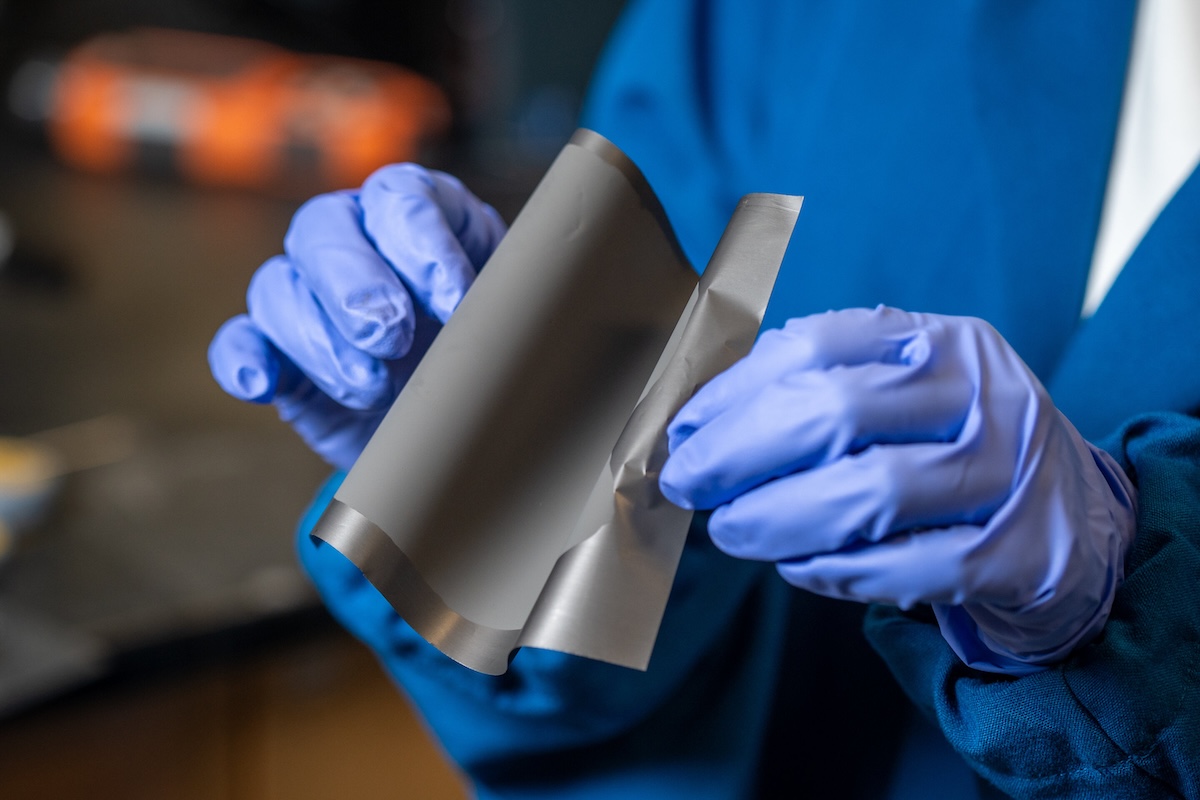
A flexible, adhesive electrode layer is shown that was made using a fluorine-free binder developed at the University of California San Diego. | David Baillot, US San Diego

Editor’s note: Batteries will be featured in sessions at the 2026 E-Scrap: The Longevity Conference Oct. 26-28 in New Orleans.

Research into fluorine-free battery binders could reduce or eliminate the need for harsh chemicals during production and recycling.

The study, done by researchers at the University of California San Diego and the Toyota Research Institute of North America, looked at improving the cost and environmental sustainability of solvent-based processing in lithium-ion battery manufacturing and recycling. The study appeared in Nature Communications earlier this month.

The problem

Binders glue together the battery’s internal parts, including the cathode and anode. The battery industry has generally used binders containing fluorine due to its thermal stability and because it creates strong, uniform electrodes that endure through thousands of charging cycles.

That binder, though, must be dissolved in N-methyl-2-pyrrolidone (NMP) before it can be mixed with the battery’s electrode powders. NMP is toxic and linked to reproductive and developmental health issues. After the electrodes are coated, the batteries go into drying ovens to evaporate the solvent, after which additional steps are taken to recover and purify the solvent for reuse.

“Those extra steps significantly increase the cost and energy use — as well as the environmental impact — of battery manufacturing,” said Jiao Lin, one of the study’s authors.

Fluorine also complicates recycling. Those binders leave residue requiring high heat or chemicals to remove, creating hazardous waste and contaminating the material that’s recovered.

The solution

Researchers created a binder that works like traditional options but contains no fluorine. This binder can also be processed using water. Their process improved upon other water-soluble binders by incorporating polyacrylic acid and carboxymethyl cellulose, which provide flexibility, strength and stickiness.

These polymers were dissolved in water and then combined with citric acid, which links them. Researchers said that combination created a binder with stability and adhesion seen from other products. They noted it also provides better cycle stability than batteries made using fluorine. The binder was compatible with different electrode types, including lithium iron phosphate, nickel-rich and silicon.

It also enabled easier recyclability, researchers said. The disassembled electrodes were submerged in water, which cleanly separated the electrode coatings from the metal foil sheets while leaving no residue. That allowed the electrode materials to then be regenerated using direct recycling processes for use in new batteries.

“The fluorine-free binder further facilitates sustainable direct recycling, demonstrating full recovery of spent positive and negative electrodes to achieve the same level of performance with pristine materials without generating fluoride residue,” the study’s authors wrote. “Lifecycle analysis shows significant reductions in energy cost and emissions compared with recycling … fluoride-based batteries. This binder strategy endows high performance with circularity, offering a scalable route to sustainable battery manufacturing technologies.”

Researchers said they’ll work to scale up production for commercial manufacturing of their binder and optimize it for different battery chemistries, working with industry partners to eventually bring it to market.

Why it matters

First and foremost, from a manufacturer’s point of view, this binder could save them money. Binders containing fluorine can cost several hundred dollars per 100 grams, while NMP-based solvents can cost $300 per liter.

Researchers have yet to determine what their binder could cost, but they said their product would result in companies spending less on products. The reduction in drying time needed using their binder would save companies additional money, they said, on equipment and energy. And water usage would also go down due to the elimination of the NMP recovery step, which is water-intensive; estimated savings are 6.9%-9.3% on energy, and estimated profits for manufacturers would go up 7.1%.

Then there are the environmental impacts. Across 12 total sustainability indicators, researchers found their binders resulted in lower calculated environmental and resource impacts as compared to the same processes using batteries with fluorine binders.

Recycling batteries using their solvents results in 10% less energy consumption and 3% less water, while greenhouse gas emissions go down 7.2%. That’s on top of removing the harsh chemicals used in the traditional recycling process.

“Moreover, its ambient aqueous processing and fluorine-free chemistry simplify end-of-life treatment and mitigate hazards,” they wrote.

Getting manufacturers to switch may prove more challenging. Changing part of their process would require manufacturers to clear technical, financial and regulatory hurdles, including potentially changing equipment and conducting extensive testing to verify the new binder’s performance. That’s assuming, of course, that researchers can achieve similar results through the scaling-up process.

Tags: BatteriesManufacturersResearch
TweetShare
Paul Lane

Paul Lane

Paul Lane is an award-winning journalist who joined Resource Recycling in June 2026 after working for several years in corporate communications and at various local news outlets. He can be reached at paul.lane@resource-recycling.com.

Related Posts

‘Fast Tech’ reduction is focus of E-Waste Day

byPaul Lane
October 14, 2026

The initiative from the WEEE Forum looks to bring focus to the problems resulting from repeated use of quickly and...

Removing an eBike battery pack.

EPR’s next fight is over embedded batteries

byStefanie Valentic
October 13, 2026

Eleven states have passed battery EPR laws since 2022, but Product Stewardship Institute staff told RCon attendees that most still...

Southeast grows into US’ critical mineral hub

byPaul Lane
October 12, 2026

A wave of development has shored up the mineral infrastructure, but some are calling for more to be done to...

ABTC gets black mass export exemption

ABTC gets black mass export exemption

byPaul Lane
October 9, 2026

Company leadership said the move allows the minerals to be used while the nation’s processing infrastructure gets up to speed.

Trade-in firm reports higher values for used phones

Device trade-ins increase amid newest iPhone release

byPaul Lane
October 7, 2026

Some in the second-hand marketplace won’t see the full impact until well after the Duo foldable phone releases later this...

GM launches recycled EV battery line

GM launches recycled EV battery line

byPaul Lane
October 5, 2026

The automaker’s partnership with Cirba Solutions is meant to keep critical minerals in use to meet growing EV demand.

Load More

2026 Buyers’ Guide

Equipment, services and technology suppliers serving the recycling industry.

Browse the Guide

More Posts

Lawsuits hover days after SB 54 approval

CAA trims first-year SB 54 budget in final plan

October 13, 2026
Fireside Chat at PRC features CAA chief

Fielkow to step down as CAA CEO

October 14, 2026
Northeast recycled commodity values hit 5-year lows

HDPE, PP prices climb for October

October 14, 2026

Southeast grows into US’ critical mineral hub

October 12, 2026
Removing an eBike battery pack.

EPR’s next fight is over embedded batteries

October 13, 2026

MRF battery fires burn ‘really fast’ and ‘really hot’

March 5, 2024

Ingram Micro looks to digital platform and AI

October 14, 2026
Panelists discuss construction waste reuse at the NERC conference in New Jersey October 7, 2026.

Ramping up reuse of construction materials

October 8, 2026
Sundry Photography / Shutterstock

Iron Mountain adds ViaTeK Solutions to ITAD business

October 9, 2026
plastic bale

Underreported sales may cost bottle bill states up to 40%

October 5, 2026
Load More

About & Publications

About Us

Staff

Archive

Magazines

Work With Us

Advertise
Jobs
Contact
Terms and Privacy

Newsletters

Get the latest recycling news and analysis delivered to your inbox every week. Stay ahead on industry trends, policy updates, and insights from programs, processors, and innovators.

Subscribe

Welcome Back!

Login to your account below

Forgotten Password?

Retrieve your password

Please enter your username or email address to reset your password.

Log In

Add New Playlist

No Result
View All Result
  • The Latest
  • Analysis
  • Recycling
  • E-Scrap
  • Plastics
  • Policy Now
  • Conferences
    • E-Scrap Conference
    • Plastics Recycling Conference
    • Resource Recycling Conference
    • Textiles Recovery Summit
  • Magazines
  • About Us
  • Advertise
  • Archive
  • Jobs
  • Staff
Subscribe
This website uses cookies. By continuing to use this website you are giving consent to cookies being used. Visit our Privacy and Cookie Policy.