




Resource Recycling
  • The Latest
  • Analysis
    • All
    • Certification Scorecard
    • Industry Announcements
    • Opinion
    From claims to custody: PCR procurement grows up

    From claims to custody: PCR procurement grows up

    What the NAND flash crunch means for remarketing, refurbishment and residual values

    Telamon acquires ITAD consultancy Retire-IT

    Certification Scorecard — Week of July 6, 2026

    Tech giant pens detailed ‘plastic-free packaging’ guide

    What Google’s latest report means for ITAD

    Unpacking the Starbucks cup data

    Unpacking the Starbucks cup data

    Amazon cutting out more flexible packaging

    Amazon’s AWS hardware reuse is measured

  • Conferences
    • Resource Recycling Conference
    • Plastics Recycling Conference
    • E-Scrap: The Longevity Conference
    • Textiles Recovery Summit
  • Publications
    • E-Scrap News
    • Plastics Recycling Update
    • Policy Now
    • Resource Recycling
    • Other Topics
      • All Topics
      • Brand Owners
      • Critical Minerals
      • Glass
      • Grant Watch / RFPs
      • Markets
      • Organics
      • Packaging
      • Research
      • Technology
      • Textiles
Subscribe
No Result
View All Result
Resource Recycling
  • The Latest
  • Analysis
    • All
    • Certification Scorecard
    • Industry Announcements
    • Opinion
    From claims to custody: PCR procurement grows up

    From claims to custody: PCR procurement grows up

    What the NAND flash crunch means for remarketing, refurbishment and residual values

    Telamon acquires ITAD consultancy Retire-IT

    Certification Scorecard — Week of July 6, 2026

    Tech giant pens detailed ‘plastic-free packaging’ guide

    What Google’s latest report means for ITAD

    Unpacking the Starbucks cup data

    Unpacking the Starbucks cup data

    Amazon cutting out more flexible packaging

    Amazon’s AWS hardware reuse is measured

  • Conferences
    • Resource Recycling Conference
    • Plastics Recycling Conference
    • E-Scrap: The Longevity Conference
    • Textiles Recovery Summit
  • Publications
    • E-Scrap News
    • Plastics Recycling Update
    • Policy Now
    • Resource Recycling
    • Other Topics
      • All Topics
      • Brand Owners
      • Critical Minerals
      • Glass
      • Grant Watch / RFPs
      • Markets
      • Organics
      • Packaging
      • Research
      • Technology
      • Textiles
Subscribe
No Result
View All Result
Resource Recycling
No Result
View All Result
Home Recycling

Seattle MRF rolls out robotic sorting and AI analytics

Colin StaubbyColin Staub
April 29, 2025
in Recycling

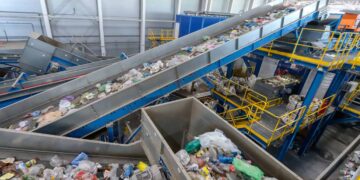
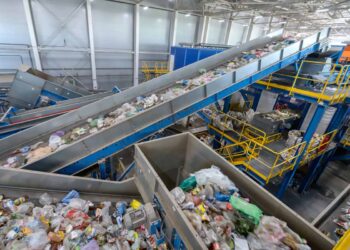
Using input from MRFs across the US, Closed Loop Partners developed a guide to help provide best practices to improve facility efficiency and optimize operations. | Courtesy of Glacier

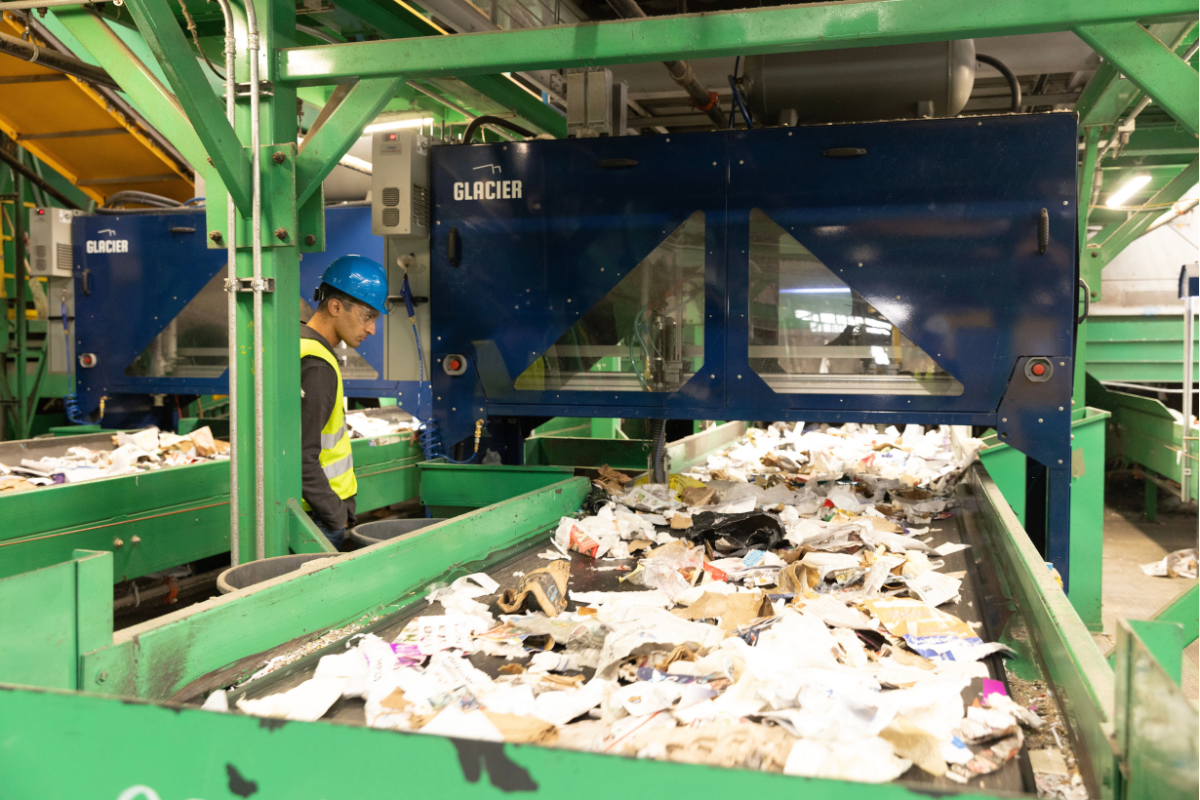
A Glacier robot positioned on the sorting line at Seattle’s King County MRF. | Photo by Colin Staub

A Seattle-area sorting facility operated by Recology has installed imaging and sorting equipment supplied by Glacier, adding another major MRF to the company’s two-dozen customers. Glacier also announced it has raised additional capital that CEO Rebecca Hu-Thrams said will help the company grow further and faster.

Glacier and Recology, both San Francisco-based companies, on April 28 announced the developments and hosted a demonstration event at the Seattle facility, a 300-tons-per-day MRF that opened in 2014.

Glacier has so far installed four robots at the MRF, where they’ve sorted for a combined 2,800 hours and diverted 14 tons of recyclables during their initial start-up period. One key area for the robots is on the plastic sort line, where they’re targeting HDPE containers.

Recology CEO Sal Coniglio told Resource Recycling the company’s facilities were designed anywhere from 10 to 30 years ago, when the waste stream looked much different. In many cases, they weren’t built to have people safely in areas where manual sorters would be beneficial, he noted, but the facilities still need to remove that contamination.

“Robots have been great for us to position them where it’s harder to get people,” Coniglio said. “It’s been key for us to bring in technology to make a safer environment to capture those additional opportunities.”

The company has been trying out several of the sorting robots on the market, and it has several different makes of robot installed at its San Francisco MRF, Coniglio added. That’s where it first deployed the Glacier model, and it also installed a Glacier unit at its Santa Rosa, California, MRF.

Coniglio said Glacier’s approach of working with the company to figure out what it was trying to solve with the robotics appealed to Recology. He said  he also just likes the design of the robot.

“I think their approach, the way the robot attaches to the line, I thought that was a very innovative style,” he said. Glacier’s robots require just 3 feet of conveyor space, making them a fairly compact option to add almost anywhere in a MRF. Glacier says it provides a way for MRFs to improve capture without going through a full retrofit.

The company plans to install two more Glacier robots, bringing the total to six.

Continuing to scale up

Glacier launched in 2019, when tech industry founders Hu-Thrams and Areeb Malik saw dual opportunities in customer demand – from the U.S. recycling industry effects of China’s National Sword policies – and in rapidly advancing technology.

A year ago, the company received capital from funders including Amazon’s New Climate Pledge Fund, bringing the company’s total funding at that point to $13 million. And with this week’s announcement of an additional $16 million in funding, the company plans to continue on its growth trajectory.
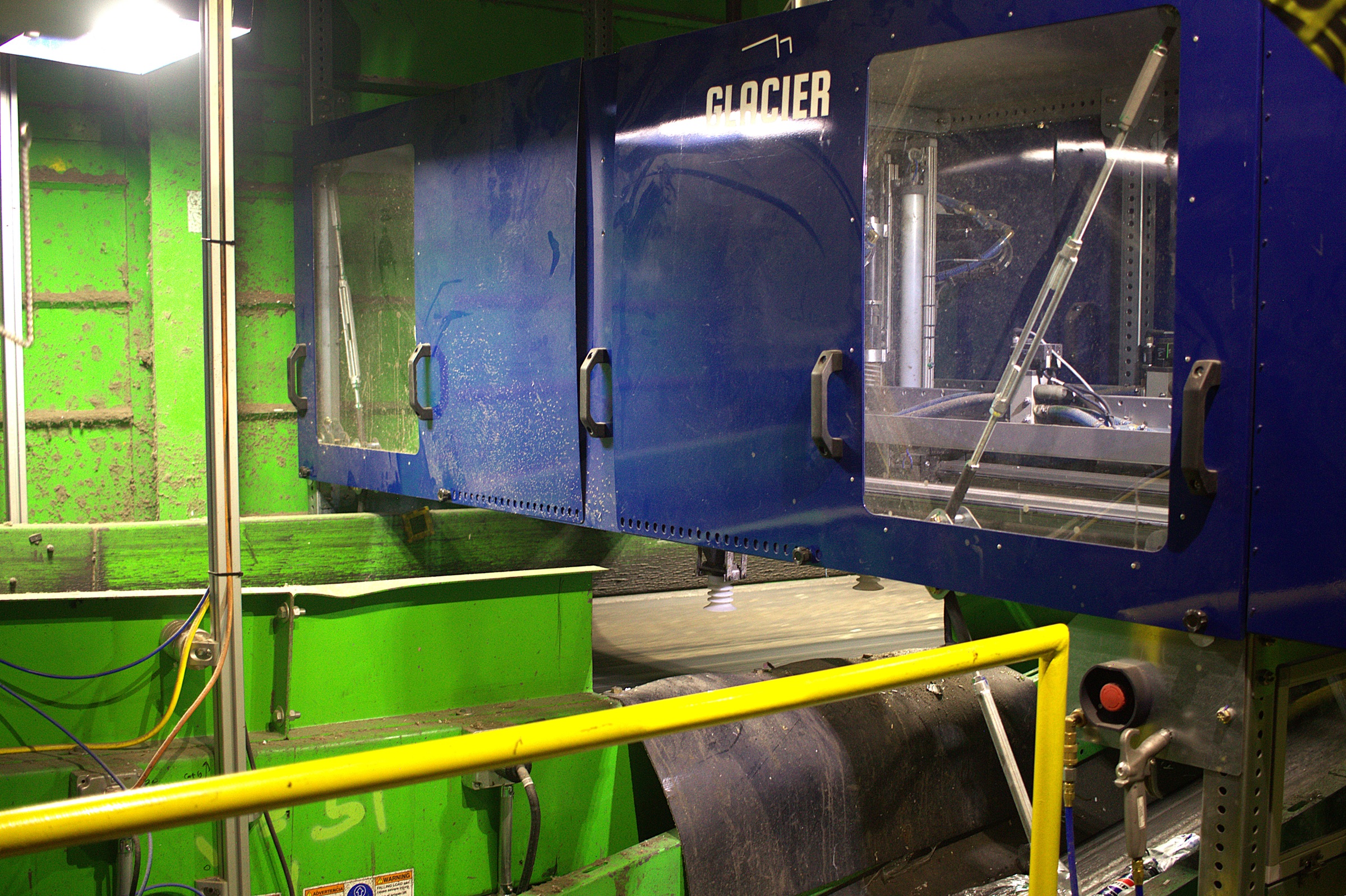
Glacier’s sorting robotics in on a conveyor line at the Recology King County MRF in Seattle. | Photo by Colin Staub

Over the past year, Glacier has upped its manufacturing capacity eightfold, Hu-Thrams said, an expansion that is directly tied to demand in the market.

The company’s sorting and analytics equipment is currently installed in two-dozen customers’ MRFs around the country, she said. Besides the Seattle MRF, that includes MRFs in the San Francisco Bay Area, Phoenix, Detroit, Minneapolis and Chicago, of all sizes and conditions, she added.

“We’ve proven that whether you’re a massive MRF that has recently gone through an upgrade or a single site with equipment that’s 20 years old, we can install successfully and improve your operations,” Hu-Thrams said.

Beyond its geographical customer footprint, Glacier has been investing in its AI visioning and data analytics model. The system captures and identifies materials as they move on the conveyor line, enabling the robotic sorter to grab target materials but also allowing for higher-level data analysis.

“A lot of our investment has already been funneled into making our AI model detect more things, detect better, detect more in real time,” Hu-Thrams said. “Now, we’re really taking that jump to translate this incredible data set of 3 billion proprietary waste images into a tool that can create actionable insights.”

The analysis can help MRF operators tweak their operations in a few ways, and it doesn’t always lead to installing robots. Hu-Thrams described a MRF in the Midwest that installed a Glacier camera on its residue line, where it showed the facility was losing 350 tons of recoverable material per year. 

Most of the lost recyclables were from the PET line, and by calculating the estimated $130,000 value of lost recoverable material, the MRF operator could see it made economic sense to position a manual sorter on the PET line.

Glacier also works with MRF operators on a more holistic look at material flow through the facility, starting at the front end with bale composition audits and contamination studies. Sometimes MRF operators will place cameras before and after key pieces of sorting equipment to see how each step is performing.

In one case, a MRF customer used Glacier’s imaging equipment on a day when the facility was processing a typical stream of recyclables. All its equipment was up and running, the sorting shift was fully staffed. Using that as the baseline performance, the MRF operator made slight modifications – changing the angle of disc screens, for example – and was able to see the real-time results.

“That’s the type of real-time feedback that a lot of our customers find to be really powerful and maybe something they haven’t been able to easily measure before,” Hu-Thrams said. “MRF operators, our customers, they oftentimes don’t have the luxury to sit down with a 100,000-row spreadsheet and do their own data analysis to see what’s going on.”
Tags: EquipmentMRFs
TweetShare
Colin Staub

Colin Staub

Colin Staub was a reporter and associate editor at Resource Recycling until August 2025.

Related Posts

Rod McDaniel

Westward expansion continues for S3 Recycling

byPaul Lane
July 2, 2026

The company is tripling its California ITAD footprint after its latest acquisition.

Tiger Group offers OCC pulp mill equipment sale

Tiger Group offers OCC pulp mill equipment sale

byTiger Group
July 1, 2026

Sale by Tiger and partner Can-Am Machinery features pulping, drying, baling and other assets from a fiber-processing and pulp-production plant...

Reworld reports increased e-scrap volumes

byPaul Lane
June 18, 2026

The New Jersey-based company separated and processed 6,000 tons of metals from discarded electronics at its Philadelphia EcoWorld facility.

NYC, Mack Trucks unveil winning artwork

NYC, Mack Trucks unveil winning artwork

byAntoinette Smith
June 4, 2026

The five new hand-painted waste collection trucks feature themes of honor, resilience and care, and will operate in the city's...

WM, Circular Materials announce new Canadian facility

byStefanie Valentic
May 21, 2026

Hauler WM will open a new preconditioning recycling facility (PCF) in Edmonton in early 2027, bringing advanced optical sorting to...

WM opens new $60m MRF in Indy

byAntoinette Smith
April 10, 2026

The newest recycling facility has annual capacity of 200,000 tons and will send all mixed paper to Pratt Industries for...

Load More
Next Post

MRF updates: An opening in NJ and a closure in MO

More Posts

Oregon’s Recycling Modernization Act faces injunction

Oregon’s EPR program posts first-year results

July 6, 2026
Two recycled-content bills gain approval in California

California agriculture seeks SB 54 repeal

July 7, 2026
Unpacking the Starbucks cup data

Unpacking the Starbucks cup data

July 8, 2026
In Our Opinion: Coalitions: The EPR Differentiator

Inside NAW’s constitutional case against packaging EPR

July 6, 2026
Tech giant pens detailed ‘plastic-free packaging’ guide

What Google’s latest report means for ITAD

July 8, 2026
EPR fees are a market signal. Here’s what they’re telling you.

Building the infrastructure behind EPR

July 6, 2026
SB 54 draft rules generate debate on rates, review

California increases PET market payments

July 7, 2026
MP Materials breaks ground on rare earth magnet campus in North Texas

ERI confirms ITAD shift toward minerals

July 3, 2026
ITAD firm wins spot for NASA purchasing

ITAD firm wins spot for NASA purchasing

July 6, 2026
Auto Draft

Digital product passports offer gateway into secondary market

July 7, 2026
Load More

About & Publications

About Us

Staff

Archive

Magazine

Work With Us

Advertise
Jobs
Contact
Terms and Privacy

Newsletter

Get the latest recycling news and analysis delivered to your inbox every week. Stay ahead on industry trends, policy updates, and insights from programs, processors, and innovators.

Subscribe

Welcome Back!

Login to your account below

Forgotten Password?

Retrieve your password

Please enter your username or email address to reset your password.

Log In

Add New Playlist

No Result
View All Result
  • The Latest
  • Analysis
  • Recycling
  • E-Scrap
  • Plastics
  • Policy Now
  • Conferences
    • E-Scrap Conference
    • Plastics Recycling Conference
    • Resource Recycling Conference
    • Textiles Recovery Summit
  • Magazine
  • About Us
  • Advertise
  • Archive
  • Jobs
  • Staff
Subscribe
This website uses cookies. By continuing to use this website you are giving consent to cookies being used. Visit our Privacy and Cookie Policy.