




Resource Recycling
  • The Latest
  • Analysis
    • All
    • Certification Scorecard
    • Industry Announcements
    • Opinion

    ITAD is moving past its adolescent phase: beyond end-of-life

    Rainforest

    Inside the Circle: What the rainforest can teach us about EPR

    Closeup of a printed circuitboard

    Hardware demand puts new focus on parts harvesting

    Rare look inside the world’s largest plastics recycler

    Mass balance matters: Why different rules can lead to different outcomes 

    Certification Scorecard — Week of June 1, 2026

    IT asset disposition and electronics recycling: Now and then

    $60 billion in AI servers will create an ITAD challenge

  • Conferences
    • Resource Recycling Conference
    • Plastics Recycling Conference
    • E-Scrap: The Longevity Conference
    • Textiles Recovery Summit
  • Publications
    • E-Scrap News
    • Plastics Recycling Update
    • Policy Now
    • Resource Recycling
    • Other Topics
      • All Topics
      • Brand Owners
      • Critical Minerals
      • Glass
      • Grant Watch / RFPs
      • Markets
      • Organics
      • Packaging
      • Research
      • Technology
      • Textiles
Subscribe
No Result
View All Result
Resource Recycling
  • The Latest
  • Analysis
    • All
    • Certification Scorecard
    • Industry Announcements
    • Opinion

    ITAD is moving past its adolescent phase: beyond end-of-life

    Rainforest

    Inside the Circle: What the rainforest can teach us about EPR

    Closeup of a printed circuitboard

    Hardware demand puts new focus on parts harvesting

    Rare look inside the world’s largest plastics recycler

    Mass balance matters: Why different rules can lead to different outcomes 

    Certification Scorecard — Week of June 1, 2026

    IT asset disposition and electronics recycling: Now and then

    $60 billion in AI servers will create an ITAD challenge

  • Conferences
    • Resource Recycling Conference
    • Plastics Recycling Conference
    • E-Scrap: The Longevity Conference
    • Textiles Recovery Summit
  • Publications
    • E-Scrap News
    • Plastics Recycling Update
    • Policy Now
    • Resource Recycling
    • Other Topics
      • All Topics
      • Brand Owners
      • Critical Minerals
      • Glass
      • Grant Watch / RFPs
      • Markets
      • Organics
      • Packaging
      • Research
      • Technology
      • Textiles
Subscribe
No Result
View All Result
Resource Recycling
No Result
View All Result
Home Recycling

Why Glacier’s MRF robots drew millions in funding

Colin StaubbyColin Staub
March 12, 2024
in Recycling

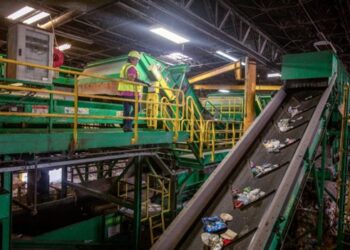
Using input from MRFs across the US, Closed Loop Partners developed a guide to help provide best practices to improve facility efficiency and optimize operations. | Courtesy of Glacier

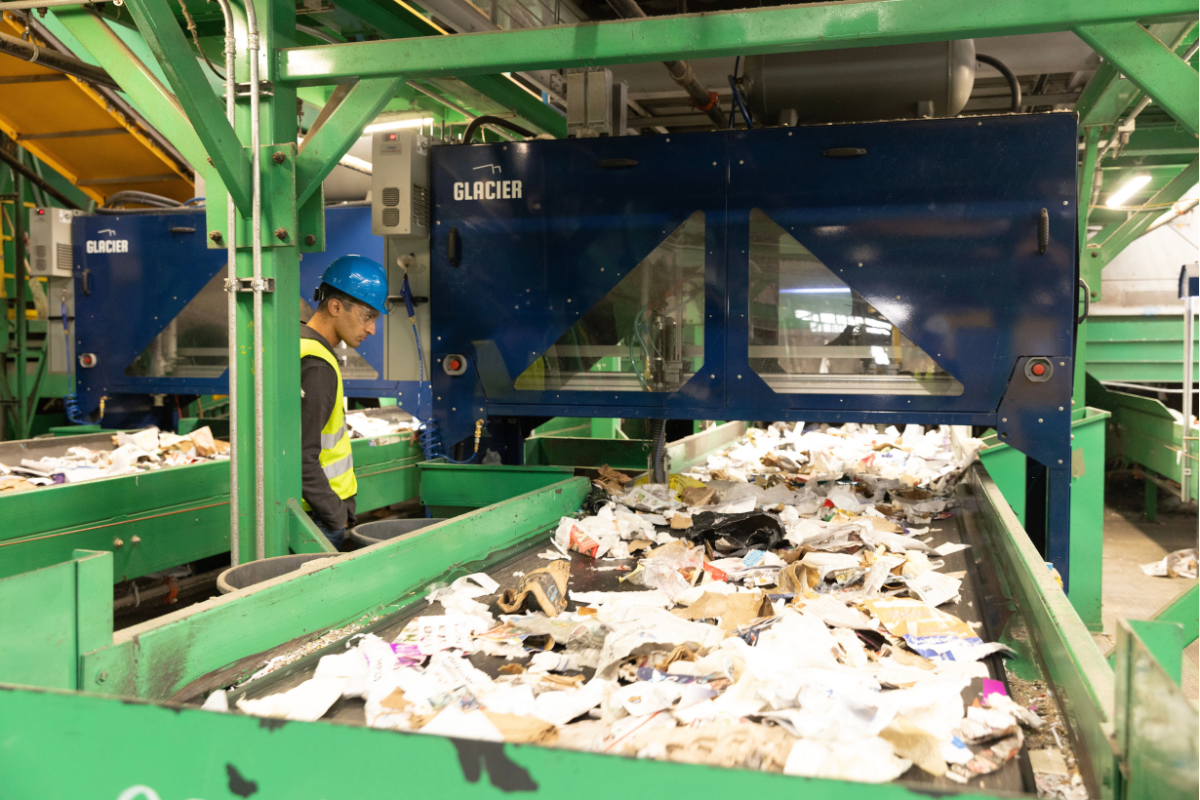
Robotics from Glacier can be made to fit any belt width and can target more than 30 distinct materials. | Courtesy of Glacier

The co-founders of emerging sortation robotics supplier Glacier say their robots provide an immediate quality benefit with a small footprint: They can be placed anywhere a manual sorter would be stationed.

Founded in 2019, tech startup Glacier on March 6 announced it received $7.7 million from New Enterprise Associates (NEA) and Amazon’s Climate Pledge Fund, an investment arm of the e-commerce giant. Glacier is an emerging player in the MRF robotics industry, and its latest funding brings the company’s total capital raised to $13 million so far since its launch.

In outlining its investment, Amazon wrote that Glacier’s technology “can help improve the quality of recycled content so that more post-consumer material is available for use in new packaging. Longer term, it can also enable recycling for more types of packaging and materials than are not currently recycled.”

With a staff of 22, the equipment supplier is based in San Francisco, where it also designs and assembles and tests its robotic systems. Glacier additionally works with a handful of contract manufacturers, who do tasks like welding frames and building motors within the robots. The company is currently working with about two dozen customers across 10 states, many of which are recycling facilities.

Resource Recycling spoke with Glacier co-founders Rebecca Hu and Areeb Malik to learn more about their compact robotic systems and why they are drawing investment attention.

Spurred by market strife

Both co-founders have backgrounds working in the tech space, and when they met, both were wanting to work more specifically on sustainability-focused ventures. They narrowed in on the recycling sector and began developing equipment for the sortation field, driven by a few observations.

The team saw opportunities in both customer demand and technological advancement. It was 2019, and the recycling industry was struggling in the wake of China’s pullback from the export market. Quality was key: MRF operators needed to reduce contamination and to do it quickly. In a lot of ways, Glacier launched because of the opportunities created by China’s National Sword campaign, Hu says.

“This industry that has done things a certain way for many decades, is actually at a moment when everyone is really excited to see what is out there and explore new technology,” she said.

Additionally, the market challenges lined up with advancement in artificial intelligence (AI) capabilities, to the point that Malik and Hu determined they could have a substantial and immediate impact in that part of the industry by using emerging technology. There was a clear opportunity to take AI and robotics and “start applying it to the sortation challenge,” Malik said.

Hu added that working to enhance the abilities of the existing MRF infrastructure was an accessible way to quickly bolster the recycling system, as opposed to moving upstream to tackle consumer recycling habits, for example.

“The immediacy of the potential impact was really appealing,” Hu said.

Compact robots allow for quick boost

Glacier’s interest in immediate improvement also played into the choice to supply robots, as opposed to other sorting technologies. Malik noted that optical sorters are a strong technology, but that they can often require a full MRF retrofit to install. The robots Glacier supplies, on the other hand, can be dropped onto a quality control line without substantial facility changes. 

“Any place in your facility that you have a sorting station, our robot can go in and provide that additional sorting power,” Malik said.

The company’s robots can be installed on conveyor belts of any width, Hu added, avoiding the need to double up with two robots to accommodate wider belts, for instance.

Glacier’s robots perform an average of 45 picks per minute, a metric the company calculates from units installed inside MRFs. But Hu explained that metric can be more complicated than it sounds: Sometimes it is reported as hypothetical picks per minute in a lab, sometimes it refers to how many times a robotic arm attempts to grab a piece of material off the belt. She noted that for MRF operators, the only thing that matters is the physical number of items the robot correctly puts in its proper location.

Hu added that although picks per minute is an important metric, she recommends MRF operators consider what they really need the robot to do, especially how many picks they actually need the robot to perform.

Ultimately, she proposed a couple variations on the metric: picks per minute per dollar spent and picks per minute per square foot the equipment occupies. Those considerations can help ensure a MRF installs the right system for its actual needs.

Glacier’s data analytics system is an equally important component of what the company offers. In fact, Hu says the team at one time considered focusing entirely on the AI system rather than robotics, but decided they wanted to also provide the tool (robotics) to put the AI data into action.

Besides enabling a general expansion of the company, Glacier’s recent funding will aid in building up the data analytics and material identification capabilities. It currently identifies 30-plus materials, including fiber, PET, HDPE, black plastic, thermoforms, aluminum, aseptic containers and more.

“We want to continue to expand that list very thoughtfully,” Hu said.

Tags: MRFsTechnology
TweetShare
Colin Staub

Colin Staub

Colin Staub was a reporter and associate editor at Resource Recycling until August 2025.

Related Posts

Smartphones in store.

Consumers’ expectations climb along with use of tech: Report

byPaul Lane
June 10, 2026

A new report on consumer technology found it’s become integral to users’ lives, but the ways companies refine the ownership...

GP Recycling offers on-ramp for smaller recyclers

GP Recycling offers on-ramp for smaller recyclers

byAntoinette Smith
June 9, 2026

The company's hubbIT platform is a way for smaller generators to sell plastic, glass and metal bottles to the brokerage,...

DOE commits federal funds toward critical minerals

ABTC wins DOE appeal for Tonopah Flats lithium refinery project

byStefanie Valentic
June 8, 2026

ABTC has won back a DOE grant that was among hundreds terminated last fall.

Closeup of a printed circuitboard

Hardware demand puts new focus on parts harvesting

byDavid Daoud
June 5, 2026

Several key electronics parts are seeing tight supplies, potentially making for opportunities for the ITAD sector.

IT asset disposition and electronics recycling: Now and then

$60 billion in AI servers will create an ITAD challenge

byDavid Daoud
June 3, 2026

An AI growth boom suggests that a large number of devices will reach end-of-life around 2029-2031.

The independent ITAD at a crossroads

DMD acquires ITAD firm Lifespan, outlines acquisition strategy

byDavid Daoud
June 2, 2026

DMD Systems Recovery is expanding through acquisitions, starting with a business bought from Bluum Technology.

Load More
Next Post

Colorado PRO revises EPR recycling scenarios

More Posts

Recycling industry addresses Beyond Plastics report

Recycling industry addresses Beyond Plastics report

May 26, 2026
House resolution aims to make recyclability central to product design

NY EPR bill fails to advance after third try

June 8, 2026
Fire at an EMR recycling facility in Camden, New Jersey May 29, 2026.

EMR faces shutdown calls after numerous fires

June 2, 2026
CalRecycle withdraws proposed regs for SB 54

Oceana, NRDC, CAW sue CalRecycle over SB 54 regs

June 5, 2026
IT asset disposition and electronics recycling: Now and then

$60 billion in AI servers will create an ITAD challenge

June 3, 2026
The independent ITAD at a crossroads

DMD acquires ITAD firm Lifespan, outlines acquisition strategy

June 2, 2026
Our top stories from June 2021

Colorado advances EV battery EPR law

June 3, 2026
Rare look inside the world’s largest plastics recycler

Mass balance matters: Why different rules can lead to different outcomes 

June 5, 2026
In My Opinion: Comparing the nation’s first packaging EPR laws

What Maine’s vape EPR law means for recyclers

June 4, 2026
Circular Materials to supply PlasCred chem recycling plant

Circular Materials to supply PlasCred chem recycling plant

June 4, 2026
Load More

About & Publications

About Us

Staff

Archive

Magazine

Work With Us

Advertise
Jobs
Contact
Terms and Privacy

Newsletter

Get the latest recycling news and analysis delivered to your inbox every week. Stay ahead on industry trends, policy updates, and insights from programs, processors, and innovators.

Subscribe

Welcome Back!

Login to your account below

Forgotten Password?

Retrieve your password

Please enter your username or email address to reset your password.

Log In

Add New Playlist

No Result
View All Result
  • The Latest
  • Analysis
  • Recycling
  • E-Scrap
  • Plastics
  • Policy Now
  • Conferences
    • E-Scrap Conference
    • Plastics Recycling Conference
    • Resource Recycling Conference
    • Textiles Recovery Summit
  • Magazine
  • About Us
  • Advertise
  • Archive
  • Jobs
  • Staff
Subscribe
This website uses cookies. By continuing to use this website you are giving consent to cookies being used. Visit our Privacy and Cookie Policy.