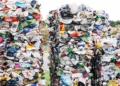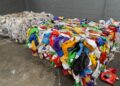





Regional waste exchange platforms are not uncommon, but Iowa’s faces a bigger challenge than many: wind turbine blades.
Great Plains states such as Iowa are America’s heartland both geographically and in terms of the rapidly growing wind power sector. The technology that harnesses the renewable energy potential in the broad, unencumbered terrain also brings with it ever-increasing volumes of discarded wind turbine blades.
Although solutions for the abundance of discarded blades are developing, “fiberglass in general has been a challenge for us for many years,” said Shelly Codner, Iowa Waste Exchange coordinator for Region 12 Council of Governments.
The COG was organized in 1973 to assist local governments in Audubon, Carroll, Crawford, Greene, Guthrie and Sac counties in western Iowa, according to its website. Originally the COG was intended to perform grant writing and planning for the area, but it now facilitates multi-community collaboration and development, including the IWE.
When the IWE program started in 1990, Iowa did not have a lot of recycling infrastructure beyond its bottle bill, passed in 1978. Since then, recycling markets have evolved and matured, but technological advances have presented the biggest challenges, said Codner, who has been with IWE since 2003.
“As our technology expands, so do our waste streams,” she said. “It’s not the simple, typical plastic, paper, cardboard things that we’re dealing with now.”
More power, more problems
Iowa sees significant volumes of discarded turbine blades, owing to its status as the second-highest wind-power generating state, behind only Texas. In a year, Iowa’s wind sector generates 34.1 terawatt hours, TWh,, according to data from the U.S. Energy Information Administration, representing 58% of the state’s net electricity generation.
To put that into perspective, just 1 TWh can:
- Cool 500,000 homes for a full year
- Light over 1 million homes for a year
- Fully power 70,000 homes for a year
Wind turbine blades on average measure over 100 feet in length for onshore units and upward of 200 feet for offshore units, and are only getting bigger – creating ever more waste. Iowa is home to more than 6,000 wind turbines, according to the U.S. Energy Information Administration, with more wind farms planned.
And although Iowa is not nearly so prominent in the solar power industry – in 2023 the state was 35th in the nation – it still has its share of discarded solar panels.
Although composition of solar panels varies among manufacturers, most – if not all – contain hazardous elements. This makes matching discarded panels with recipients trickier than other materials, Codner said: “There’s not a one-size-fits-all for that.”
The IWE also encounters diatomaceous earth used to filter biofuels, she said.
Working for the clients
IWE’s client base is primarily industrial manufacturing, because it creates the most waste, Codner said. “But anybody that calls us, we will assist,” she said.
“We get calls on tankers of industrial sludge, stuffed animals and anything in between. And of course the stuffed animals are more fun,” Codner added.
“Every day at work is a different material, a different challenge,” she said. “I could give you so many examples, but the most rewarding is when we can take something and use it to not only save our client company money, but when we can get it out to folks that are in need or at risk and reduce the bill on those nonprofits.”
IWE also engages with other states, to maximize potential recipients of what would otherwise be waste and to make the exchange as economical as possible.
“Our clients are really the drivers of how successful this program has been, because they want to seek the most environmentally sound, but also economically sound way to divert this material from the landfill,” Codner said. For example, for clients in Mason City or Clear Lake, which are in the northern part of the state, a market in Minnesota may be more economically efficient for them to use than a location within Iowa.
In her role as coordinator, Codner serves territory comprising the I-35 corridor, between Iowa’s borders with Minnesota and Missouri.
“We’re client-based, so we work for our clients,” she said. “When they call us, we talk to them about what their goals are, what their mission is. And sometimes it’s economic, sometimes it’s part of their overall corporate mission to divert materials from the landfill. So we try to balance all of those things and meet their goals, but also divert materials from the landfill.
“But the economics of that are very important. We want our clients to remain profitable, because we wouldn’t be in business if they aren’t. And although we’re government, private companies need to remain lucrative. It’s all kind of a balancing act on our end.”
A three-decade history
Only community colleges and COGs can administer the free, confidential IWE program, said Reid Bermel, senior environmental specialist for the state Department of Natural Resources.
One challenge for IWE is that many companies don’t want to be seen as having waste, whether it’s agricultural machine manufacturing or food processing, particularly in an era of intense public scrutiny.
“We see it as having waste is nothing to be ashamed of,” he said. “What we think is shameful is paying to put it in the landfill.”
During the COVID-19 pandemic, IWE found a match for tens of thousands of hospital gowns that otherwise would have wound up in a landfill, he said.
Bermel himself has even benefited from the program. His family owns a Christmas tree farm, and needs five-gallon buckets to hold mulch and other supplies. A state university food service division receives five-gallon HDPE buckets of pickles and other items, and Codner has sourced 30 to 50 of the buckets for Bermel.
Other matches have included hydroponic tomatoes that were unsuitable for sale, and were matched with an entity that produced compost that then was sold to consumers; and excess leaf blower bags from a manufacturer, that Codner disassembled and made into pencil bags and other items for school children.
IWE gets the word out by attending trade shows, and by partnering with elementary and secondary educators, who otherwise may wind up paying for supplies out of their own pockets.
Bermel’s department also awards competitive grants for food storage capacity to nonprofit organizations such as food banks. According to the U.S. EPA, food is the single largest category of landfill-bound material. In 2023, the Iowa agency awarded 64 grants of up to $8,000 each, for refrigerators, freezers and shelves.
The state’s DNR receives a portion of tipping fees, Bermel said, to fund the program.
“It’s nice when you get those bigger matches,” he said, such as stockpiles of wind turbine blades, but “no material or match is too small.”
Since its inception in 1990, the Iowa Waste Exchange has kept more than 4.5 million tons of material out of landfills, with nearly 82,000 Iowa companies, nonprofits and municipalities participating, according to a recent press release.
In fiscal 2024, representatives made 5,215 contacts with Iowa industries, added more than 400 materials to the exchange database and made 461 matches, according to the IWE. This prevented more than 87,000 tons of material from ending up in Iowa landfills, saving nearly $3.4 million in fees and disposal costs, the organization said.