Resource Recycling
  • The Latest
  • Analysis
    • All
    • Certification Scorecard
    • Industry Announcements
    • Opinion
    EU recyclers make case for solvent-based methods

    The electronics recycling industry has a plastics problem

    What a report on Starbucks cups reveals about recycling

    What a report on Starbucks cups reveals about recycling

    Recycling industry addresses Beyond Plastics report

    Recycling industry addresses Beyond Plastics report

    Our top stories from June 2022

    e-Stewards adds RGX as enterprise partner

    MP Materials breaks ground on rare earth magnet campus in North Texas

    How critical mineral alliances aim to shape the future of e-scrap metals

    Certification Scorecard — Week of May 18, 2026

  • Conferences
    • Resource Recycling Conference
    • Plastics Recycling Conference
    • E-Scrap: The Longevity Conference
    • Textiles Recovery Summit
  • Publications
    • E-Scrap News
    • Plastics Recycling Update
    • Policy Now
    • Resource Recycling
    • Other Topics
      • Brand Owners
      • Critical Minerals
      • Glass
      • Grant Watch
      • Markets
      • Organics
      • Packaging
      • Research
      • Technology
      • Textiles
      • All Topics
Subscribe
No Result
View All Result
Resource Recycling
  • The Latest
  • Analysis
    • All
    • Certification Scorecard
    • Industry Announcements
    • Opinion
    EU recyclers make case for solvent-based methods

    The electronics recycling industry has a plastics problem

    What a report on Starbucks cups reveals about recycling

    What a report on Starbucks cups reveals about recycling

    Recycling industry addresses Beyond Plastics report

    Recycling industry addresses Beyond Plastics report

    Our top stories from June 2022

    e-Stewards adds RGX as enterprise partner

    MP Materials breaks ground on rare earth magnet campus in North Texas

    How critical mineral alliances aim to shape the future of e-scrap metals

    Certification Scorecard — Week of May 18, 2026

  • Conferences
    • Resource Recycling Conference
    • Plastics Recycling Conference
    • E-Scrap: The Longevity Conference
    • Textiles Recovery Summit
  • Publications
    • E-Scrap News
    • Plastics Recycling Update
    • Policy Now
    • Resource Recycling
    • Other Topics
      • Brand Owners
      • Critical Minerals
      • Glass
      • Grant Watch
      • Markets
      • Organics
      • Packaging
      • Research
      • Technology
      • Textiles
      • All Topics
Subscribe
No Result
View All Result
Resource Recycling
No Result
View All Result
Home Recycling

How a robot is solving San Antonio’s organics challenges

byJared Paben
April 19, 2022
in Recycling
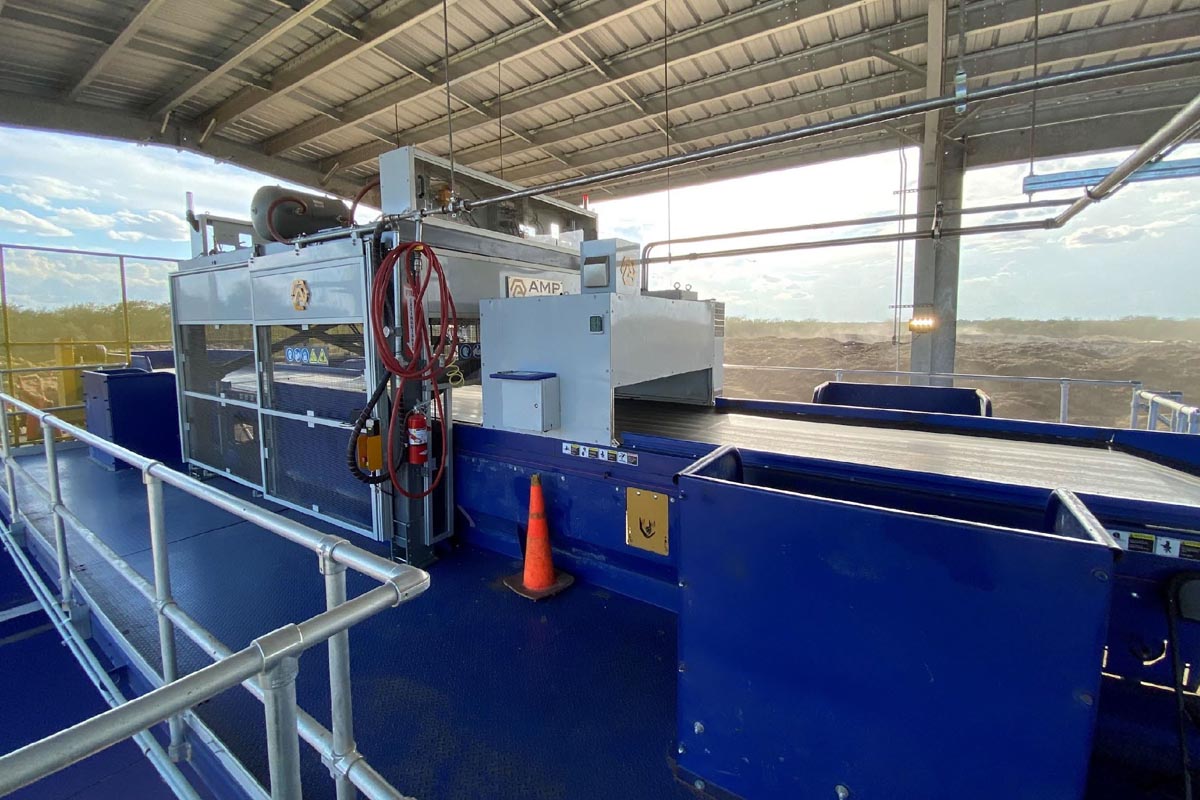
An AMP Robotics unit is removing contamination at Atlas Organics’ composting facility in San Antonio. | Courtesy of Atlas Organics

For perhaps the first time, an AI-equipped robot is removing contaminants from the organics stream headed to composting.

Composting company Atlas Organics installed the robot about a year ago when it built a composting facility in San Antonio. Leslie Rodgers, director of sales and marketing at Atlas, talked about the project during a session at the Sustainable Packaging Coalition (SPC) Impact 22 conference in San Francisco earlier this month.

Rodgers said the sorting system has allowed Atlas to provide a reliable home for the organic materials that city crews collect in green curbside carts. Atlas’ composting facility processes over 100,000 tons of organic material a year.

“The city of San Antonio was dealing with loads being denied and their trucks would have to leave,” Rodgers said. “And we have yet to refuse a single city vehicle. That was the goal of this project and this partnership and the technology for Atlas and the city.”

Based in Spartanburg, S.C., Atlas now operates eight composting facilities across Florida, North Carolina, South Carolina, Tennessee and Texas. The company at the beginning of 2021 opened the San Antonio composting facility, which sits at a city-owned brush recycling center and closed landfill complex called Nelson Gardens. It was built as part of a public-private partnership with the city, which is the seventh largest in the country.

In April 2020, city leaders awarded Atlas a lease and 10-year contract (with a couple of one-year extensions) to build the composting facility and accept all incoming city loads of organic material. The contract provided for a $1.87 million payment to Atlas for the first year of the contract, as well as $3.5 million for site and infrastructure improvements and $2 million for sorting and grinding equipment (including the robot) at Nelson Gardens.

Texas company New Earth held the previous contract, under which the city had loads rejected because of contamination, a city official told the San Antonio City Council in April 2020.

How ‘NOCRAP’ works

Supplied by Denver-based AMP Robotics, the robotic sorting system at Nelson Gardens is removing contaminants, including plastics and some metals, from the yard debris and food scraps stream before the material is composted.

The sort line is called NOCRAP, which stands for Non-Organics Contamination Removal Automated Process, Stefan Holt, vice president of marketing for Atlas Organics, told Resource Recycling.

The robot works similar to AI-powered robots at MRFs, PET recycling plants, electronics recycling facilities and other facilities. The system recognizes items on a conveyor belt based on their visual characteristics, and it uses arms with suction cups to pull the items off the belt (Atlas has one visioning system with two sorting “arms”).

In this case, the AMP system is removing non-organic material for disposal. Rodgers noted that contamination at a composting facility damages processing equipment, costs the company both time and disposal fees and devalues the compost product. The goal of the robot is to reduce contamination to less than 1%.

The artificial intelligence improves its recognition capabilities over time, and the system is “drastically” improving its pick rate very quickly, Rodgers said.

“I have been pleasantly surprised at what the robot has been able to pick up,” she said.

Poised for growth

The robot is unique in an industry that typically uses manual sorters and trommels to remove contamination. Holt noted that Atlas’ goal with the first sort line is to improve the process and educate manufacturers on the new technology.
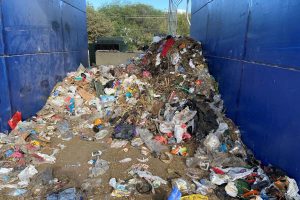
Contaminants removed from the organics stream. | Courtesy of Atlas Organics

“Remember, as the material moves through the shredding and sorting process it is broken down and in some cases, the material is unrecognizable from its original form,” Holt said. “It’s one of the reasons AI helps in the sorting process.”

Future robots are in the cards for Atlas. The company was recently acquired by Generate Capital, which owns and operates organic scrap processing companies in North America. The transaction brought $200 million “for expansion of Atlas composting facilities in the coming years,” according to a press release (Generate’s president of waste-to-value operations is Bill Caesar, who was CEO of WCA Waste Corporation until the company’s acquisition by GFL Environmental in October 2020. Before that, he held key leadership roles at Waste Management).

After the acquisition by General Capital, Atlas has plans to expand with new facilities and sorting lines elsewhere, Rodgers said.

According to the January 2022 Generate Capital press release, Atlas was already developing several additional composting sites and was awarded a contract to build, own and operate a facility for Salinas Valley, Calif., as part of the city’s effort to comply with the Golden State’s new regulations requiring local governments to provide composting service and purchase compost products.

“We’ve built a solid platform for growth and a partner like Generate will help open the door to new opportunities and deliver on our nationwide expansion,” Joseph McMillin, CEO of Atlas Organics, stated in the release.

Tags: ContaminationOrganics
TweetShare
Jared Paben

Jared Paben

Related Posts

California extends compostable labeling law

Report finds path forward for compostable packaging

byKeith Loria
April 28, 2026

A new report by Closed Loop Partners’ Composting Consortium examined five years of research, field testing and cross-industry collaboration and...

Wisconsin outlines steps to cut landfill food waste

Wisconsin outlines steps to cut landfill food waste

byScott Snowden
March 18, 2026

Wisconsin officials say food makes up about 20% of landfill material. A new state evaluation maps the policy, collection and...

Nebraska awards $7m in recycling grants

byAntoinette Smith
February 18, 2026

The grants will help fund waste and litter reduction projects, recycling programs, and costs to collect scrap tires, HHW, electronic...

Wisconsin food waste amounts to 1,033 pounds per resident each year

byStefanie Valentic
January 28, 2026

Wisconsin's nearly 6 million residents discard 1,033 pounds of food per person annually, creating the state's largest waste stream and...

BioCycle shifts leadership as Paula Luu takes the reins

byScott Snowden
January 23, 2026

BioCycle, a long-running publication covering composting, anaerobic digestion and organics recycling, has named Paula Luu as managing director while longtime...

OC Waste, Agromin partner on organics recycling program

OC Waste, Agromin partner on organics recycling program

byStefanie Valentic
January 19, 2026

OC Waste and Recycling and Agromin are expanding organics recovery in southern California as SB1383 compliance efforts progress.

Load More
Next Post

News from Azek, Chroma Color and more

More Posts

Revised CA budget includes $200m for recycling

Revised CA budget includes $200m for recycling

May 20, 2026
Federal PACK Act aims to preempt ‘patchwork’ of state laws

House advances Recycling Infrastructure and Accessibility Act

May 21, 2026
Bottle bill backers see opportunity for action

PET collapse exposes gaps in US recycling infrastructure

May 15, 2026
Plastic packaging

Why SB 54 source reduction planning is becoming the industry’s most challenging EPR test

May 19, 2026
Aurubis: Thefts involved scrap sample manipulation

Metals and electronics recyclers report growth

May 20, 2026
Industry descends on DC to fight for PET

Industry descends on DC to fight for PET

May 13, 2026
Niagara acquires rPlanet Earth assets in California

Niagara acquires rPlanet Earth assets in California

May 15, 2026

Before the Bin: America’s textile waste problem starts in your closet

May 19, 2026
Recycler cites market pressure in short-term closure

AI, data anxiety push enterprises to destroy working devices: report

May 19, 2026
Extruder pushes out natural HDPE pellets at KW Plastics in Troy, Alabama.

Rare look inside the world’s largest plastics recycler

May 13, 2026
Load More

About & Publications

About Us

Staff

Archive

Magazine

Work With Us

Advertise
Jobs
Contact
Terms and Privacy

Newsletter

Get the latest recycling news and analysis delivered to your inbox every week. Stay ahead on industry trends, policy updates, and insights from programs, processors, and innovators.

Subscribe

Welcome Back!

Login to your account below

Forgotten Password?

Retrieve your password

Please enter your username or email address to reset your password.

Log In

Add New Playlist

No Result
View All Result
  • The Latest
  • Analysis
  • Recycling
  • E-Scrap
  • Plastics
  • Policy Now
  • Conferences
    • E-Scrap Conference
    • Plastics Recycling Conference
    • Resource Recycling Conference
    • Textiles Recovery Summit
  • Magazine
  • About Us
  • Advertise
  • Archive
  • Jobs
  • Staff
Subscribe
This website uses cookies. By continuing to use this website you are giving consent to cookies being used. Visit our Privacy and Cookie Policy.