Resource Recycling
  • The Latest
  • Analysis
    • All
    • Certification Scorecard
    • Industry Announcements
    • Opinion

    Certification Scorecard — Week of July 20, 2026

    Amazon plastic use flat despite shift to paper

    Amazon plastic use flat despite shift to paper

    Rare earth processor lands $5.1M in Defense funds

    ERI, Cyclic Materials team up on e-scrap

    Cascade Asset Management sees higher sales volumes

    Sorted: Restoring mineral supplies, one junk drawer at a time

    Passing the baton: Sims shakeup marks new ITAD generation

    Ten e-scrap projects receive federal prize funds

    Recycling rates for rare earths could double by 2040

  • Conferences
    • Resource Recycling Conference
    • Plastics Recycling Conference
    • E-Scrap: The Longevity Conference
    • Textiles Recovery Summit
  • Publications
    • E-Scrap News
    • Plastics Recycling Update
    • Policy Now
    • Resource Recycling
    • Other Topics
      • All Topics
      • Brand Owners
      • Critical Minerals
      • Glass
      • Grant Watch / RFPs
      • Markets
      • Organics
      • Packaging
      • Research
      • Technology
      • Textiles
Subscribe
No Result
View All Result
Resource Recycling
  • The Latest
  • Analysis
    • All
    • Certification Scorecard
    • Industry Announcements
    • Opinion

    Certification Scorecard — Week of July 20, 2026

    Amazon plastic use flat despite shift to paper

    Amazon plastic use flat despite shift to paper

    Rare earth processor lands $5.1M in Defense funds

    ERI, Cyclic Materials team up on e-scrap

    Cascade Asset Management sees higher sales volumes

    Sorted: Restoring mineral supplies, one junk drawer at a time

    Passing the baton: Sims shakeup marks new ITAD generation

    Ten e-scrap projects receive federal prize funds

    Recycling rates for rare earths could double by 2040

  • Conferences
    • Resource Recycling Conference
    • Plastics Recycling Conference
    • E-Scrap: The Longevity Conference
    • Textiles Recovery Summit
  • Publications
    • E-Scrap News
    • Plastics Recycling Update
    • Policy Now
    • Resource Recycling
    • Other Topics
      • All Topics
      • Brand Owners
      • Critical Minerals
      • Glass
      • Grant Watch / RFPs
      • Markets
      • Organics
      • Packaging
      • Research
      • Technology
      • Textiles
Subscribe
No Result
View All Result
Resource Recycling
No Result
View All Result
Home Recycling

How scrap plastic exports shifted at largest U.S. port district

byJared Paben
April 17, 2018
in Recycling

In the course of one year, Los Angeles-area exporters cut their scrap polyethylene shipments to China by 99 percent, leaving thousands of tons of plastic looking for a home. Other countries were only able to absorb about one-fifth of the volume.

Resource Recycling recently analyzed scrap plastics export data from the U.S. Census Bureau, focusing on January numbers from the Los Angeles port district. That district is by far the largest U.S. exporter of scrap plastics, handling material from all over the country brought in on trains and trucks.

In all, scrap plastic exports from the L.A. district fell by more than half in January 2018 year over year. The numbers suggest it was a result of China’s National Sword campaign.

The following is a closer look at year-over-year shifts in the port’s export numbers for specific recovered resins.

A tale of two Januarys

The analysis shows how clearly 2017 was a year of change for scrap plastics exports at the port. Looking at the “before,” nearly 67,130 short tons of scrap plastics left the L.A. district in January 2017. Of that, 52 percent went to China, 37 percent to Hong Kong and 11 percent to the rest of the world.

As 2017 progressed, however, China’s import policies took hold, with the country cracking down on smuggling, issuing tighter quality inspections, decreasing import permits and banning some post-consumer bales.

The effects are seen clearly in the January 2018 data. That month, 30,150 tons of scrap plastics left the port district, a decrease of 55 percent. Of that amount, only 7 percent went to China, 14 percent to Hong Kong and 80 percent to the rest of the world.

Other countries increased their imports, but it wasn’t enough to fully absorb the material that would have otherwise gone to China. Previous analyses by Plastics Recycling Update, sister publication to Resource Recycling, and industry groups have painted the same picture on nationwide basis.

But a deeper look – on a polymer-by-polymer basis – shows some plastics leaving the L.A. area had an easier time finding a new overseas home than others.
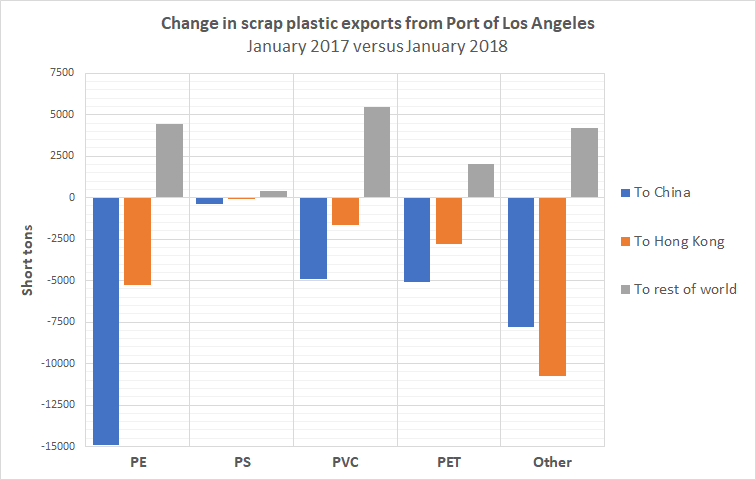
Figures compiled by Resource Recycling, Inc.

How different polymers fared

For background, L.A.’s recovered plastics exports were made up of the following in 2017: 39 percent “other” plastic (a category combining PP and No. 7); 34 percent PE, 14 percent PET, 11 percent PVC; and 2 percent PS.

The following shows how different polymers were affected, comparing January 2017 with January 2018:

Other (polypropylene and No. 7 misc. plastics)

  • To China: -84%
  • To Hong Kong: -84%
  • To rest of world: +147%

Polyethylene

  • To China: -99%
  • To Hong Kong: -83%
  • To rest of world: +176%

Polyethylene terephthalate

  • To China: -96%
  • To Hong Kong: -80%
  • To rest of world: +196%

Polyvinyl chloride

  • To China: -99%
  • To Hong Kong: -84%
  • To rest of world: +557%

Polystyrene

  • To China: -90%
  • To Hong Kong: -100%
  • To rest of world: +595%

Finding alternative homes

Comparing January 2017 with January 2018, some polymers had an easier time finding new overseas markets than others. Specifically, the large volume plastics weren’t able to find alternatives as easily as the small volume ones:

For instance, all of the PS tonnages no longer headed to China found alternative foreign homes in January 2018, and 84 percent of the displaced PVC found other homes.

In contrast, only 23 percent of “other” plastics no longer shipped to China and Hong Kong was taken to other countries in January 2018. For PE and PET, 22 percent and 26 percent, respectively, were absorbed by other countries.

Resource Recycling also recently quantified the reduction in Chinese imports from all countries. Global shipments to China roughly mirror the plastic volume drop-off seen by the California port.

Photo credit: trekandshoot/Shutterstock

 

CPM

Tags: AsiaTrade & Tariffs
TweetShare
Jared Paben

Jared Paben

Related Posts

Groups call for end to e-scrap imports to Philippines

Groups call for end to e-scrap imports to Philippines

byPaul Lane
June 30, 2026

A task force claims hundreds of containers of material have illegally entered the country since last year.

Novelis posts steady Q2 amid tariffs, fire recovery

Tariff updates unlikely to impact recyclers

byPaul Lane
June 18, 2026

Revisions under Section 232 would lower the tariffs on certain materials through 2027.

Aluminum can bale close up.

Aluminum scrap exports face scrutiny under HB 9161

byStefanie Valentic
June 9, 2026

A new House bill would direct the US International Trade Commission to investigate whether US aluminum scrap exports to adversarial...

Wisconsin prepares for E-Cycle rulemaking

Reading Asia’s e-scrap recycling market through YDDL

byDavid Daoud
May 15, 2026

One Asian recycler’s latest financials offer a rare, detailed look at how downstream metals recovery from e-scrap is developing in...

APR, industry groups testify on overcapacity

APR, industry groups testify on overcapacity

byAntoinette Smith
May 8, 2026

Steve Alexander, CEO of APR, pointed to China as driving global oversupply despite fluctuating PET imports to the US and...

Volatility reshapes outlook for US metals businesses

byScott Snowden
April 15, 2026

Panelists at the ReMA conference in Las Vegas said tariffs, reshoring and geopolitical tension are remaking trade flows, lifting US...

Load More
Next Post

Resource Recycling Conference grants now available

More Posts

CarbonLite to open $60 million Pennsylvania plant

Federal judge blocks CA ‘Truth in Recycling’ (SB 343) law

July 15, 2026
Industry announcements for January 2026

Industry announcements for July 2026

July 1, 2026
Greg Saxon to lead The Recycling Partnership

Greg Saxon to lead The Recycling Partnership

July 15, 2026
Former president of CRT processor sentenced to prison

Groups say injunction doesn’t settle labeling issues

July 17, 2026

US recycling rates rise despite drop in bottles

July 16, 2026
Shredded rubber from Pacific Palisades running track by Ecore

Wildfire-damaged track finds second life ahead of 2028 LA Olympics

July 20, 2026
Amazon plastic use flat despite shift to paper

Amazon plastic use flat despite shift to paper

July 22, 2026
Cascade Asset Management sees higher sales volumes

Sorted: Restoring mineral supplies, one junk drawer at a time

July 20, 2026
May pricing bullish for most bales

Nth Cycle joins SPAC to IPO in US critical minerals push

July 22, 2026
RecyClass hits 500 EU recyclability evals

RecyClass hits 500 EU recyclability evals

July 21, 2026
Load More

About & Publications

About Us

Staff

Archive

Magazine

Work With Us

Advertise
Jobs
Contact
Terms and Privacy

Newsletter

Get the latest recycling news and analysis delivered to your inbox every week. Stay ahead on industry trends, policy updates, and insights from programs, processors, and innovators.

Subscribe

Welcome Back!

Login to your account below

Forgotten Password?

Retrieve your password

Please enter your username or email address to reset your password.

Log In

Add New Playlist

No Result
View All Result
  • The Latest
  • Analysis
  • Recycling
  • E-Scrap
  • Plastics
  • Policy Now
  • Conferences
    • E-Scrap Conference
    • Plastics Recycling Conference
    • Resource Recycling Conference
    • Textiles Recovery Summit
  • Magazine
  • About Us
  • Advertise
  • Archive
  • Jobs
  • Staff
Subscribe
This website uses cookies. By continuing to use this website you are giving consent to cookies being used. Visit our Privacy and Cookie Policy.