



Editor’s note: For insight into this major bale buyer’s take on commodity markets, subscribe to our new quarterly markets newsletter, publishing Aug. 17. This story has been corrected to clarify plant operational status.
Six weeks into second-half 2026, PureCycle is already seeing its forecast for recycled polypropylene offtake become a reality, the CEO said during a recent earnings call.
Earlier this year CEO Dustin Olson said a ramp-up of demand would be weighted toward the second half of the year. And during the Aug. 6 update, he pointed to regulatory developments and supply-chain readiness, along with improving operational conditions, as the primary drivers for promising momentum.
“It’s one thing to qualify products and another thing to deliver it consistently with every truck. Both are now proving out,” he said.
In May, New Jersey granted one-year conditional approval for PureCycle resin to qualify as mandated recycled content. “We have 17 active trials that were tied to New Jersey compliance,” Olson said. “Brands were, quite frankly, paused because of the uncertainty.”
In addition, increasing certainty over product quality and consistency encourages customers to commit, he said. “Brands buy at the SKU level one application at a time, and they do not start until they’re confident the material in the 10th truck will be identical to the material of the first.”
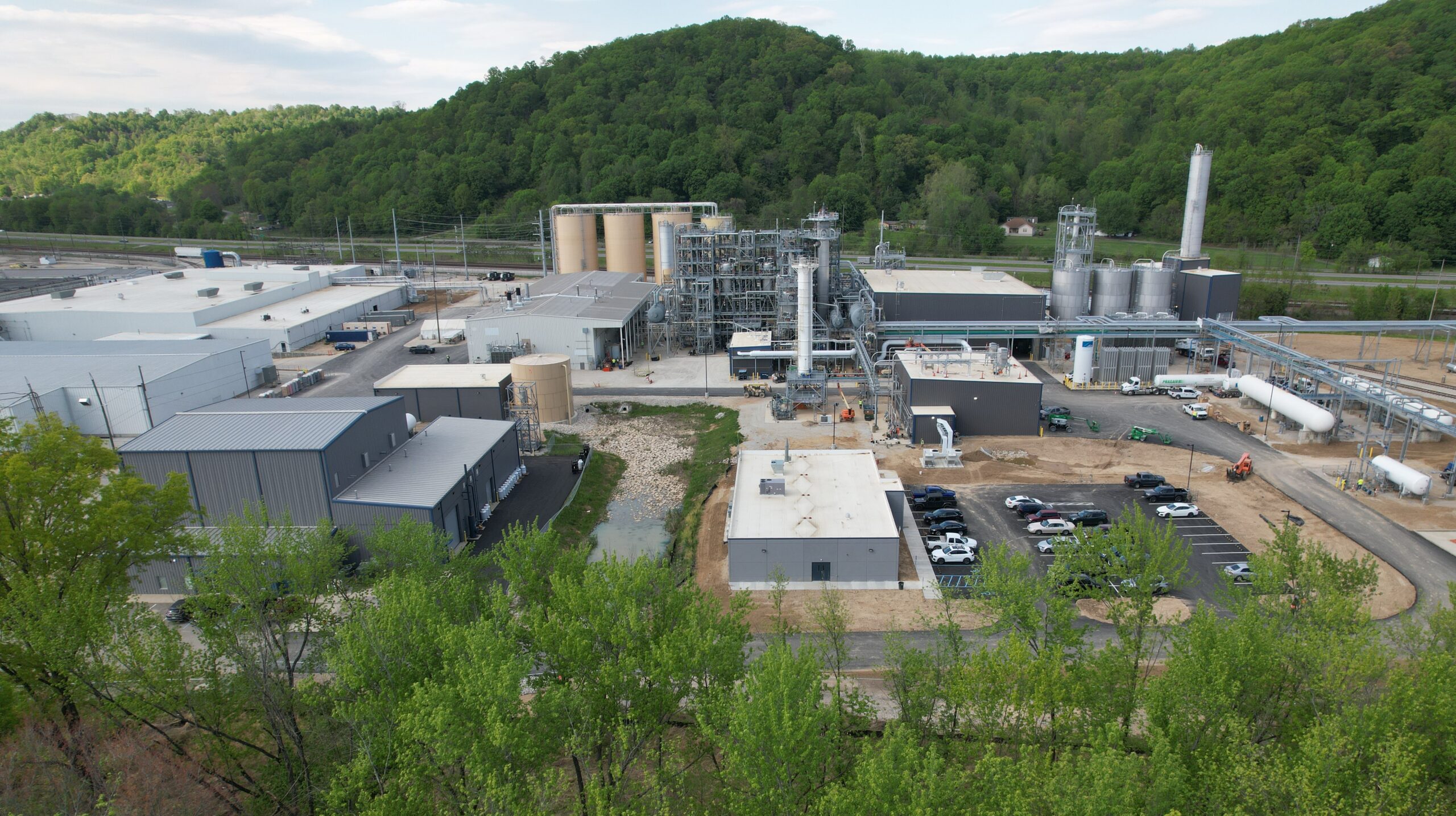
PureCycle also moved compounding services in-house, which reduces the inherent risk of using third-party services, and enables the company to ship via railcar directly from the flagship plant in Ironton, Ohio, he said. Compounded volumes include virgin resin and additives to meet performance requirements, in addition to the PureFive R-PP resin.
About 45% of the H2 ramp volumes are 100% PCR, while 29% contain 50% PCR and 24% contain 30% PCR. As for color, 71% of the volumes are clear, 20% are white and 7% are black.
Value-add supports premium pricing
Even amid the headwinds presented by inexpensive virgin resin, customers see PureCycle as a value-added service provider, Olson said. “We’re giving them a one-pellet solution. So the operational headaches are reduced, the supply chain headaches are reduced. And they’re willing to pay a premium for that as well.”
Consumer goods heavyweight Procter & Gamble is expanding adoption of the resin for its packaging – caps for Downy liquid are in commercial production, and Tide caps are scheduled for production for Q3, while Vicks ZzzQuil child-resistant lids are expected in Q4. P&G granted an exclusive license for its dissolution recycling process to PureCycle in 2015.
Although P&G has demanding qualification standards, clearing them once makes qualifying subsequent applications move faster, Olson said. He added that other large companies follow similar trajectories, and that in the case of cold-drink cups, major quick service restaurants (QSRs) “moved from conversation to shipments in weeks.”
And although “they’re not ready to put their names out there,” a large global food manufacturer pulled forward its purchasing timeline during the quarter – a first for PureCycle, Olson said. As such, public announcements of resin commitments often lag customer commitments, he said.
“The activity is the ramp.”
As the January 2027 enforcement of recycled-content mandates approaches, customers are working to secure supply and begin production of compliant packaging, Olson said. So PureCycle is aiming for Ironton to run at the breakeven level of 40% to 50% utilization in H2 – a goal developed based on brand commitments at previously stated pricing.
The company reported a Q2 operating loss of $41.3 million (from -$45.6 million), though adjusted EBITDA worsened to -$31.7 million versus -$27.8 million. Revenue for the quarter was $4.5 million, significantly higher than the $1.7 million a year ago, and marking a sixth consecutive quarter of growth.
Record throughput after turnaround
With the breakeven goal in mind, the compounding operations are running 24 hours a day, five days a week, with plans to increase to 24/7 in the fourth quarter, Olson said. The dissolution plant is running 24/7, the company said in a follow-up email.
Following planned maintenance in the spring, the recycling plant set a daily throughput record of 12,000 pounds per hour, or about 85% utilization. However, Olson emphasized that this was not a routine run rate as yet. “It shows what’s capable, not what we’re doing on a day-to-day basis,” he said, adding, “This was not a quarter for rate.”
May was “by design, a low-volume month,” as the company commissioned new equipment and tested processes designed for the two planned facilities in Belgium and Thailand, Olson said.
The spring turnaround resolved issues with the co-product 2 (CP2) system, improved mechanical reliability, de-bottlenecked the plant and addressed “the worst-performing seal in the plant,” Olson said.
During the quarter, the plant produced 4.5 million pounds of resin from 5 million pounds of feedstock, resulting in a 90% yield for R-PP.
| In million lb | Q2 2026 | Q1 2026 | Q2 2025 |
| PureFive production | 4.5 | 8.4 | 3.4 |
| Other production | 0.1 | 1.3 | 0.6 |
| Feedstock processed | 5.0 | 10.0 | 4.2 |
| R-PP yield | 90% | 84% | 81% |
| “Other production” includes Co-product 1, Co-product 2, and additional saleable volumes, net of material reprocessed back into the production stream, representing recovered material intended for sale as commercial markets develop | |||
Next-generation facilities
As the Ironton plant continues to refine processes and inform design for future facilities, PureCycle continues to work on announced plants in Thailand and Belgium.
Groundbreaking for the $250 million Thailand plant is expected in the second half of the year, with operations expected to begin in 2028, Olson said. The project received Board of Investment approval and was admitted to Thailand’s FastPass investment acceleration program, which will speed permitting and licensing.
PureCycle has ordered long-lead time equipment, confirmed a detailed design and signed seven letters of intent for feedstock – enough to cover requirements, Olson said.
The Ironton facility’s compounding capabilities have also enabled the company to send samples directly to potential customers in Thailand and Europe, helping to accelerate adoption even before local startup, he said.
Earlier this year PureCycle signed a €40 million EU innovation grant to support the Antwerp project.
Both projects remain on track, according to Olson, with Thailand’s financial close targeted for year-end and first production expected in 2028.