Having proven the technology of its Battery-In-Device Shredding (BIDS) system overseas, Gloyd Recycling Solutions (GRS) has started expanding its reach stateside.
The Houston-based company’s first domestic BIDS system is commissioned and operational after getting installed earlier this month. Company founder Jeff Gloyd declined to name the customer but said they’re located in the Southeast. Two other systems are set to go online in the US in the next 90 days.
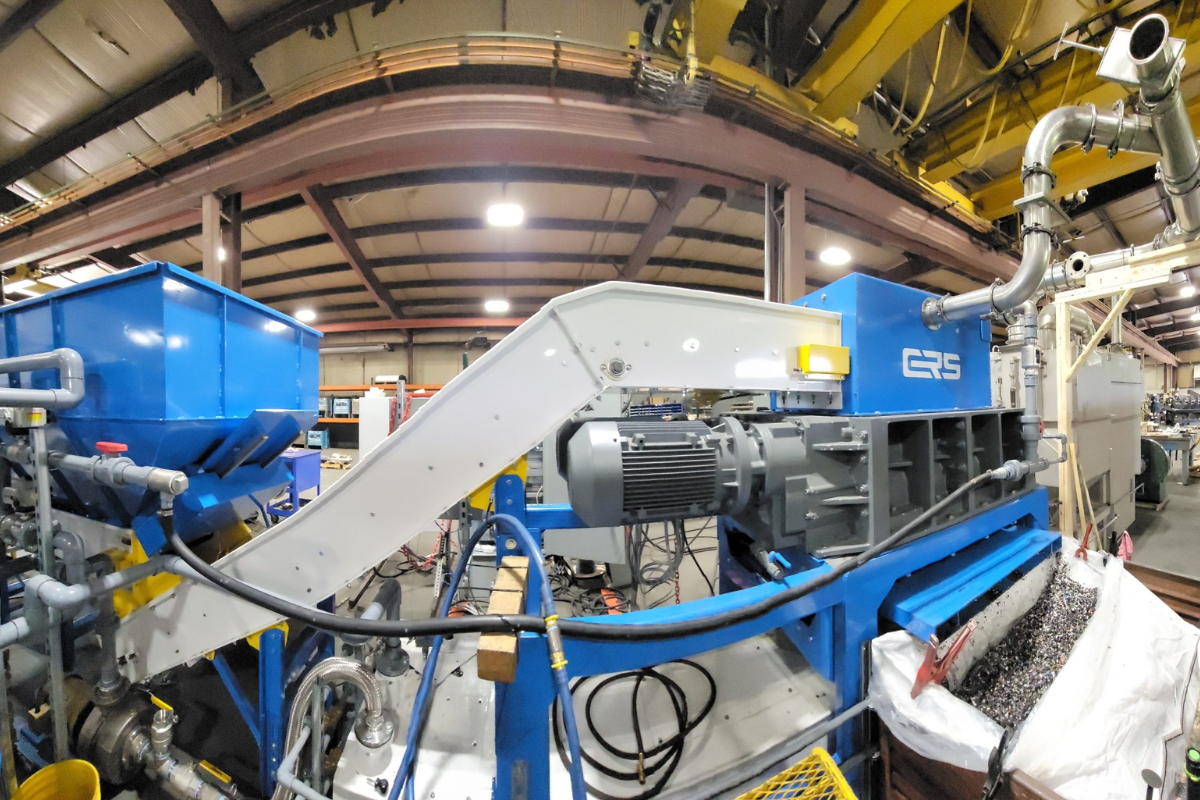
BIDS is the first system to process battery-embedded devices at the warehouse level. Companies can feed earbuds, vapes and other electronics that are laptop-sized or smaller into the system, as well as batteries themselves. They are fed into a wet shredder, which removes the risk of fire or explosion, before getting fed into a density separation tank.
From there, the system separates elements and gives four outputs: plastic, ferrous metal, nonferrous metal and black mass. Users can sell those outputs or otherwise put them to new use; Gloyd said his company can help set up those downstream relationships if companies don’t already have them.
“There’s a high cost and high risk to battery storage,” he said. “We figured there had to be a better solution.”
The company was founded in 2021 and also performs other technological and advisory services. BIDS was one of GRS’ first projects on its manufacturing side.
A complete unit takes up about 750 square feet; Gloyd said this is intentional so it doesn’t dominate facility space or cost too much. They’re shipped by design to be plug-and-play devices, needing only a power connection and water.
“The problem was never that recyclers did not want to manage batteries safely,” Gloyd said. “The problem was that nothing existed at their scale. The big battery processors want 30,000- and 40,000-pound loads. E-scrap recyclers and others have been storing this material in pails and hoping there will not be a fire.”
A unit can handle between 4 million and 8 million pounds of product per year and eliminate the need to have employees manually disembed batteries from devices.
Australian company EcoBatt began using BIDS in September 2025 as part of the world’s first dedicated battery-in-device shredding facility. EcoBatt leadership said the BIDS system helped them recover more than 90% of the minerals contained in the devices they processed. Their success stirred up demand elsewhere, Gloyd said.
“We’ve made a lot of progress in the last six months,” he said. “We’re in an industry where they want to see it and touch it before they use it. Now that we’ve shown that it does what we say it does, we’re seeing a lot of interest on the purchase side.”
Gloyd expects to convert that interest into upwards of 20 facilities within the US and Canada using the BIDS system within the next two years. The company plans to both sell units to other companies and to, in time, shift to an owner-operator model that would see GRS gain funding partners to build and run its own facilities.
He also expects more international expansion. Plans are to have the first European units operational by the second quarter of 2027, with growth into Asia coming at some point after that.
As safety and mineral recovery concerns mount, Gloyd expects the BIDS system to gain more traction.
Businesses “see this as a game-changer,” he said. “It’s cheaper to make these batteries as they are now. This is one of those ‘change moments.’ The industry has a problem, and this process and equipment solves it.”