





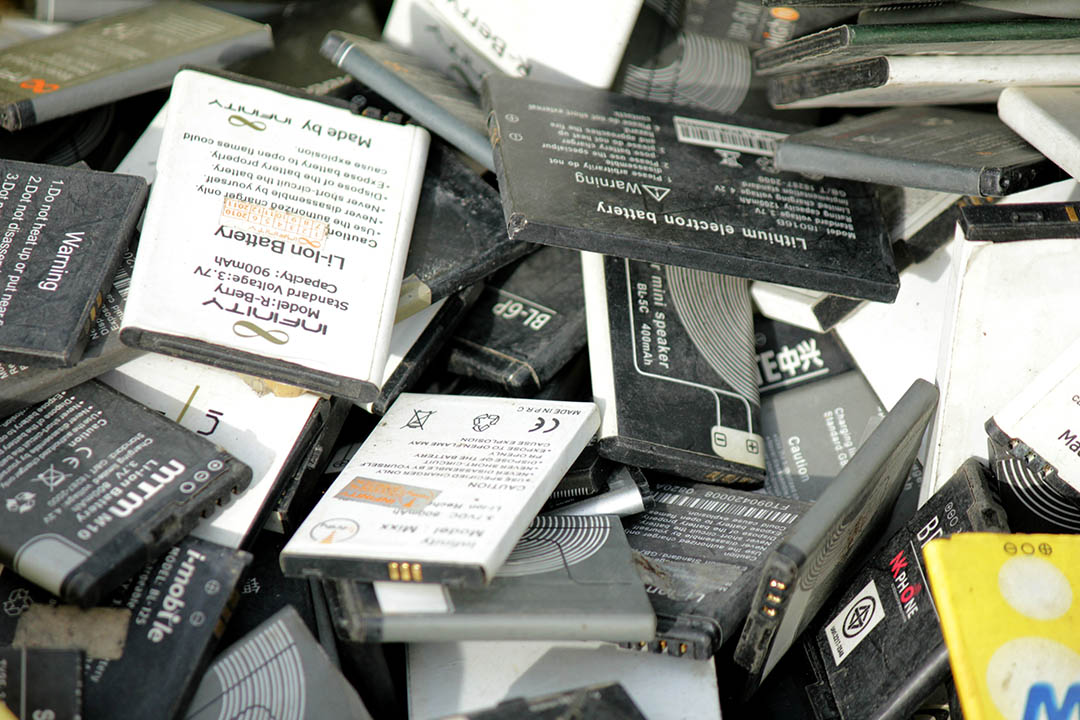
There’s a growing worry among MRF operators, and it has nothing to do with commodity markets: Lithium-ion batteries are causing fires and explosions at facilities nationwide.
Although experts agree the issue has not been studied conclusively, operators report increasing instances of battery fires at recycling facilities across the country. The problem has grown so substantial that, during a presentation last fall on markets and the Chinese import restrictions, a California MRF operator took the opportunity to sound the alarm.
Although markets have clearly impacted revenue, lithium-ion (LI) batteries in the recycling stream are “an existential threat” to the industry, said Hilary Gans of the South Bay Waste Management Authority. The agency runs a MRF that has experienced two fires per month caused by LI batteries. An LI battery-sparked fire at the agency’s Shoreline Environmental Center MRF cost $8.5 million in 2016.
“They are bombs, they get crushed by the equipment, they get tangled up in the rolling stock and then tangled up in the MRF,” Gans said in the October webinar by The Recycling Partnership. “And in a house of paper, you don’t want fires.”
Now, stakeholders are coming together to help respond to the growing problem. In a March episode of its Sustainable Materials Management webinar series, the U.S. EPA focused on the problems caused by improper disposal of LI batteries, and how to mitigate the threat.
Why battery fires start
Since 2010, LI batteries have become more powerful, lighter and cheaper, said Michael Timpane of consultancy RRS. The future looks bright for them as well, he added, particularly in their potential to store wind or solar energy.
There are many LI battery chemistries, each with their own characteristics, but all are very energy dense compared with other battery types such as lead-acid. The most common LI chemistry in consumer electronics is lithium cobalt oxide (LCO), which is why LCO batteries most frequently show up in MRFs.
The fire potential from LI batteries comes from a combination of factors. They store lots of energy and high voltage, and the high voltage doesn’t allow use of water-based electrolytes. Instead, manufacturers use organic-based electrolytes, which are flammable.
“So we have high-energy chemistries, flammable materials, and this sets the stage for the challenge that we’re talking about today,” said Jeff Spangenberger, an engineering specialist at Argonne National Laboratory, which is part of the U.S. Department of Energy.
The problem is straightforward. During collection and sorting at MRFs, materials frequently get crushed, punctured, ripped and dropped. But with an LI battery, rupturing of any kind can cause damage to the safety separator between the cathode and anode. This allows a discharge, which generates heat and can cause a fire or explosion, Timpane explained.
RRS was hired by the South Bay Waste Management Authority to study the LI battery problem in the recycling stream. During a five-week period, the study captured more than 1,000 batteries.
“In a given hour, if you’re paying attention, you can get up to 5.48 batteries per hour,” Timpane said.
Collection gaps
A large part of the problem is the lagging collection infrastructure for common LI batteries, such as the LCO chemistry. Ironically, their cobalt gives them the highest recycling value, because cobalt prices have tripled in the past three years. Large-format electric vehicle batteries have relatively less cobalt, but they are anticipated to be returned at a higher percentage through future formal collection systems.
Lead-acid batteries present another ironic situation. There’s talk about banning them because lead is a concern material, Spangenberger said, but he noted that there is a well-established collection mechanism for lead-acid batteries, and that 99 percent of them are recycled.
Argonne is working to develop a recycling model for LI batteries. The goal is to present a picture of the entire life cycle of an LI battery, evaluating the costs and environmental impact at each phase.
“The hope is that this will help accelerate the progress, the development of the battery recycling processes and infrastructure in general,” Spangenberger said, noting the lab hopes to release the model this summer.
One problem exacerbating the situation is mixed messaging on LI batteries. Some include symbols to indicate the batteries can be recycled, though not in curbside programs. But these can confuse consumers if they’re not clear enough.
Existing system
Although it’s not as developed as the lead-acid collection system, there is infrastructure for LI battery recycling. Call2Recycle, an industry-backed battery stewardship group, has handled close to 30 million pounds of LI batteries, said group CEO Carl Smith. He spoke on the webinar and described some of the current trends in LI battery recycling.
More and more LI batteries are being reconditioned rather than recycled, particularly in consumer electronics, Smith explained. That trend is driven by the changing economics, as manufacturers are moving away from using cobalt in batteries due to the price.
LI batteries are also getting damaged more often. When they’re damaged, they require different shipping and treatment processes. This often happens when a consumer tries to remove a battery from a device that is designed to prohibit battery removal.
“Invariably, because of how these are attached to those electronics devices, it’s almost impossible to take them out without causing some damage to them,” Smith said. These are often what are referred to as lithium polymer batteries, indicating they have a thin film exterior rather than a hard case, which means they can easily get bent or scraped.
Once collected through Call2Recycle’s network, LI batteries are either sent to four sorting facilities or directly to six processing plants. The sorting sites are two Battery Solutions facilities, one in Howell, Mich. and another in Mesa, Ariz.; INMETCO in Ellwood City, Pa.; and Wistron GreenTech in McKinney, Texas.
The six processors are Glencore in Sudbury, Ontario; Recycling Coordinators in Akron, Ohio; Retriev Technologies in Trail, British Columbia; another Retriev site in Lancaster, Ohio; SungEel Hitech in South Korea; and Umicore in Hoboken, Belgium.
Photo credit: Mr.Samarn Plubkilang/Shutterstock