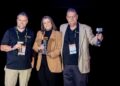




Live from the floor at E-Scrap: The Longevity Conference in New Orleans, Uriah Kiser talks with Rod McDaniel, CEO of S3 Recycling Solutions, a Nashville-area ITAD company with facilities in Tennessee and California.
Rod explains why healthcare makes up nearly 60% of S3’s client base, what the company learned acquiring iGlobal Asset Management in California, and its plans to partner more with industry peers. He also shares how a single technology device changed his life growing up in Nashville’s housing projects — and why S3 has donated nearly 10,000 computers to underserved individuals.
Plus: why Rod sees AI as a job enhancer, not a job replacer.
Like, comment, subscribe, and turn on notifications so you don’t miss the next conversation on the Resource Recycling Podcast.
Transcript of episode 8: The Resource Recycling Podcast
Host: Uriah Kiser, Resource Recycling | Guest: Rod McDaniel, CEO, S3 Recycling Solutions
Uriah Kiser: Welcome back to the Resource Recycling Podcast. I’m Uriah Kiser. We are on the floor here at E-Scrap: The Longevity Conference, in NOLA. Here with me is Rod McDaniel of S3 Recycling Solutions. And we have name tags, so if you want to know who we are, we’re proving it. We are who we say we are. Rod, thanks for coming on the podcast.
Rod McDaniel: Thanks for having me. I’m excited about it.
Uriah: We were talking, and your company has experienced some fantastic growth. You’re based in Nashville. Tell us about S3.
Rod: S3 is an ITAD company based in Nashville. We have three facilities: two in Tennessee and one in California. As you mentioned, we’ve grown a lot. I acquired the company in 2016, and we’ve had almost 4,000 percent revenue growth since then. We’ve been on the Inc. 5000 six consecutive years.
Uriah: And healthcare is your market, right?
Rod: Healthcare. It’s nearly 60 percent of our client base. They’re not all headquartered in Nashville, but Nashville is the healthcare capital of the United States.
Uriah: Which I think is interesting, because when you say Nashville, you think music.
Rod: That’s the first thing that comes to mind. But think about headquarters. Most hospital operators, not just ones with one hospital but operators with multiple sites, are headquartered in Nashville. They’ve got facilities throughout the U.S., and that’s how we’ve grown. Honestly, they’ve pushed us to grow, because we’ve had to figure out how to get that equipment to one of our facilities and build out our logistics network. That’s been fun.
Uriah: You’re in Tennessee and California. Talk about some of the challenges you’ve faced in the different markets you serve.
Rod: We can start with California. That was our first acquisition. We acquired iGlobal Asset Management about two years ago, in 2024, I believe. Our philosophy was: if we can acquire a business in California, one of the toughest states to do it in, we can probably do it anywhere.
We started out hard and learned some good lessons, and that team is really doing well. We’re a people-centered organization, and I think that helped us there. Getting into a market is always a people thing first, especially with an acquisition. We already had a client out there, which is why we were looking in the area. We had the volume to feed that location. We were looking for a good company to acquire that could add on to what we were doing.
Uriah: And you’ve been on the acquisition track since 2016?
Rod: We’ve only done two since then. But we’re looking for great partners. We want to grow something meaningful, something people are proud to say they’re part of: “I’m part of the S3 organization.”
One of the things we’ve done since 2016 is donate nearly 10,000 computers to underserved individuals. I grew up in the housing projects in Nashville, and a technology device changed my life. That’s become a big part of our business model.
Uriah: This is not your first E-Scrap.
Rod: It’s not my first E-Scrap.
Uriah: Not your first rodeo, as they say. But it is your first one as an exhibitor. You’ve got a beautiful booth over here. That’s what we’re all talking about here: how to grow and serve. Talk about your plans for the next five to 10 years.
Rod: Traditionally, we’ve brought devices in from our clients, whether in healthcare or financial services, but we haven’t partnered much with our peers. We’ve seen that work a lot in the industry. So we’re starting to build out a team to help us do that, and I believe we’ve got the relational skills to do it. That’s why we’re exhibiting here.
Uriah: It’s 2026, and we’re in Louisiana. I’m sure somewhere in state law it says I have to ask about AI. Where do you see AI changing your company over the next five to 10 years?
Rod: Sometimes we look at AI as a job replacer. I see it as a job enhancer. When you’re running a people-focused organization, you have to look at it that way. I talk a lot about being relational. My hope is that AI takes the administrative tasks off of us so we can be more relational. When you’re more relational, people want to do business with you more.
Whether it’s helping us write better emails, logistics software that makes it easier and more efficient to get to pickups, or even a robot that helps us tear down a device, I think AI will eventually help us be more relational.
Uriah: I love the positivity, and you share it with so many people I’ve talked to at this conference. Here, it’s not doom and gloom. It’s not “the world is ending and your job’s going away.” It’s being assisted by AI, and that seems to be the buzz around here. It’s so different from everywhere else I’ve been. I’m seeing it as I go around and talk to everybody. Very optimistic.
How can we follow you? Your socials, your websites, your favorite flavor of birthday cake, all that good stuff. How can we track Rod McDaniel?
Rod: I have a big following on LinkedIn. Just search Rod McDaniel and you’ll see this big smiling mug. You can also go to S3’s website, s3rs.com. And I have a personal website: meetrod.com, M-E-E-T-R-O-D dot com.
Uriah: And this is the one where you’ll do house calls for comedy shows, right?
Rod: That’s exactly it. Birthdays, bar mitzvahs, roach coach, I’m there. Book online.
But seriously, I share some personal things. There are a lot of people who will tell you a lot about business, and I’m not that guy. What I like to talk about is how you balance life as a leader, whether that’s family or faith. You’ll see me with this “What would Jesus do” bracelet that I wear pretty much all the time. And what you do to give back.
Uriah: You have certainly given a lot back through your tech giveback. I love that one device changed your life, and here you are, the CEO of a big company with 80 employees and growing. Thank you for coming on the podcast today. This has been a lot of fun.
Rod: This is great. I really appreciate it. Thank you.
Uriah: If you want more conversations like this in the circularity space, ITAD and e-scrap, give us a like at the Resource Recycling Podcast. Like the video, share it, hit the notification bell and subscribe so you know when we’re talking about you. Stay tuned for more from the floor at E-Scrap: The Longevity Conference. I’m Uriah Kiser, and we’ll see you on the next one.