
Quebec’s producer responsibility organization (PRO) is looking back on the first year of managing the Canadian province’s EPR program for packaging, using stakeholder feedback to help adapt the program targets and provide transparency.
As PRO, Éco Entreprises Québec (EEQ) has heard many producer comments about higher costs, a common argument against EPR programs regardless of packaging substrate. Although the organization had proactively communicated that the fees would be coming, some participants were caught off-guard, said Charles David Mathieu-Poulin, public affairs and sustainability manager for EEQ.
Most big companies in the EPR scheme expected a 50-75% increase in fees, after seeing similar programs roll out in other provinces and in Europe, he said. “So those people were a little bit more aware and maybe had budgeted better.”
He added that smaller companies “have a million things to think about,” so may have overlooked the notifications. “And then they saw the bill come in, and it was much higher. So they reacted very strongly when we sent the bills last year,” he said.
As a result, this month Quebec’s government announced it would provide CAD $27 million (US $19.43 million) to help producers transition to the new system. EEQ will receive the funds and then redistribute them to eligible businesses to help offset the costs.
Maryse Vermette, president and CEO of EEQ, said, “The modernization of the curbside recycling system has placed significant financial pressure on businesses that market containers, packaging, and printed paper in Québec.”
She added that EEQ had worked for more than a year with the government to find a solution.
“The financial support announced today, together with the anticipated regulatory changes, will help strengthen the modernized curbside recycling system and reduce its costs over the medium and long term,” she said.
In addition to the financial support, the government adjusted recovery and recycling goals and pushed the target date out by three years to 2030. This made the goals “more realistic,” Mathieu-Poulin said.
Key changes for plastic packaging include:
- Lowering 2030 collection rate targets
- PET: from 80% to 75%
- HDPE: from 80% to 75%
- Other rigid plastics: from 75% to 45%
- Flexible plastics: from 50% to 45%
- Lowering 2030 recycling rate targets
- PET: from 70% to 60%
- HDPE: from 65% to 60%
- Other rigid plastics: from 65% to 35%
- Flexible plastics: from 40% to 20%
Transparency is key
EEQ’s emphasis on transparency also helped make the new fees easier to swallow. Participants wanted to know the rationale for investing in sorting centers and other decisions, he said, to help understand the gap between their expectations and the fee invoice.
Transparency is key, even for data that exposes areas in need of improvement. For example, EEQ found that 58% of residual material was recyclable material, which is high, Mathieu-Poulin said. This could be due to older equipment, or unusual packaging formats.
Following internal discussions, the PRO ultimately decided that the statistics showed what the program was created to improve. “People are asking us why we invest in sorting centers – here’s one of the reasons,” he said. “A lot of the MRFs and the recyclers were very happy that we came out with that data too.”
Another surprise was the amount of information the system would produce. “I think we underestimated how much data was going to come in,” he said.
On the positive side, EEQ can now show that 63% of recycled material is sold locally and 80% stays in North America, “which we’re very, very proud of.”
Contamination rates also are decreasing, due to EEQ’s education campaigns. At its most basic level, the messaging is: “If you put your packaging and paper in the bin, 80% is going to be recycled,” he said. “It’s still not 100%. But don’t listen to the people saying everything’s going to go to landfill. The vast majority finds a home.”
Being able to prove the destiny of post-consumer packaging materials also improves public trust of recycling systems, which in Quebec is around two-thirds of the population, he said. For 2025, EEQ could trace the entire life cycle for 98% of processed material, he said. “When it goes to a landfill, we’re telling you. When it goes to waste-to-energy, we’re telling you.”
Residents aren’t the only ones invested in seeing materials move through the system. Recyclers also find value in knowing that, for example, the discarded HDPE is being used in the drainage pipes used in local construction projects. “I think we sometimes forget about that last little part, where we’re telling people where it goes,” Mathieu-Poulin said.
Regional program approaches vary
Canadian provinces have packaging EPR programs of various vintages, from British Columbia starting in 2014, to Nova Scotia, which launched in December 2025. This has made EPR a commonly known term, but still each program has its differences, Mathieu-Poulin said.
The biggest difference is that British Columbia has multiple curbside streams, including the newly launched flexible packaging collection, while Quebec has only one. While both approaches have pros and cons, the single stream simplifies messaging efforts.
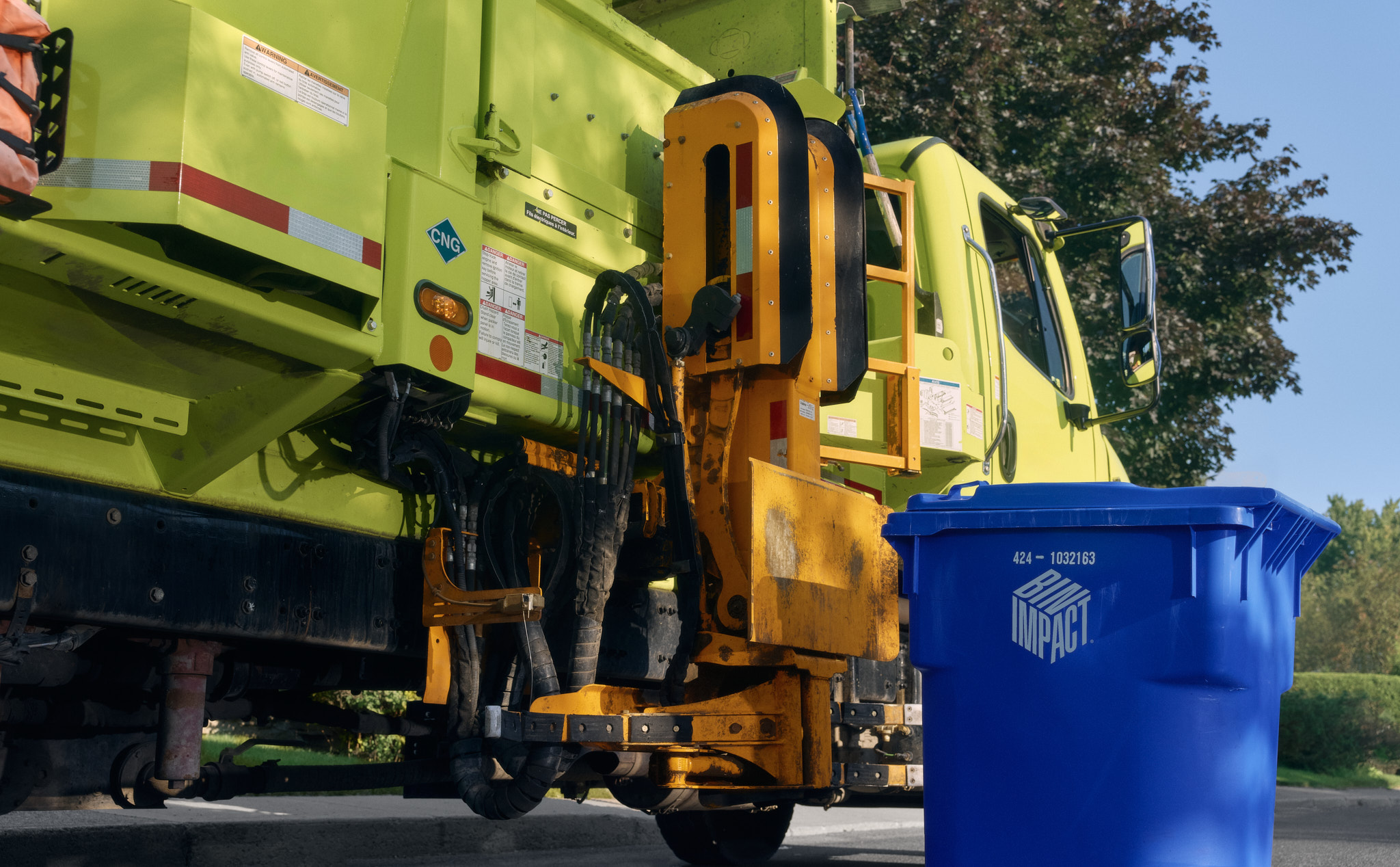
In addition, “I think culturally, people just love to have the convenience of that one big blue bin at their door.”
And as the US begins implementing state-level EPR programs, Mathieu-Poulin sees differences in attitudes, after two decades of increasing modes of producer responsibility. “I think people understand why we’re doing it. So the conversation is more about ‘how’ than ‘let’s make it not happen.'”
Harmonization across geographical bounds
Amid new Canadian and US EPR schemes for packaging, the need for harmonized guidelines is clear, he said, something Canadian PROs do well. EEQ was among five Canadian PROs receiving a Recycling Leadership Award from the Association of Plastic Recyclers (APR) last month. APR owns Resource Recycling, Inc., publisher of Plastics Recycling Update.
“Through their leadership, a harmonized framework will deliver clear, consistent guidance and help build a more effective and efficient recycling system across North America,” APR said in announcing the award.
In addition, US and Canadian programs have overlapping markets and participants, pointing to the need for North American PROs to work together, Mathieu-Poulin said.
“It makes sense for all of us to align as much as we can,” he said, acknowledging that regulations vary among localities. He added that producers typically support harmonization, as having common guidelines simplifies compliance.
And while EEQ recognizes that work remains to be done, the PRO is pleased with the first year’s results, Mathieu-Poulin said. “We’re not expecting to go from bad to amazing in one year, but we can see that the trend is quite good.”