





The fourth meeting to draft a global plastic pollution treaty ended just after 3 a.m. on April 30 with general agreement on the need for global rules and mandates on product design, composition, performance and extended producer responsibility.
In a week of both constructive conversation and contentious debate, delegates began text-based negotiations and edits of some sections of the revised draft texts. There was work done to validate the streamlined portions of the treaty text, to make sure the revisions were in line with what had been discussed. The delegates also created a legal drafting group that will conduct a legal review of the text.
On the flip side, the regulation of problematic and avoidable plastics, chemicals of concern and primary plastic polymers, or virgin resin, remained contentious, with blocs of countries staying firm in their positions through the week, according to daily reports from The Earth Negotiations Bulletin, a division of the International Institute for Sustainable Development.
There will be intersessional work on the financial mechanism, plastic products, chemicals of concern and product design, reusability and recyclability before the next United Nations Intergovernmental Negotiating Committee meeting, INC-5, in Busan, Korea from Nov. 25 through Dec. 1.
However, the primary plastic polymers did not make the list for intersessional work, to the disappointment and frustration of many who support production caps and reductions.
Camila Aguilera, communications officer for the environmental advocacy group GAIA Latin America and the Caribbean, said in a statement that “historical injustices have made their way into the halls of the plastics treaty negotiations.”
“The Global South countries who are fighting tooth and nail for a strong plastics treaty have been steamrolled by the will of wealthy nations,” Aguilera said. “The debate over intersessional work is a proxy for these geopolitical divides between the Global North and the Global South.”
In response, 28 governments launched a “Bridge to Busan: Declaration on Primary Plastic Polymers” campaign to ensure negotiators address the full lifecycle of plastics. The U.S. is not one of the participating countries.
With one meeting left, many on the ground said the goal of having a final treaty text to vote on by the end of the year is edging out of reach. The Center for International Environmental Law said in a statement that the “weak plan for formal intersessional work” will not be enough.
Felipe Victoria, senior manager of multilateral affairs and international policy at Ocean Conservancy, said in a statement the group is “cautiously optimistic that the process will remain on track,” but “the next few months will be negotiations on steroids.”
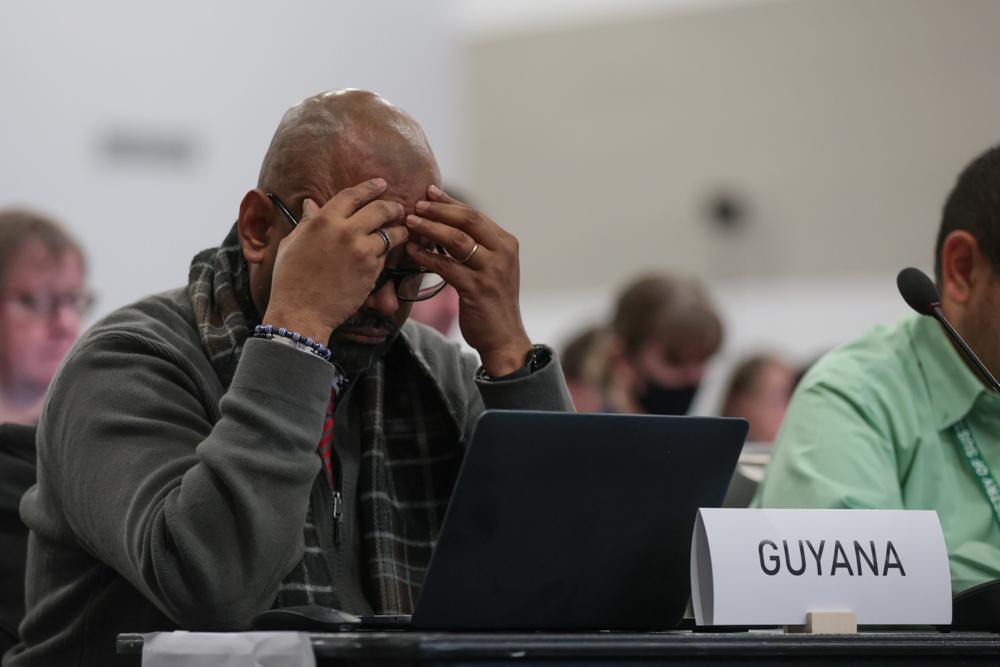
The Earth Negotiations Bulletin noted that by the final day, “heavy sighs among participants were palpable in the hallways and contact group rooms as many realized the sheer amount of work they will need to get through before the end of 2024.”
Stakeholders have varied takeaways
Kate Bailey, chief policy officer with the Association of Plastic Recyclers, was at the negotiations for part of the week. The Association of Plastic Recyclers owns Resource Recycling, Inc., publisher of Plastics Recycling Update.
Bailey told Plastics Recycling Update she feels optimistic that treaty text will come out of the process, but also that “there is significant momentum within a lot of key stakeholders to move forward on the issue regardless of some of the exact language and limitations of the treaty itself.”
“To me, the entire process still continues to symbolize this seachange moment, that we are shifting gears on how we make, use, consume and dispose of plastics,” she said.
There are also key differences between INC-2 and INC-4, Bailey noted. For example, now EPR is thrown around “like a household word,” she said, compared to a year ago when it was barely part of the vocabulary. In addition, there seemed to be a greater willingness among North American and United States stakeholders, including businesses, to work together, she said.
“At the end of the day, we’re going to walk away from a global political process and come back to the real work on the ground,” she said.
The Center for International Environmental Law again called out the number of fossil fuel and chemical industry lobbyists registered for the negotiations: 196.
CIEL released a report showing a 37% increase in industry lobbyists from the previous round of negotiations in Kenya, outnumbering the combined 180 representatives of the European Union delegations and the 73 representatives from the Pacific Small Island Developing States.
In a statement at the end of the talks, CIEL said the end result of INC-4 was to “sacrifice ambition for compromise” and that “most countries accepted a compromise that played into the hands of petrostates and industry influences.”
“When the time came to go beyond issuing empty declarations and fight for work to support the development of an effective intersessional program, we saw the same developed Member States who claim to be leading the world towards a world free from plastic pollution, abandon all pretense as soon as the biggest polluters look sideways at them,” David Azoulay, director of environmental health at CIEL, said in the statement.
Chris Jahn, council secretary of the International Council of Chemical Associations, an industry advocacy group, said on behalf of the Global Partners for Plastics Circularity that “the global plastic and chemical industries appreciate the progress governments have made.”
“Throughout this round of negotiations, our delegates have been encouraged to hear many governments affirm the need for the plastics agreement to align and not duplicate the functions of other U.N. agreements and frameworks,” Jahn said. “Our industry is fully committed to a legally binding agreement all countries can join that ends plastic pollution without eliminating the massive societal benefits plastics provide for a healthier and more sustainable world.”
Von Hernandez with the environmental group Break Free From Plastics said in a press release that “although there was progress on substantial negotiations in Ottawa, countries are walking away with a text that is not yet fit for final negotiations in Busan.”
“A small number of countries continued their obstructionist and low-ambition tactics – watering down, adding countless brackets and shamelessly twisting the language across the different provisions in an attempt to narrow the scope and lower the ambitions of the treaty,” Hernandez added.
World Plastics Council Chairman Benny Mermans said in a statement that “progress has been made during INC-4 to streamline the text and establish a much-needed process of intersessional negotiations to maintain momentum before INC-5,” but added that to finalize an agreement “much more pragmatism and compromise regarding the scope, focus and process of these negotiations is needed.”
The World Plastics Council, which represents resin producing companies, is against production caps and instead prefers more robust end-of-life management.
Policy sticking points
Each day of negotiations saw delegates engage in the two contact groups and various subcommittees, working to streamline the draft text, both technically and substantively.
The Earth Negotiations Bulletin noted in its daily report that while some felt that talks were bogging down, another delegate said that “we are finally hearing what other states really want and how to bridge those gaps, and that’s something.”
EPR and problematic and avoidable plastic products both saw a lot of discussion, and much of it centered on definitions and if the scope of requirement should be set at the international level or left to nations to decide for themselves.
Earth Negotiations Bulletin’s daily report added that “while EPR is a fundamental and ambitious strategy for addressing plastic pollution, the concept remains contentious among delegations at the INC, partly due to the interests of those plastic producers present in these negotiations.”
Financial mechanism
The financial mechanism was also a topic of much debate over the week, with delegations agreeing that there’s a need to clarify the purpose, sources and recipients of funds.
When it came to implementation and compliance, many delegates “emphasized the importance of a mechanism that is facilitative, non-adversarial and non-punitive, and respects national sovereignty, national capacities and circumstances of parties,” Earth Negotiations Bulletin noted.
In addition, there was discussion over whether the Global Environment Facility, an existing multilateral environmental fund that provides grants and blended finance options for sustainability projects, should serve as the financial mechanism or if a stand-alone mechanism should be created, modeled after the Multilateral Fund of the Montreal Protocol.
And as for who would be providing the funds, some wanted a polluter-pays principle, while other delegations wanted to delete the text altogether, as “national budgets are nationally determined and should not be subject to international scrutiny.”
“Several developing countries were adamant that donor countries should give the lion’s share of any resources required,” Earth Negotiations Bulletin reported. “It should come as no surprise that developed countries were not of the same opinion, calling instead for broad and innovative resource mobilization efforts, especially from the private sector.”
Delegates lodge complaints over meeting logistics
At points, multiple subgroups were running simultaneously, meaning that smaller delegations had to choose which working group to participate in.
While the U.S., Norway, Switzerland, the European Union, the United Kingdom, Australia, Canada, New Zealand, the Cook Islands, Japan, Chile and the Dominican Republic supported three subgroups working in parallel, to stay on track with timing goals, other countries opposed the move, including Cuba, China, Pakistan, Saudi Arabia, the Russian Federation, Kazakhstan, Nigeria, Gabon, Brazil, Kuwait, Iraq, Argentina, Guatemala, Kenya, Uganda and Senegal.
“My delegation cannot be in three different places at the same time, didn’t we agree we wouldn’t do that?” one delegate said, according to the Earth Negotiations Bulletin.
There were also concerns about some of the technical streamlining, which some said had gone too far, and some frustration that elements were missing.
“Discussions had become heated in one group late Saturday evening, with some delegations noting that their considerations did not appear in the streamlined text,” Earth Negotiations Bulletin reported.
Looking toward INC-5, delegates will engage in line-by-line textual negotiations and seek to create a final text to vote on by the end of the year.
APR’s Bailey noted that this work is “deeply connected to the conversation around climate.”
“There’s a collective fate there,” she said. “There’s just so much work that can be done” on plastic outside of the U.N. discussions.